ESP32-P4 Powers Retro Handheld After A Transplant

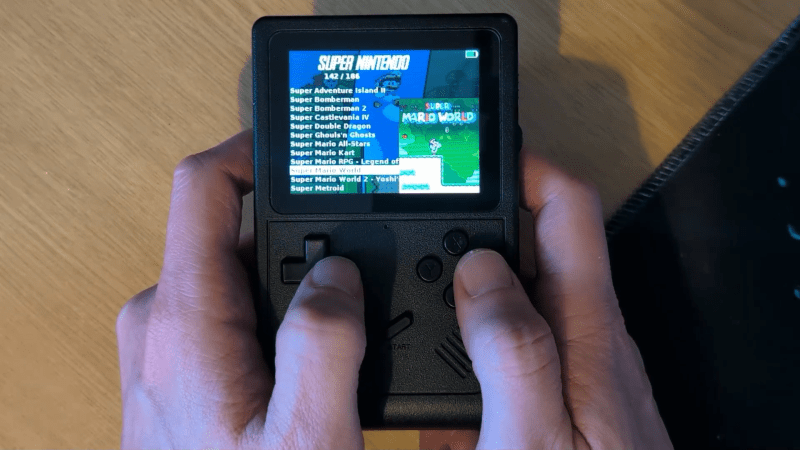
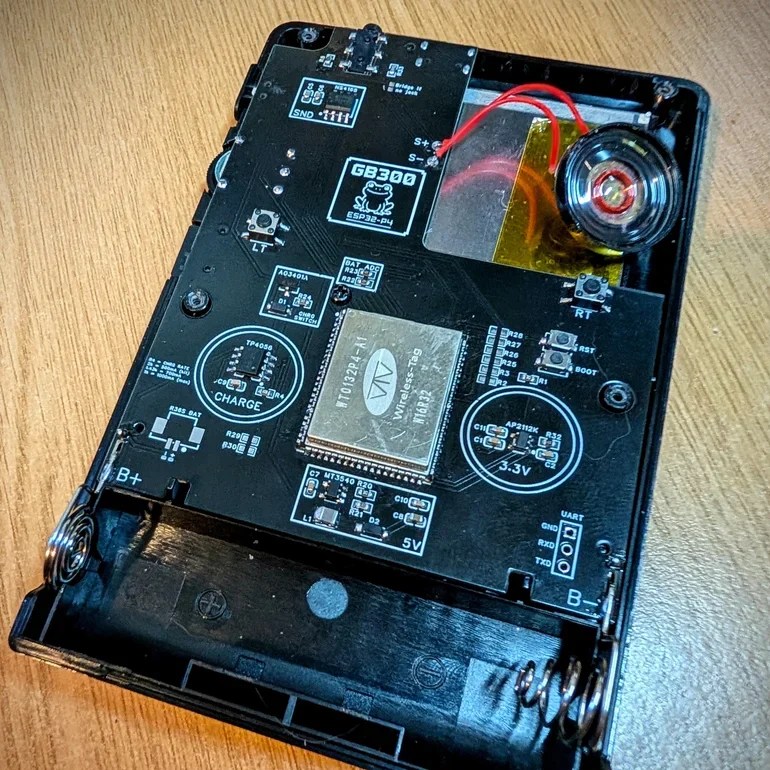
The ESP32-P4 is the new hotness on the microcontroller market. With RISC-V architecture and two cores running 400 MHz, to ears of a certain vintage it sounds more like the heart of a Unix workstation than a traditional MCU. Time’s a funny thing like that. [DynaMight] was looking for an excuse to play with this powerful new system on a chip, so put together what he calls the GB300-P4: a commercial handheld game console with an Expressif brain transplant.
Older ESP32 chips weren’t quite up to 16-bit emulation, but that hadn’t stopped people trying; the RetroGo project by [ducalex] already has an SNES and Genesis/Mega Drive emulation mode, along with all the 8-bit you could ask for. But the higher-tech consoles can run a bit slow in emulation on other ESP32 chips. [DynaMight] wanted to see if the P4 performed better, and to no ones surprise, it did.

If the build quality on this handheld looks suspiciously professional, that’s because it is: [DynaMight] started with a GB300, a commercial emulator platform. Since the ESP32-P4 is replacing a MIPS chip clocked at 914 MHz in the original — which sounds even more like the heart of a Unix workstation, come to think of it — the machine probably doesn’t have better performance than it did from factory unless its code was terribly un-optimized. In this case, performance was not the point. The point was to have a handheld running RetroGo on this specific chip, which the project has evidently accomplished with flying colours. If you’ve got a GB300 you’d rather put an “Expressif Inside” sticker on, the project is on github. Otherwise you can check out the demo video below. (DOOM starts at 1:29, because of course it runs DOOM.)

The last P4 project we featured was a Quadra emulator; we expect to see a lot of projects with this chip in the new year, and they’re not all going to be retrocomputer-related, we’re sure. If you’re cooking up something using the new ESP32, or know someone who is, you know what to do.

Continue reading “ESP32-P4 Powers Retro Handheld After A Transplant”
A UI-Focused Display Library For The ESP32

If you’re building a project on your ESP32, you might want to give it a fancy graphical interface. If so, you might find a display library from [dejwk] to be particularly useful.

Named roo_display for unclear reasons, the library is Arduino-compatible, and suits a wide range of ESP32 boards out in the wild. It’s intended for use with common SPI-attached display controllers, like the ILI9341, SSD1327, ST7789, and more. It’s performance-oriented, without skimping on feature set. It’s got all kinds of fonts in different weights and sizes, and a tool for importing more. It can do all kinds of shapes if you want to manually draw your UI elements, or you can simply have it display JPEGs, PNGs, or raw image data from PROGMEM if you so desire. If you’re hoping to create a touch interface, it can handle that too. There’s even a companion library for doing more complex work under the name roo_windows.

If you’re looking to create a simple and responsive interface, this might be the library for you. Of course, there are others out there too, like the Adafruit GFX library which we’ve featured before. You could even go full VGA if you wanted, and end up with something that looks straight out of Windows 3.1. Meanwhile, if you’re cooking up your own graphics code for the popular microcontroller platform, you should probably let us know on the tipsline!

Thanks to [Daniel] for the tip!

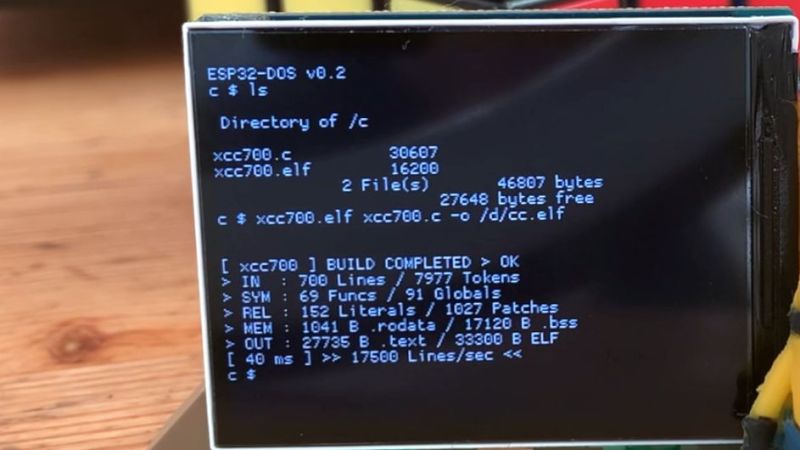
Xcc700: Self-Hosted C Compiler For The ESP32/Xtensa

With two cores at 240 MHz and about 8.5 MB of non-banked RAM if you’re using the right ESP32-S3 version, this MCU seems at least in terms of specifications to be quite the mini PC. Obviously this means that it should be capable of self-hosting its compiler, which is exactly what [Valentyn Danylchuk] did with the xcc700 C compiler project.

Targeting the Xtensa Lx7 ISA of the ESP32-S3, this is a minimal C compiler that outputs relocatable ELF binaries. These binaries can subsequently be run with for example the ESP-IDF-based elf_loader component. Obviously, this is best done on an ESP32 platform that has PSRAM, unless your binary fits within the few hundred kB that’s left after all the housekeeping and communication stacks are loaded.

The xcc700 compiler is currently very minimalistic, omitting more complex loop types as well as long and floating point types, for starters. There’s no optimization of the final code either, but considering that it’s 700 lines of code just for a PoC, there seems to be still plenty of room for improvement.

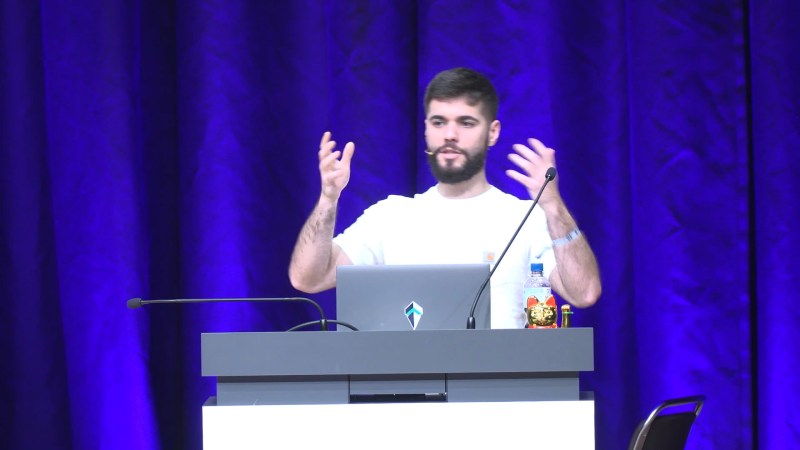
39C3: Liberating ESP32 Bluetooth

Bluetooth is everywhere, but it’s hard to inspect. Most of the magic is done inside a Bluetooth controller chip, accessed only through a controller-specific Host-Controller Interface (HCI) protocol, and almost everything your code does with Bluetooth passes through a binary library that speaks the right HCI dialect. Reverse engineering these libraries can get us a lot more control of and information about what’s going on over the radio link.

That’s [Anton]’s motivation and goal in this reversing and documentation project, which he describes for us in this great talk at this year’s Chaos Communication Congress. In the end, [Anton] gets enough transparency about the internal workings of the Bluetooth binaries to transmit and receive data. He stops short of writing his own BT stack, but suggests that it would be possible, but maybe more work than one person should undertake.

So what does this get us? Low-level control of the BT controller in a popular platform like the ESP32 that can do both classic and low-energy Bluetooth should help a lot with security research into Bluetooth in general. He figured out how to send arbitrary packets, for instance, which should allow someone to write a BT fuzzing tool. Unfortunately, there is a sequence ID that prevents his work from turning the controller into a fully promiscuous BT monitor, but still there’s a lot of new ground exposed here.

If any of this sounds interesting to you, you’ll find his write-up, register descriptions, and more in the GitHub repository. This isn’t a plug-and-play Bluetooth tool yet, but this is the kind of groundwork on a popular chip that we expect will enable future hacking, and we salute [Anton] for shining some light into one of the most ubiquitous and yet intransparent corners of everyday tech.

Be Wary Of Flash-less ESP32-C3 Super Mini Boards

Everyone loves tiny microcontroller boards, and the ESP32-C3 Super Mini boards are no exception. Unfortunately if you just casually stroll over to your nearest online purveyor of such goods to purchase a bunch of them, you’re likely to be disappointed. The reason for this is, as explained in a video by [Hacker University] that these boards are equipped with any of the variants of the ESP32-C3. The worst offender here is probably the version with the ESP32-C3 without further markings, as this one has no built-in Flash for program storage.

Beyond that basic MCU version we can see the other versions clearly listed in the Espressif ESP32-C3 datasheet. Of these, the FN4 is already listed as EOL, the FH4AZ as NRND, leaving only the FH4 and FH4X with the latter as ‘recommended’ as the newest chip revision. Here the F stands for  built-in Flash with the next character for its temperature rating, e.g. H for ‘High’. Next is the amount of Flash in MB, so always 4 MB for all but the Flash-less variant.

Identifying this information from some online listing is anything but easy unless the seller is especially forthcoming. The chip markings show this information on the third row, as can be seen in the top image, but relying solely on a listing’s photos is rather sketchy. If you do end up with a Flash-less variant, you can still wire up an external Flash chip yourself, but obviously this is probably not the intended use case.

As always, caveat emptor.

Continue reading “Be Wary Of Flash-less ESP32-C3 Super Mini Boards”

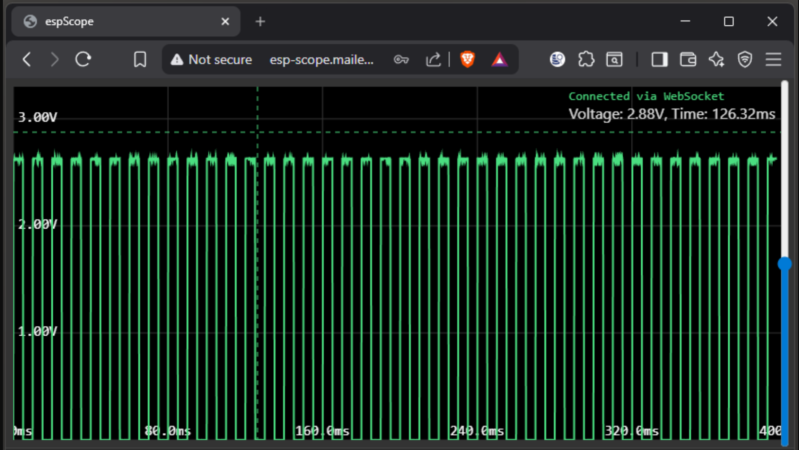
A browser window is shown, in which a web page is displaying a green trace of a square wave.

A Compact, Browser-Based ESP32 Oscilloscope

An oscilloscope is usually the most sensitive, and arguably most versatile, tool on a hacker’s workbench, often taking billions of samples per second to produce an accurate and informative representation of a signal. This vast processing power, however, often goes well beyond the needs of the signals in question, at which point it makes sense to use a less powerful and expensive device, such as [MatAtBread]’s ESP32 oscilloscope.

Continue reading “A Compact, Browser-Based ESP32 Oscilloscope”

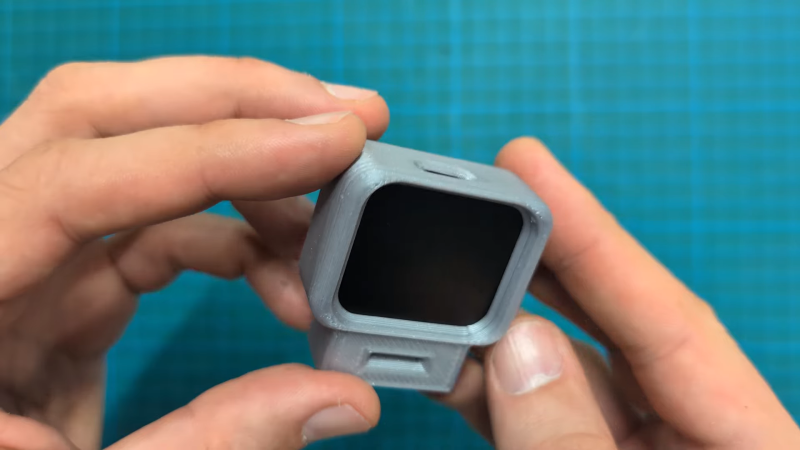
Tiny Little TV Runs On ESP32

Few of us keep big old cathode ray tubes in the house anymore, but we can still appreciate the form factor of the classic TV. Indeed, the Tinytron from [t0mg] is a neat little tchotchke in this vein — a miniature TV that you could just about fit on a keyring.

[t0mg] wanted this project to be quick and easy to put together. It starts with an ESP32-S3-LCD-1.69 from Waveshare. It’s an all-in-one dev module which combines the microcontroller with a small screen right out of the box. You just have to solder a single six pin header to hook it up with an SD card reader and battery, and you’re done with the electronics. Even the case is a cinch to build, with four 3D printed components that can be spat out of a Prusa MK4S in just half an hour. Programming it can be done via a web browser. Just about the only thing it’s missing is a speaker — this TV is video only.

To watch things on the Tinytron, you just have to prepare them properly and drop them on the SD card. [t0mg] provides a web page for transcoding the video files, although you can do it yourself locally with ffmpeg if you prefer.

If you’re looking for a silly gift for a TV-obsessed friend, you could probably whip up a Tinytron in a couple hours or less. It reminds us of another great project, the tiny Simpsons replica TV that endlessly plays the greatest cartoon on Earth.

Continue reading “Tiny Little TV Runs On ESP32”