New Tool Makes 3D Printed PCBs, Fast

Getting PCBs made is often the key step in taking a dodgy lab experiment and turning it into a functional piece of equipment. However, it can be tedious to wait for PCBs to ship, and that can really slow down the iterative development process. If you’ve got a 3D printer, though, there’s a neat way to make your own custom PCBs. Enter PCB Forge from [castpixel].
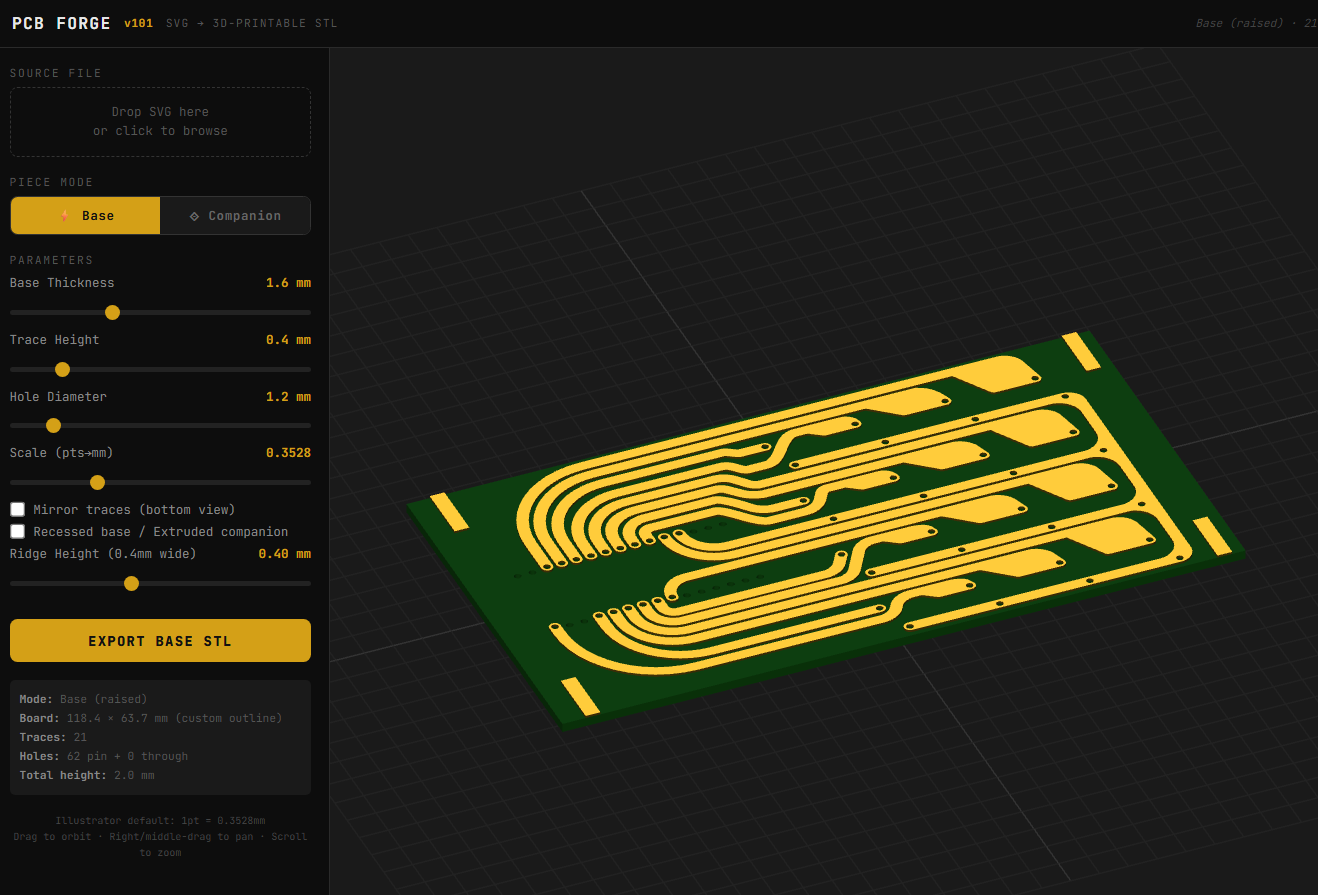
The online tool.

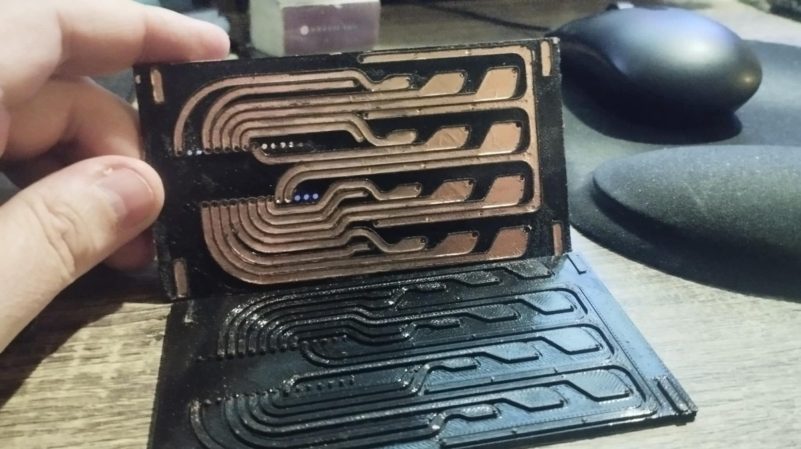
The concept involves producing a base and a companion mold on your 3D printer. You then stick copper tape all over the base part, using the type that comes with conductive adhesive. This allows the construction of a fully conductive copper surface across the whole base. The companion mold is then pressed on top, pushing copper tape into all the recessed traces on the base part. You can then remove the companion mold, quickly sand off any exposed copper, and you’re left with a base with conductive traces that are ready for you to start soldering on parts. No etching, no chemicals, no routing—just 3D printed parts and a bit of copper tape. It rarely gets easier than this.

You can design your PCB traces in any vector editor, and then export a SVG. Upload that into the tool, and it will generate the 3D printable PCB for you, automatically including the right clearances and alignment features to make it a simple press-together job to pump out a basic PCB. It bears noting that you’re probably not going to produce a four-layer FPGA board doing advanced high-speed signal processing using this technique. However, for quickly prototyping something or lacing together a few modules and other components, this could really come in handy.

The work was inspired by a recent technique demonstrated by [QZW Labs], which we featured earlier this year. If you’ve got your own hacks to speed up PCB production time, or simply work around it, we’d love to know on the tipsline! Video after the break.

Continue reading “New Tool Makes 3D Printed PCBs, Fast”

[Denny] removing a plaster bust from a microwave-softened mold

PLA Mold To Plaster Bust, No Silicone Needed

3D printing is wonderful, but sometimes you just don’t want to look at a plastic piece. Beethoven’s bust wouldn’t look quite right in front of your secret door if it was bright orange PLA, after all. [Denny] over at “Shake the Future” on YouTube is taking a break from metal casting to show off a quick-and-easy plaster casting method— but don’t worry, he still uses a microwave.

Most people, when they’re casting something non-metallic from a 3D print are going to reach for castable silicone and create a mold, first. It works for chocolate just as easily as it does plaster, and it does work well. The problem is that it’s an extra step and extra materials, and who can afford the time and money that takes these days?

[Denny]’s proposal is simple: make the mold out of PLA. He’s using a resin slicer to get the negative shape for the mold, and exporting the STL to slice in PrusaSlicer, but Blender, Meshmixer and we’re pretty sure Cura should all work as well. [Denny] takes care when arranging his print to avoid needing supports inside the mold, but that’s not strictly necessary as long as you’re willing to clean them out. After that, it’s just a matter of mixing up the plaster, pouring it into the PLA, mold, and waiting.

Waiting, but not too long. Rather than let the plaster fully set up, [Denny] only waits about an hour. The mold is still quite ‘wet’ at this point, but that’s a good thing. When [Denny] tosses it in his beloved microwave, the moisture remaining in the plaster gets everything hot, softening the PLA so it can be easily cut with scissors and peeled off.

Yeah, this technique is single-use as presented, which might be one advantage to silicone, if you need multiple copies of a cast. Reusing silicone molds is often doable with a little forethought. On the other hand, by removing the plaster half-cured, smoothing out layer lines becomes a simple matter of buffing with a wet rag, which is certainly an advantage to this technique.

Some of you may be going “well, duh,” so check out [Denny]’s cast-iron benchy if his plasterwork doesn’t impress. We’ve long been impressed with the microwave crucibles shown off on “Shake the Future”, but it’s great to have options. Maybe metal is the material, or perhaps plain plastic is perfect– but if not, perchance Plaster of Paris can play a part in your play.

Continue reading “PLA Mold To Plaster Bust, No Silicone Needed”

PC Watercooling Uses Everything But CNC Machining

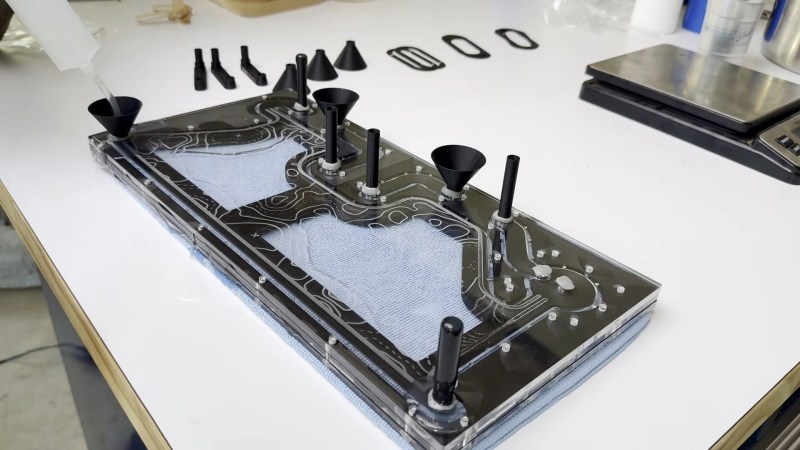
Names and labels are difficult. Take this “3D Printed” water-cooling loop by [Visual Thinker] on YouTube. It undeniably uses 3D printing — but it also uses silicone casting and laser-cut acrylic, too. All of these are essential parts, yet only 3D printing gets top billing in his thumbnail. At least the version we saw, anyway; the A/B testing game YouTubers play means that may change.

Perhaps that’s simply due to the contrast with [Visual Thinker]’s last build, where the “distro plate” that acts to plumb most of the coolant was made of layers of CNC-routed acrylic, held water-tight with O-rings. Not wanting to wait for his next build to be fabricated, and not wanting to take up CNC machining himself, [Visual Thinker] fell back on tools many of us have and know: the 3D printer and laser cutter.

In this project, the end plates of the cooling loop are still clear acrylic, but he’s using a laser cutter to shape them. That means he cannot route out gaps for o-rings like in the last project, so that part gets 3D printed. Sort of. Not trusting the seal a 3D printed gasket would be able to give him, [Visual Thinker] opts to use his 3D printer to create a mold to cast a seal in silicone. Or perhaps “injection-mold” would be a better word than cast; he’s using a large syringe to force the degassed silicone into the mold. The end part is three pieces: a 3D printed spacer holding two acrylic plates, with the cast-silicone gasket keeping the whole thing water-tight to at least 50 psi, 10x the operating pressure of his PC.

After that success, he tries replacing the printed spacer with acrylic for a more transparent look. In that version only temporary shims that are used to form the mold are 3D printed at all, and the rest is acrylic. Even if you’re not building a water-cooled art PC, it’s still a great technique to keep in your back pocket for fluid channeling.

In some ways, this technique is the exact opposite of the copper-pipe steampunk builds we’ve featured previously. Those were all about pretty plumbing, while with a distro plate you hardly need pipes at all. Like any water-cooled project, it’ll need a radiator, which could be a hack in and of itself.

Continue reading “PC Watercooling Uses Everything But CNC Machining”

Casting Concrete With A 3D-Printed Mould

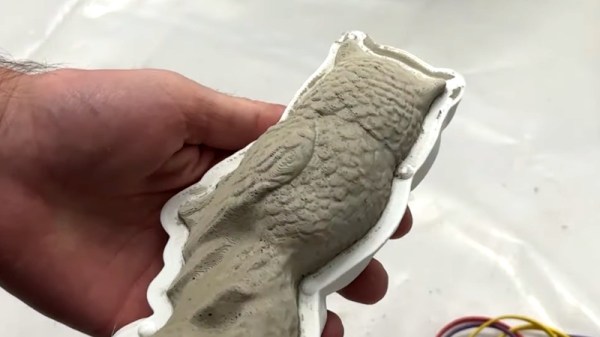
We’re accustomed to covering the use of 3D printing in casting, usually as a lost-PLA former in metal casting. That’s not the only use of the technique though, and perhaps one of the simplest is to use a 3D-printed mould for casting concrete. It’s what [ArtByAdrock] is doing in their latest video, casting an ornamental owl model.

The first part of the video below the break deals with the CAD steps necessary to produce the mould, and depending on your CAD proficiency may not be the most interesting part. The process creates a mould with two halves, a pouring hole, and registration points. Then a 3D printer produces it using flexible TPU. The pour is then simplicity itself, using a casting cement mix at a consistency similar to pancake batter. The video shows how a release spray provides easy separation, and the result is a fresh concrete owl and a mould ready for the next pour.

We can see that maybe readers have only so much space in their lives for concrete owls, but this process could be a valuable part of the armoury when it comes to making some less decorative items. It’s not the first time we’ve looked at this type of work.

Continue reading “Casting Concrete With A 3D-Printed Mould”

How To Cast Silicone Bike Bits

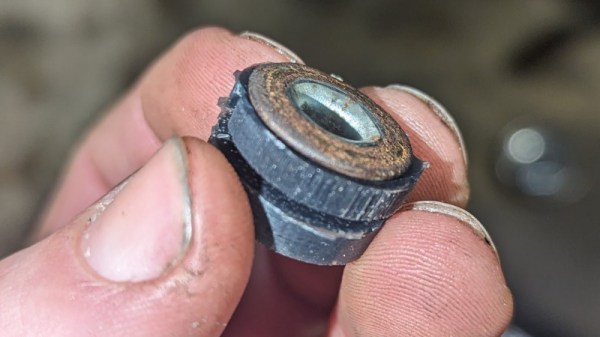
It’s a sad fact of owning older machinery, that no matter how much care is lavished upon your pride and joy, the inexorable march of time takes its toll upon some of the parts. [Jason Scatena] knows this only too well, he’s got a 1976 Honda CJ360 twin, and the rubber bushes that secure its side panels are perished. New ones are hard to come by at a sensible price, so he set about casting his own in silicone.

Naturally this story is of particular interest to owners of old motorcycles, but the techniques should be worth a read to anyone, as we see how he refined his 3D printed mold design and then how he used mica powder to give the clear silicone its black colour. The final buses certainly look the part especially when fitted to the bike frame, and we hope they’ll keep those Honda side panels in place for decades to come. Where this is being written there’s a CB400F in storage, for which we’ll have to remember this project when it’s time to reactivate it.

If fettling old bikes is your thing then we hope you’re in good company here, however we’re unsure that many of you will have restored the parts bin for an entire marque.

3D Printed Cookies, Sort Of

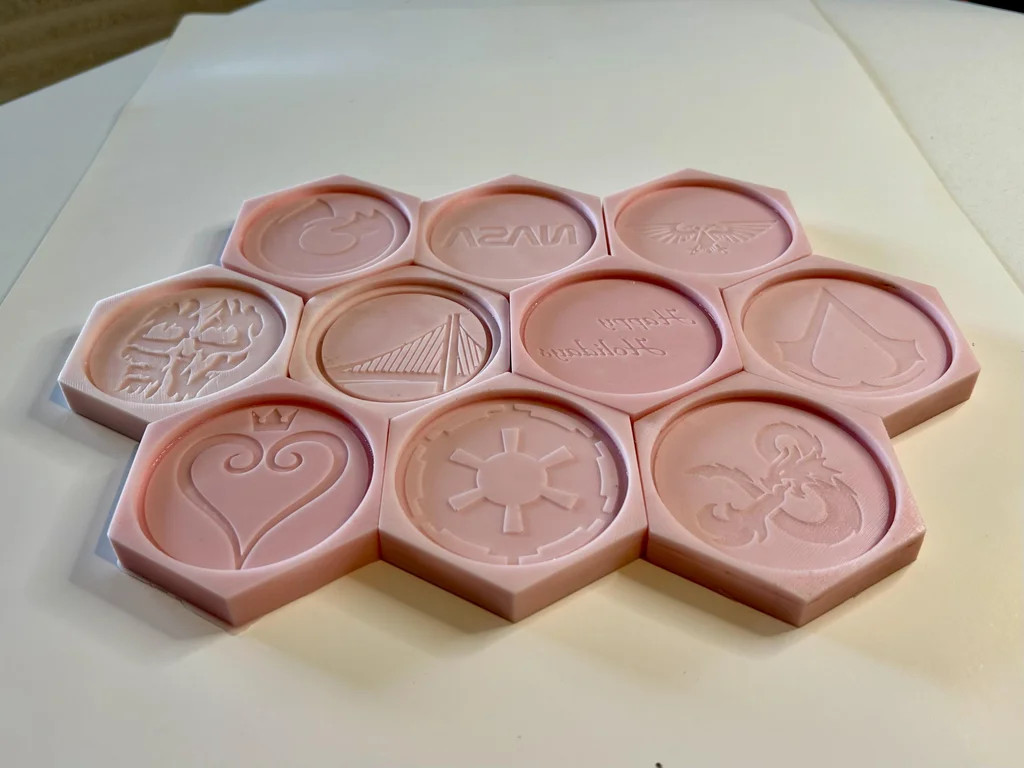
Are there any cookies that taste better than the ones you make yourself? Well, maybe, but there’s a certain exquisite flavoring to effort. Just ask [jformulate], who created these custom chocolate-topped butter cookies using a mixture of 3D printing, silicone, and of course, baking and tempering.

[jformulate] did this project along with a makerspace group, and the first thing they did was decide on some images for the cookies. Once a hexagon-shaped mold was created in Fusion360, the images were added in. Some had to be height-adjusted in order for the detail to come out.

Once these positives were printed, it was time to make the food-safe silicone molds that would form the custom chocolate toppers. If you don’t have a vacuum de-gasser, [jformulate] recommends pouring a thin stream from a high place to avoid air bubbles. You can always tap the mold several times on a flat surface as well to bring trapped air to the top.

Finally, it’s time to make cookies. [jformulate] has good instructions for tempering chocolate, as well as a recipe for the butter cookies that support the designs. As a bonus, [jformulate] shows how to make a fish-shaped hot chocolate bomb, and made Jolly Rancher (sadly not Wrencher) medallions using the silicone molds and a microwave.

For the semi-disappointed, directly 3D printing cookies is definitely a thing.

Ultra-Thin Rubber Parts Made With A 3D Printed Plug

We generally think of 3D printed components as being hard bits of plastic, because for the most part, that’s what we’ve got loaded up in our desktop machines. But outside of the normal PLA, PETG, and ABS, you can also print with various flexible filaments such as TPU. This can be handy for producing custom seals, or rugged enclosures.

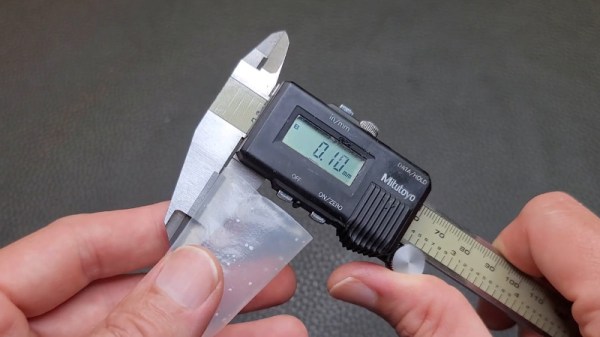
But what if you want to make very thin rubberized parts? In that case, the 0.4 mm nozzle on most desktop machines will be your limiting factor. But not so with the method [Daniel Bauen] demonstrates in his latest Engineerable video. The trick here is that the printer isn’t producing the final product — it’s making a water-soluble plug that has been slightly undersized for the application at hand.

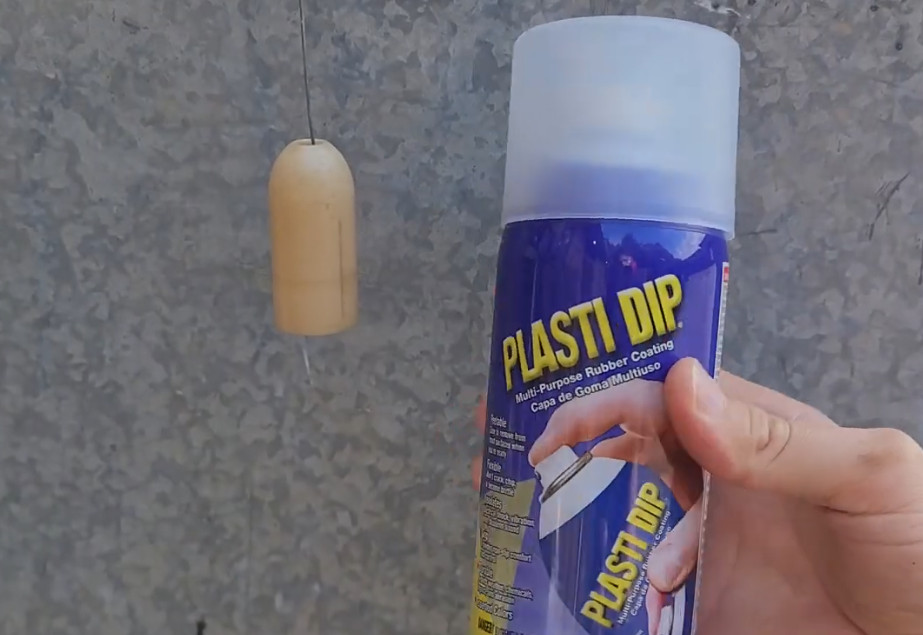
Once the plug has been printed, [Daniel] sprays it with several coats of Plasti Dip. This builds up a rubberized coating on the printed part, and once it’s reached the desired thickness, the whole thing gets tossed into an ultrasonic cleaner to break up the filament. What you’re left with is a silicone-like part that has the same shape as your original print, but is far thinner than anything you could have extruded normally.

So what is [Daniel] looking to accomplish with this technique? We’ll admit the shape of the object is rather suggestive, but in that case, the dimensions just leave us with more questions than answers. Perhaps we’ll learn more in the next video, which we’re told will see the plugs get dipped into latex.

If subtractive manufacturing is more your speed, you can always freeze a sheet of rubber and use a CNC to cut custom parts out of it.

Continue reading “Ultra-Thin Rubber Parts Made With A 3D Printed Plug”