Bluetooth For Android Open Accessories

[Ytai], the lead developer for the IOIO breakout board for the Android Open Accessory kit, figured out how to control just about anything from an Android phone wirelessly over Bluetooth.

When [Ytai] first announced the IOIO breakout board for Android devices, one of the commentors on his post said a standard Bluetooth dongle could stand in for the USB cable between the phone and the IOIO. Wireless control of home automation project and robots was just too good of an idea to let go, so [Ytai] dove into this new Bluetooth project.

After getting a cheap Bluetooth dongle from DealExtreme, [Ytai] found btstack, a lightweight Bluetooth stack that was perfect for an embedded environment. Dealing with the USB driver for a no-name Bluetooth adapter didn’t come as easily, but after a few long nights, [Ytai] emerged victorious.

He still has a few more problems to overcome. Namely, supporting environments where more than IOIO board is available. [Ytai] is thinking about adding support for WiFi dongles, something we’d love to see. Check out [Ytai]’s demo of wireless control of a servo after the break.

Continue reading “Bluetooth For Android Open Accessories”

Custom Flat Cables To Suit Your Needs

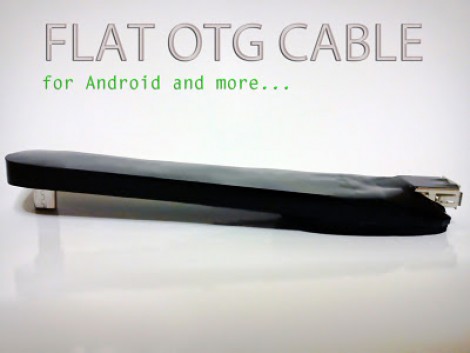
[Cosimo Orlando] has a Motorola Xoom tablet. It’s an Android device that works great as a tablet, but can double as a Laptop when you need it to by adding a keyboard. The problem he was having is that the USB On-The-Go cables that he tried were never the right size or orientation. So he scavenged them for parts and built his own flat cable for a custom fit.

The final product pictured here actually uses protoboard to give the body some strength. [Cosimo] first laid out the dimensions on the substrate using a felt-tipped pen. He then took connectors from his mis-sized commercial cables and affixed them to the board with a combination of hot glue and solder. From there, just connect the five data lines and ground with some jumper wire and test for continuity. He finished this off with what he calls ‘adhesive plastic glossy black’ shaped to make a decent looking case. If you have any idea what product was used here, let us know by leaving a comment.

Remote Controlled Glass Block LED Matrix

hive13_remote_controlled_led_matrix

At Hive13, a Cincinnati-based hackerspace, they like to hack everything – even their bathroom. One of the bathroom’s walls faces the street, and is made up of thick glass privacy blocks. A few years ago, they thought it would be a cool idea to install an LED matrix to the back side of the glass wall to spruce things up a bit. After a couple of iterations, they finally had something they were happy to show off, but they wanted to make it even cooler.

While the the Arduino and ShiftBrite shield running the matrix could be controlled over a serial connection, they wanted to use the ProjectBlinkenlights tools to control things over the network. While that didn’t quite work out as planned, it wasn’t necessarily an exercise in futility. While Blinkenlights controls were out of the question, they were inspired to add OSC compatibility to the Processing sketch, which allows them to work the display with an app available for both Android and iOS devices.

The result is pretty slick, as you can see in the video below. Now all they need to do is get Tetris up and running!

Continue reading “Remote Controlled Glass Block LED Matrix”

Over-the-air FM Radio Gains Internet Control

[Old bit collector] is giving up control of his radio dial to the Internet. He combined a couple of Parallax products which now allow him to tune, adjust volume, and toggle the power for an FM radio receiver.

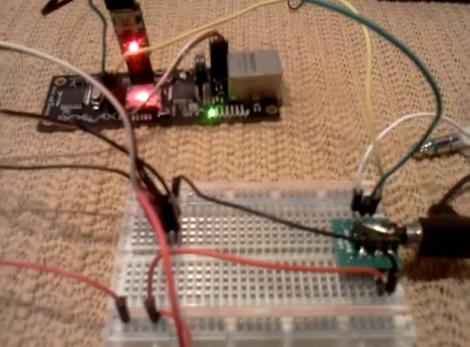
The setup is pretty simple. An FM receiver module is mounted in the breadboard seen above which helps to break out its control pins. Those are connected to a Parallax Spinnarette web server board. It’s auxiliary I/O pins are controlled via a web interface that he set up and plans to operate with the browser on his Android phone. But as you can see after the break, any web browser works as long as you know the correct address.

This is pretty good if you’re on a quest to make everything controllable from your smart phone. But we would love to use the concept to make our own streaming radio. You’d be able to tune in to all of your local stations from anywhere in the world.

Continue reading “Over-the-air FM Radio Gains Internet Control”

Robust Wireless DSLR Control Over Bluetooth

yanis_android_bluetooth_camera_controller

[Manishi] wrote in to share his latest project, a Bluetooth DSLR controller that works with Android. More than a mere Bluetooth shutter trigger, his device lets you control a wide array of other settings such as aperture, shutter speed, ISO, white balance, focus position and live view.

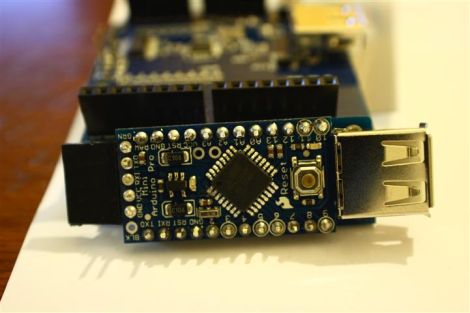
His “YaNis” control system was built using an Arduino Pro Mini, along with a USB host shield and a Bluetooth module he picked up from SparkFun. Obviously any other Arduino and SPP compatible Bluetooth board can be used, though component size is definitely a consideration for this project, and his selections are pretty well-suited to the job. The Arduino half of the software relies heavily on [Oleg Maruzov’s] PTP/USB libraries to get things done, but the free Android control app is all [Manishi’s] creation.

The Bluetooth dongle connects to the camera via USB, and once it’s paired with his Android phone, [Manishi] has total control at his fingertips. He has plenty of improvements planned for the near future including additional camera support, so we expect that we’ll see an even more robust control application before too long.

Continue reading to see a quick video demo of YaNis in action.

Continue reading “Robust Wireless DSLR Control Over Bluetooth”

Google ADK On An EvalBot

evalbot_google_adk

After learning that Google’s ADK relied on using an Arduino-compatible board, [Benjamin] was disappointed that other microcontroller platforms weren’t invited to the party. Rather than switch camps, he took it upon himself to get the ADK working with his EvalBot. In fact, his modifications should allow the ADK to work with nearly any Stellaris ARM kit.

The hack is composed of two parts. The first, and most important bit is the USB host driver he developed to work with the ADK. The code borrows some bits from Texas Instruments, and will be published on GitHub once he gets a chance to clean up the source a bit. To get his phone working with the EvalBot, he also had tweak the external USB power supply in order to provide the current required to operate properly with other USB-connected hardware.

It’s always nice to have more options when working with Google’s ADK, and [Benjamin’s] work is likely a welcome addition to any Stellaris developers toolkit.

Continue reading to see a quick video of his EvalBot ADK demo.

Continue reading “Google ADK On An EvalBot”

Chumby Controlled Mechanum Wheel Robot

[Madox] gutted an Insignia Infocast to use with this robot. Insignia is Best Buy’s house brand and they partnered with Chumby to make their Infocast line. If you can find a used or clearance model it’s a great way to get yourself and embedded Linux board for a project like this one.

The body and wheels are 3D printed, with design files available at [Madox’s] Thingiverse page. The mechanum wheels work amazingly well, using seven bearings each for smooth operation. The body itself includes a holder for two groups of batteries. One of those battery packs powers the Chumby board while the other is used to power the four servo motors responsible for locomotion. To simplify the electronics [Madox] chose to use a USB servo drive which only set him back about $20.

We’re not sure what the USB dongle on top of the robot is used for. We’d guess it’s a WiFi adapter, since the machine sets up its own access point to act as a controller. But we thought Chumby boards had WiFi built-in. At any rate, check out the video after the break where you can see an Android phone driving the little bugger. There’s a flaw in the code that prevents side-to-side movement, it gets fixed after a video break at about 2:15 and everything is peachy after that.

Continue reading “Chumby Controlled Mechanum Wheel Robot”