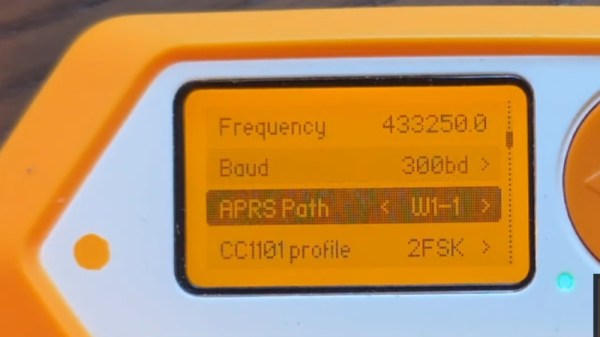
APRs is an amateur radio protocol allowing the exchange of short packets of data. It’s commonly used to transmit a GPS position, though it can find other applications. The Flipper Zero RF hacker’s multi tool normally needs to be hooked up to an external transmitter to do APRS, but [Richard YO3GND] has made his Flipper do the job without any external parts at all.
One of the the Flipper’s radios sits in the 435 MHz ISM band, meaning that the rest of the 70 cm amateur band is well within its reach. There only remains the subject of modulation, in which the Flipper’s FSK and APRS’s FM are similar on paper if not on a waterfall display. Some software hackery ensues, and the Flipper is an APRS station. Because of the FSK-as-FM modulation it won’t be decoded by everything, but you can’t argue with the bill of materials if you happen to own a Flipper. Check out the demo video below.
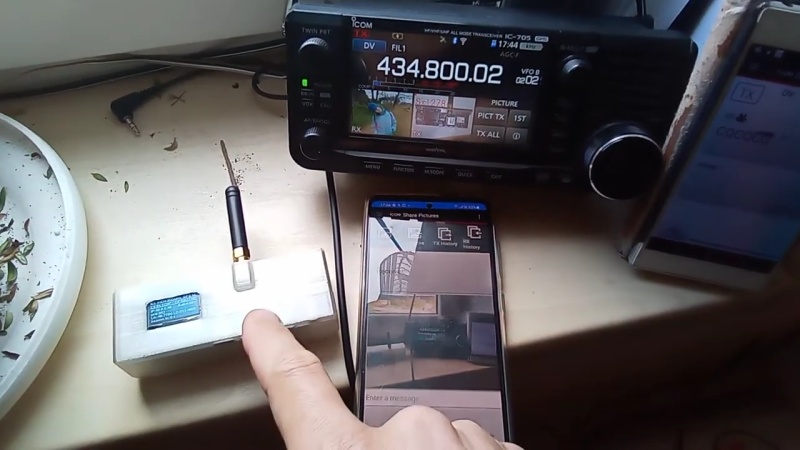
[Yeckel] recently put the finishing touches on an ambitious implementation of a simple D-STAR (Digital Smart Technologies for Amateur Radio) transceiver using some very accessible and affordable hardware. The project is D-StarBeacon, and [Yeckel] shows it working on a LilyGO TTGO T-Beam, an ESP32-based development board that includes a SX1278 radio module and GPS receiver. It even serves a web interface for easy configuration.
What is D-STAR? It’s a protocol used by radio operators for voice that also allows transmitting low-speed data, such as short text messages or GPS coordinates. While voice is out of scope for [Yeckel]’s project (more on that in a moment) it can do all the rest, including send images. That makes beacon-type functions possible on inexpensive hardware, instead of requiring a full-blown radio.
As mentioned, voice is a big part of D-STAR. While [Yeckel] was able to access the voice data, attempts to decode it were unsuccessful. A valiant effort, but we suppose voice decoding isn’t terribly relevant to beacon-type operations like transmitting APRS (Automatic Packet Reporting System).
So far as [Yeckel] is aware, D-StarBeacon is currently the only open-source implementation of a D-STAR radio available on the internet, which is pretty interesting. We’ve seen projects that touch indirectly on D-STAR, but nothing like this.
Watch it go through its paces in the video embedded below. Since the T-Beam is just a microcontroller development board, the user interface comes from an Android app on a mobile phone, which is why you see a phone in the video.
Stay in the amateur radio hobby long enough and you might end up with quite a collection of antennas. With privileges that almost extend from DC to daylight, one antenna will rarely do everything, and pretty soon your roof starts to get hard to see through the forest of antennas. It may be hell on curb appeal, but what’s a ham to do?
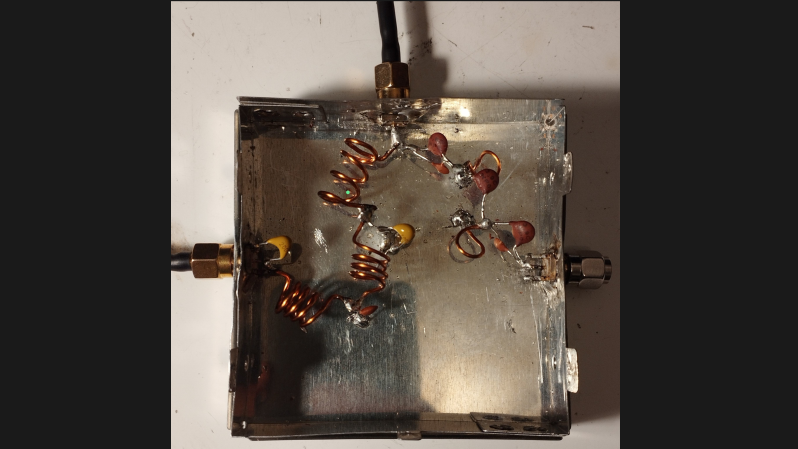
One answer could be making one antenna do the work of two, as [Guido] did with this diplexer for dual APRS setups. Automatic Packet Reporting System is a packet radio system used by hams to transmit telemetry and other low-bandwidth digital data. It’s most closely associated with the 2-meter ham band, but [Guido] has both 2-meter (144.8-MHz) and 70-cm LoRa (433.775-MHz) APRS IGates, or Internet gateway receivers. His goal was to use a single broadband discone antenna for both APRS receivers, and this would require sorting the proper signals from the antenna to the proper receiver with a diplexer.
Note that [Guido] refers to his design as a “duplexer,” which is a device to isolate and protect a receiver from a transmitter when they share the same antenna — very similar to a diplexer but different. His diplexer is basically a pair of filters in parallel — a high-pass filter tuned to just below the 70-cm band, and a low-pass filter tuned just above the top of the 2-m band. The filters were designed using a handy online tool and simulated in LTSpice, and then constructed in classic “ugly” style. The diplexer is all-passive and uses air-core inductors, all hand-wound and tweaked by adjusting the spacing of the turns.
[Guido]’s diplexer performs quite well — only a fraction of a dB of insertion loss, but 45 to 50 dB attenuation of unwanted frequencies — pretty impressive for a box full of caps and coils. We love these quick and dirty tactical builds, and it’s always a treat to see RF wizardry in action.
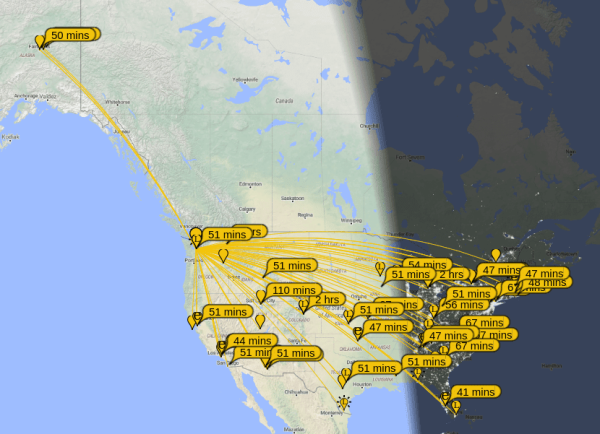
While most of us carry cell phones that have GPS and other location services, they require a significant amount of infrastructure to be useful. Drive from Washington to Alaska like [Lonney] did a while back, where that infrastructure is essentially nonexistent, and you’ll need to come up with some other solutions to let friends and family know where you are.
A tool called the Automatic Packet Reporting System (APRS) is fairly robust in the very high frequency (VHF) part of the amateur radio spectrum, but this solution still relies on a not-insignificant amount of infrastructure for the limited distances involved with VHF. [Lonney] adapted a few other tools to get APRS up and running in the HF range, letting his friends keep tabs on him even from the most remote locations.
RNode is an open source, unrestricted digital radio transceiver based on — but not limited to — the Reticulum cryptographic networking stack. It is another interesting project in what we might call the “Federated application” space in that it is intended to be used with no central controlling body. It can be used in a LAN or WAN context with the Reticulum network when operating in network adaptor mode, but it also has other use cases.
Essentially, RNode is a software project running on a LilyGO LoRa32 board wrapped up in a snazzy-looking 3D-printed case. Just make sure to grab a version of the board with an u.FL connector in place or somewhere to solder one. If it comes with an SMA connector, you will want to remove that. The device can be standalone, perhaps attached to a mobile device via Wi-Fi, but it needs to be hooked up to a laptop for the really interesting applications. When set to TNC mode, it can act as an APRS gateway, which allows you to access packet radio BBSs and all that fun stuff.
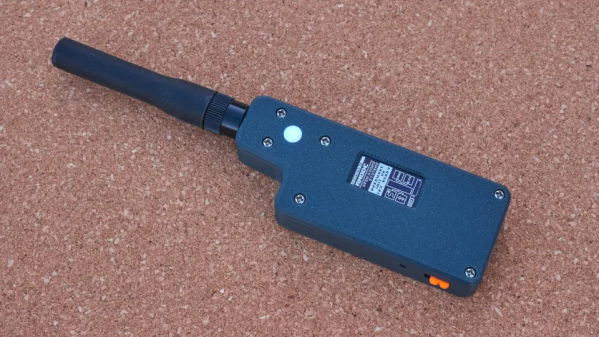
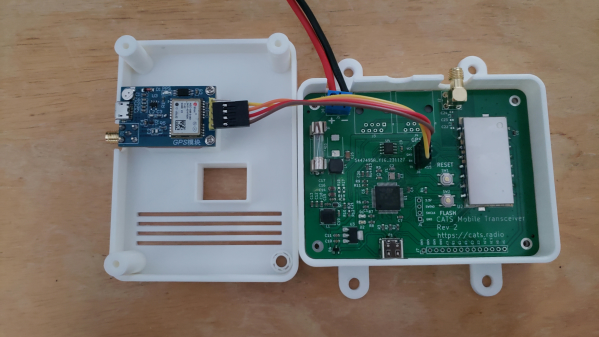
CATS is a new communication and telemetry standard intended to surpass the current Automatic Packet Reporting System (APRS) standard by leveraging modern, super-cheap Frequency Shift Keying (FSK) transceivers rather than standard FM units. The project is in the early stages, but as of this writing, there is a full open source software stack and reference hardware for both Raspberry Pi-based gateway devices and an STM32-based mobile device.
CATS packets are called ‘whiskers!’
From a radio perspective, CATS uses raw FSK rather than the inefficient AFSK used by APRS. A real killer for channel utilization is the PTT time; this is the dead time around a packet APRS requires for ‘keying up’ and ‘keying down.’ The CATS standard is aggressive with PTT timing, enabling the channel to get going on sending the data sooner.
Additionally, compared to APRS, the packet baud rate increases from 1200 baud to 9600 baud. Other key points are using LDPC encoding for forward error correction and data whitening (a useful PDF guide from Ti) to smooth over any burst errors.
One of the neat concepts of APRS is the APRS-IS (APRS Internet service). This enables amateur radio services to be connected over the Internet, vastly improving range. The CATS equivalent is called FELINET (if you’re not spotting all the ‘cat’ references by now, go and get another coffee). Together with the I-gate hardware, FELINET bridges the CATS radio side with the current APRS network. As FELINET expands to more than the current few dozen nodes, APRS services will no longer be required, and FELINET may well replace it. Interestingly, all software for FELINET, the APRS relay, and the I-Gate firmware are written in Rust. We told you learning Rust was going to be worth the effort!
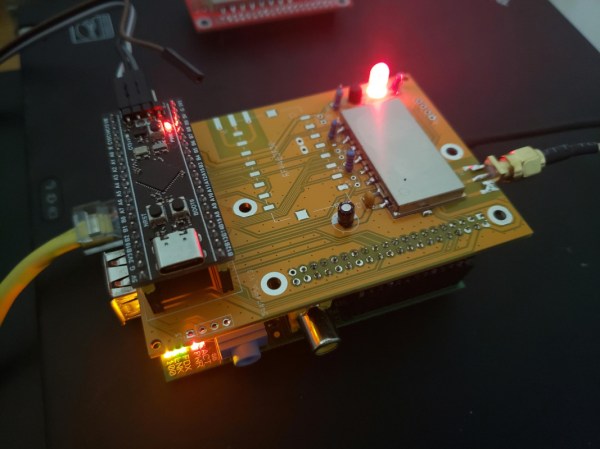
On the reference hardware side of things, the CATS project has delivered a Raspberry Pi hat, which uses a 1 watt RF4463 transceiver and supporting passives. The design is about as simple as it can be. A mobile transceiver version uses an STM32 micro to drive the same RF4463 but with supporting power supplies intended to run from a typical automotive outlet. Both designs are complete KiCAD projects. Finally, once you’ve got some hardware in place and the software installed, you will want to be able to debug it. CATS has you covered with an RTL-SDR I-Gate module, giving you an independent packet log.
Starlink has been making tremendous progress towards providing world-wide access to broadband Internet access, but there are a number of downsides to satellite-based internet such as the cluttering of low-Earth orbit, high expense, and moodiness of CEO. There are some alternatives if standard Internet access isn’t available, and one of the more ambitious is providing Internet access by balloon. Project Loon is perhaps the most famous of these (although now defunct), but it’s also possible to skip the middleman and build your own high-altitude balloon capable of connection speeds of 500 Kbps.
[Stephen] has been working on this project for a few months and while it doesn’t support a full Internet connection, the downlink on the high altitude balloon is fast enough to send high-resolution images in near-real-time. This is thanks to a Raspberry Pi Zero on board the balloon that is paired with an STM32 board which handles the radio communication on a RF4463 transceiver module. The STM32 acts as an intermediary or buffer to ensure reliable information is sent out on the radio, rather than using the Pi directly. [Stephen] also wrote a large chunk of the software responsible for handling all of these interactions, optimized for balloon flight specifically.
The blog post for this project was written a few weeks ago with a reported first launch date for the system already passed, so we will eagerly anticipate the results and the images he was able to gather using this system. Eventually [Stephen] hopes the downlink will be fast enough for video as well.Balloons are an underappreciated tool as well, and this isn’t the only way that they can be used to help send radio signals from place to place.