For The Trade Show Booth That Has Everything, A Blimp!

Trade shows are all about attracting attention and getting people to learn about your product, so what could be better than a custom-built RC blimp? Sure, you could just buy one, but what’s the fun in that? After several design iterations, [Tretton37] came up with a blimp known as the [LeetZeppelin] controlled by an Arduino, an XBee module, as well as a Wiimote controller connected to a computer.

The hack itself is a great example of repurposing off-the-shelf materials into something more interesting and unique. In addition to the components listed above, hobby servos were modded to allow for thrust motor control in conjunction with Legos for the gearing and “pillow-block bearings.” A list of the “important” parts used in this hack is furnished on their site as well as a video of it in action, which is also after the break.

As for the results of this hack as a trade-show attention grabber, Fredrik Leijon had this to say: “We think that all the gazing at the sky and half opened mouths proves that it was a huge success!”

[youtube http://www.youtube.com/watch?v=geMrAmBJsls&w=470&h=315%5D

UberFridge Helps Keep Beer Production Going Through The Dog Days Of Summer

uberfridge

[Elco Jacobs] used to let his beer ferment in the kitchen, but when things got too hot over the summer, he had to suspend his ale making for a few months. Not wanting to have to put production on hiatus again, he modified an old refrigerator into an awesome fermentation unit he calls the UberFridge.

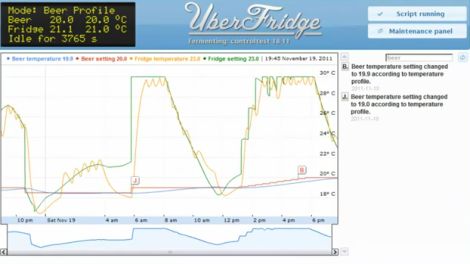
The refrigerator features two temperature sensors, one that sits in the fermenting beer, and one that measures the temperature of the fridge. This dual probe setup offers him the ability to closely monitor the fermentation process, which he does via a sharp-looking web interface.

An Arduino serves as the PID controller, talking to a wireless router via a serial connection. The Arduino logs and relays data to the router where it can be viewed via a web browser. Not only can he keep tabs on what’s going on inside the fridge, he can reprogram the Arduino via the web interface as well.

Keep reading to see [Elco] explain the ins and outs of his UberFridge – we’re pretty sure you’ll want to build your own after you do.

[via BuildLounge]

Continue reading “UberFridge Helps Keep Beer Production Going Through The Dog Days Of Summer”

Hackaday Links: November 24, 2011

Finally an Arduino shield that does nothing

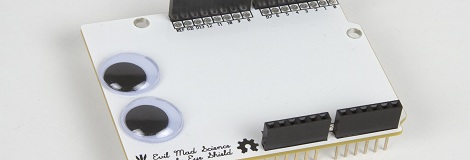
The folks at Evil Mad Scientist labs have finally created the Googly Eye Shield for Arduinos. With it’s pass-through .100 headers, it adds googly eyes to your Arduino projects. Of course, instead of in addition to the googly eyes you could add a breadboard, making it somewhat useful. A million fake internet points goes to the first person to implement Xeyes on this thing.

Phat beats from kids toys

[Ville] couldn’t afford an Akai MPC for laying down some beats. Wanting a real tactile interface, he hacked this kid’s toy. It’s just an RCA cable attached to the tiny chip inside the toy. The new line out goes to his mixers where he does some pretty impressive stuff.

Mona Lisa is Vigo the Carpathian

What did we just say about real-life Xeyes? [Geert] just made a print of the Mona Lisa follow you around the room with her eyes (Dutch, translation). The build is a pair of servos and a DIY motion capture app running on a laptop. Now we need to find a print of Vigo…

Quantifying heat sink efficiencies

[Mike] is an experimenter at heart. He was wondering about the efficiency of small, clip-on heat sinks versus the ones we use to defrost frozen food. The results are exactly as you would expect, but he did find something interesting – his experimental technique didn’t find much of a difference between thermal paste/grease/pads and no thermally conductive material.

Mini-fig sized R/C LEGO car

The guys at Brickmodder.net took a car from a LEGO set and made it remote control. The drive train and steering both use servos controlled by the smallest 3-channel receiver they could find.

Tracking Satellites With An Arduino

The guys over at brainwagon just finished up ANGST, the Arduino n’ Gameduinio Satellite Tracker, a build that displays 160 different satellites in Earth orbit on any SVGA monitor.

The build is of course based off an Arduino and Gameduino shield. A real-time clock is always needed for a satellite tracker, so a DS1307 RTC is thrown into the mix. The satellite data is stored on a 128KB EEPROM that is big enough to hold 750 different satellites and orbits.

The software side of things is a bit trickier. The guys at brainwagon used [James Miller]’s very popular and very old-school PLAN-13 sat tracking software. This orbit calculation program was published in 1983 and has since been ported from BBC Basic to just about every system imaginable.

Once the ANGST is hooked up and powered on, it reads the real-time clock and calculates the position of a satellite. This is done in real-time and updated every three minutes. On the screen, the last orbit (and a little more) is displayed along with the sun and the location of the ANGST. You might not find something like ANGST at the Space Command at NORAD, but we can’t think of a better way to keep track of the cubesats and spy sats above our heads.

Continue reading “Tracking Satellites With An Arduino”

Stroboscope Project Uses Optical Drive Motor And Arduino

In the quest for a diy laser cutter made from DVD burner parts (that hack’s still in the works) this guy ended up with a junk box full of optical-drive leftovers. He put some of that surplus to good use by building this stroboscope. As the media spins, the white LED just out of focus in the foreground strobes to freeze the little black figure in the same place. The effect, as seen in the video after the break, is a dancing figure created by the optical illusion.

This is the same concept as that amazing 3D rowing skeleton build, but scaled down greatly. Each of the silhouettes seen above are slightly different, showing one pose that makes up a frame of the overall animation. They’re laser cut, but some careful paper-craft could probably accomplish the same thing. Assuming you could keep them from warping when spinning at high speeds.

Continue reading “Stroboscope Project Uses Optical Drive Motor And Arduino”

An Exercise In Servo Voice Control With Android

voice-controlled-android-lock

[Shazin] had some free time on his hands, so he settled in to do something he had been meaning to for a while – learn Android programming. He went an indirect route, and ended up using the Scripting Layer for Android (SL4A), which gave him a head start on the process. Sitting in between the Android API and scripting languages such as Python, SL4A allowed him the ability to apply something he was already familiar with to the Android environment.

He thought it would be cool to try building a door entry system which relied on voice commands to lock and unlock. Using the Google Voice API for Android and an Arduino, he built a small Python application that allows him to toggle a servo simply by talking into his phone.

The application on his phone communicates with an Arduino over WiFi, once Google Voice has decoded the command [Shazin] is giving. The Arduino controls a servo, which in theory could control the locking mechanism on a door.

After a bit of tweaking and some added security, his proof of concept could definitely come in handy.

Check out the short video below to see [Shazin’s] voice-controlled servo in action.

Continue reading “An Exercise In Servo Voice Control With Android”

Syneseizure Makes Objects Feel Loud

Synesthesia is a mix-up in the wiring of the brain where sensory inputs are perceived differently than what ‘normal people’ usually experience. People with synesthesia can have visual input mapped to aural perception in the mind, or driving along a highway where there’s a recent skunk roadkill can smell ‘loud.’ It’s an interesting way of perceiving the world that’s usually inaccessible to most of the population, but the Syneseizure tries to replicate this way of viewing the world.

There’s a bunch of types of synesthesia (Led Zeppelin feels purple, or apples smelling further away than grapes), but [Greg] and his team needed to choose one subtype to reduce the complexity of their project. They chose mapping visual input to touch sensation. This was accomplished by attaching a dozen speakers to the test subject’s face. A webcam recorded where the subject was looking at and with a Processing sketch, the webcam was reduced to a grayscale 4×3 pixel grid. The intensity of the each pixel corresponded to the strength of buzzing in each speaker. All that was left to do is put a mask over the subject and have them walk around.

The Syneseizure was built for Science Hack Day San Francisco and ended up winning the people’s choice award. There’s a bunch of pics and a great write-up on the project website, so be sure to check that out.