Patterned Plywood Makes For Attractive Speakers

In the matter of audio, we’re well past the reign of the home hi-fi and the boombox. If you’re not listening on headphones or directly on your phone, you’ve got a brick-sized Bluetooth speaker pumping out the tunes. Still a fan of the old-school, [Amanda Ghassaei] built some bookshelf speakers with a hip aesthetic.

First, the speaker enclosures were designed in WinISD, a software package specifically made for the task. For given woofers and tweeters, it helps get the enclosure and port sizes in the correct range for good sound. Panels were then fabricated out of plywood to make the enclosures. The plywood was cut and reformed several times to make the panels, using the pattern from the multiple plies to create the zig-zag look. Audio wise, a class D amplifier takes in line-level signals, before pumping them out to a woofer and tweeter through a custom designed crossover network.

It’s a tidy build, and we’d love to experiment ourselves with the fancy patterned plywood technique. Getting your enclosure design right can make a big difference to sound quality, as we’ve seen before. Video after the break.

Continue reading “Patterned Plywood Makes For Attractive Speakers”

Make A Set Of Headphones From Scratch

There are a variety of ways to enjoy your audio, of which headphones are one. Making a set of headphones is a straightforward enough project, but [madaeon] has taken the art to a new level by building the headphone drivers from scratch rather than using an off-the-shelf pair.

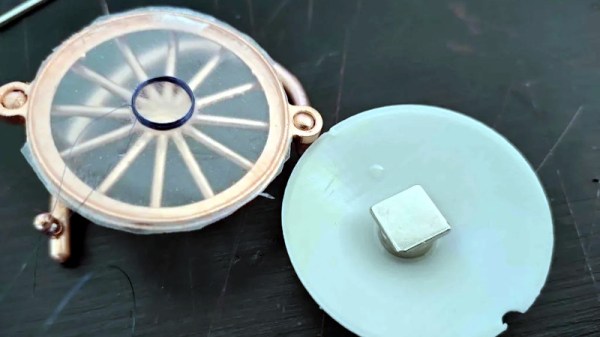
The result is a set of moving coil drivers with a construction technique involving using the semi-opaque thin window from an envelope as a diaphragm and as a former for the coil. Cyanoacrylate adhesive holds everything in place. The diaphragm is suspended across the mouth of a cardboard tube with the coil positioned above a magnet, resulting in the minimum moving mass necessary for as good a sound reproduction as possible. Judge for yourself, there’s a video that we’ve placed below the break.

The drivers are placed in a set of 3D-printed on-ear holders, and while they probably won’t match an expensive set of commercial headphones, we’d hazard a guess that they won’t have too bad quality. At the very least, it’s an interesting design to base further experimentation on.

Surprisingly few home made speaker or headphone drivers have made it onto these pages, probably because of the ubiquity of the ready-made article. An exception is this flexible PCB speaker, and of course we’ve also talked about home made electrostatic speakers. Continue reading “Make A Set Of Headphones From Scratch”

Analyzing CNC Tool Chatter With Audacity

When you’re operating a machine that’s powerful enough to tear a solid metal block to shards, it pays to be attentive to details. The angular momentum of the spindle of a modern CNC machine can be trouble if it gets unleashed the wrong way, which is why generations of machinists have developed an ear for the telltale sign of impending doom: chatter.

To help develop that ear, [Zachary Tong] did a spectral analysis of the sounds of his new CNC machine during its “first chip” outing. The benchtop machine is no slouch – an Avid Pro 2436 with a 3 hp S30C tool-changing spindle. But like any benchtop machine, it lacks the sheer mass needed to reduce vibration, and tool chatter can be a problem.

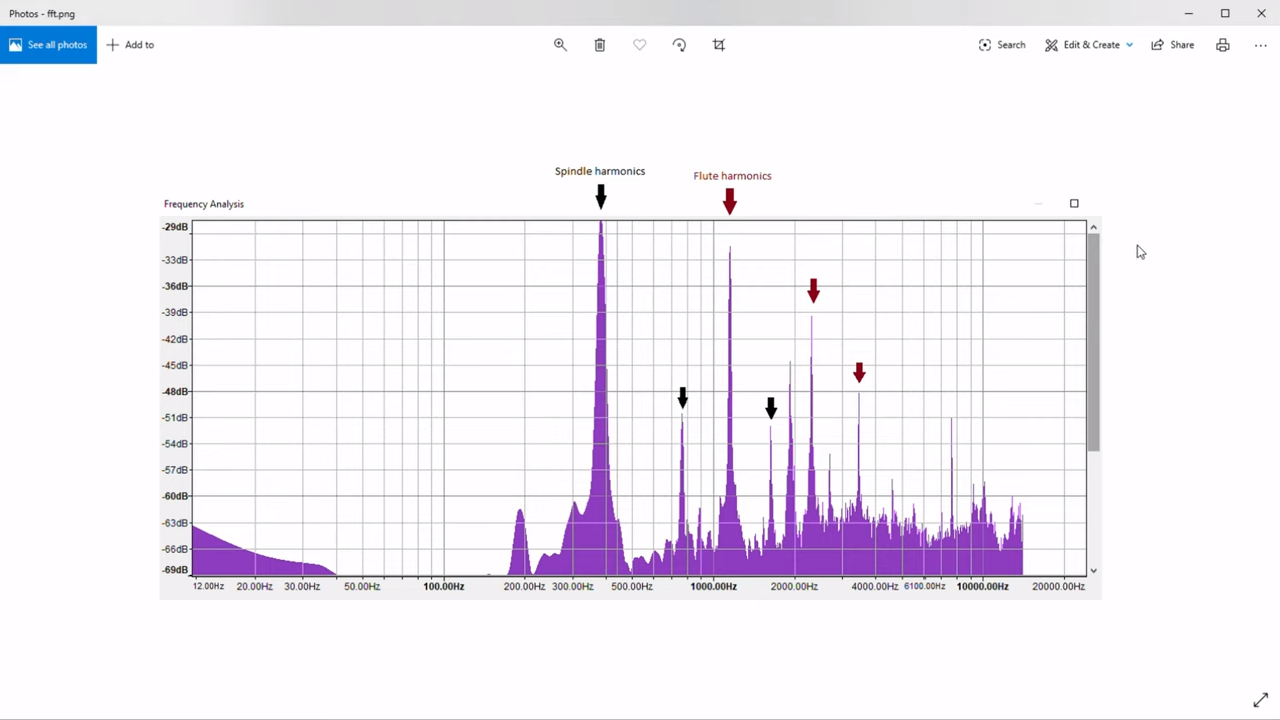
The analysis begins at about the 5:13 mark in the video below, where [Zach] fed the soundtrack of his video into Audacity. Switching from waveform to spectrogram mode, he was able to identify a strong signal at about 5,000 Hz, corresponding to the spindle coming up to speed. The white noise of the mist cooling system was clearly visible too, as were harmonic vibrations up and down the spectrum. Most interesting, though, was the slight dip in frequency during the cut, indicating loading on the spindle. [Zach] then analyzed the data from the cut in the frequency domain and found the expected spindle harmonics, as well the harmonics from the three flutes on the tool. Mixed in among these were spikes indicating chatter – nothing major, but still enough to measure.

Audacity has turned out to be an incredibly useful tool with a broad range of applications. Whether it be finding bats, dumping ROMs, detecting lightning strikes, or cloning remote controls, Audacity is often the hacker’s tool of choice.

Continue reading “Analyzing CNC Tool Chatter With Audacity”

HiFi Audio On The Commodore 64 – 48KHz, Yo!

Prior to the development of CD-quality audio hardware in the mid-1990s, home computers and consoles typically made do with synthesized music. Due to the storage and RAM limitations of the time, there weren’t a whole lot of other practical options. If you’re willing to ignore practicality, however, you can do some wonderful things – such as playing high-quality audio on a Commodore 64!

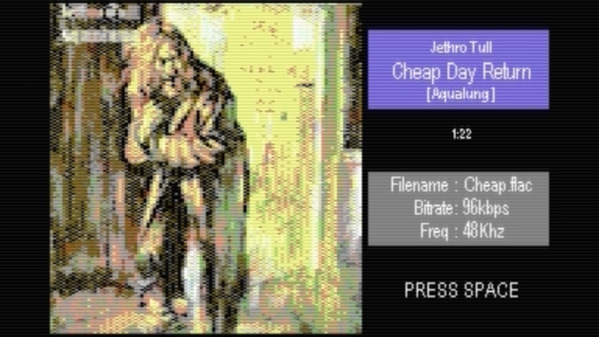
The project is the work of [Antonio Savona], who set out to play hi-fi audio on a Commodore 64 using only period-correct hardware. That means no 16MB RAM expansions, and no crazy high-capacity carts. The largest carts of the era were just 1MB, as produced by Ocean, and [Antonio] intended to cram in a full 90 seconds of music.

Targeting a sample rate of 48 KHz with 8-bit samples would mean the cartridge could only fit 20 seconds of raw audio into its 1MB of storage. This wasn’t good enough, so the audio would have to be compressed, with the target being a 4:1 ratio to reach the 90 second goal. With the C64’s CPU running at just 1MHz, there are just 21 clock cycles to deal with each sample when playing at 48 KHz.

Obviously, [Antonio] had set quite the challenge, and some masterful assembly coding was used to get the job done. The final result has the audio sounding impressively good, given that it’s being pumped out by a 6502 that is surely sweating to get the job done.

We love a good C64 hack around these parts, and it’s now even possible to build a new one from scratch if that’s your particular itch. Video after the break.

Continue reading “HiFi Audio On The Commodore 64 – 48KHz, Yo!”

Organic Audio: Putting Carrots As Audio Couplers To The Test

[Boltz999]'s carrot interconnect.
[Boltz999]’s carrot interconnect.
If there’s one thing that gives us joy here at Hackaday it’s a story of audio silliness. There is a rich vein of dubious products aimed at audiophiles which just beg to be made fun of, and once in a while we oblige. But sometimes an odd piece of audio equipment emerges with another purpose. Take [Boltz999]’s interconnects for example, which were born of necessity when there were no female-to-female phono adapters to connect a set of cables. Taking a baby carrot and simply plugging the phonos into its flesh delivered an audio connectivity solution that worked.

Does this mean that our gold-nanoparticle-plated oxygen-free directional audio cables are junk, and we should be heading for the supermarket to pick up a bag of root vegetables instead? I set out to test this new material in the secret Hackaday audio lab, located on an anonymous 1970s industrial estate in Milton Keynes, UK.

Continue reading “Organic Audio: Putting Carrots As Audio Couplers To The Test”

Secret C64 Program Found On A Christian Rock Band’s Vinyl Record

How often do you find Easter eggs in old vinyl records?

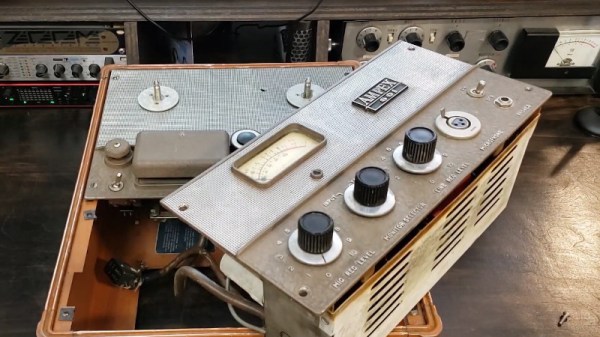
It sure was a surprise for [Robin Harbron] when he learned about a Commodore 64 program hidden on one of the sides of a record from the 1985 album of Christian rock band Prodigal. The host of the YouTube channel 8-Bit Show and Tell shows the “C-64” etching on one side of the vinyl, which he picked up after finding out online that the record contained the hidden program.

The run-out groove on records is typically an endless groove that keeps the record player from running off the record (unless there is an auto-return feature, which just replays the record). On side one of the vinyl, the run-out groove looks normal, but on side two, it’s a little thicker and contains some hidden audio. Recording the audio onto a cassette and loading it onto a dataset reveals a short C64 program.

The process is a little more troublesome that that, but after a few tries [Harbron] reveals a secret message, courtesy of Albert Einstein and Jesus Christ. It’s not the most impressive program ever written, but it’s pretty cool that programmers 35 years ago were able to fit it into only a few seconds of audio.

Unfortunately, we won’t be hearing much actual music from the album – [Harbron] chose not to play the songs to avoid copyright issues on YouTube.

Continue reading “Secret C64 Program Found On A Christian Rock Band’s Vinyl Record”

InstaBeat Started Out Of Spite

[Tom] teaches electronics with this small programmable MP3 player, but it didn’t get its start as a teaching tool.

As all parents are sometimes required to do, [Tom] was acting as chauffeur for his daughter and his friends. When he played the Beatles one of his passengers informed him that she was completely devoid of taste and didn’t like them at all. So he decided what the world needed was a Beatles appliance. This way all the ignorant plebs could educate themselves at the push of a button.

The machine is based around some SEED studio parts and a simple PCB. It was able to hold all 12 original albums and even announced their titles in a generated voice. Since the kit is easy to put together it was quickly re-purposed as a teaching aid. They get to learn the laser cutter and do some through-hole soldering.

He has plans to turn it into a more formal how-to workshop that anyone can duplicate.He’d also like to make a small software suite for playing with text-to-speech and hacking the speaker into other roles such as a multi meter.