CuteUino: Only Use The Parts Of The Arduino That You Need For Each Project

CuteUino

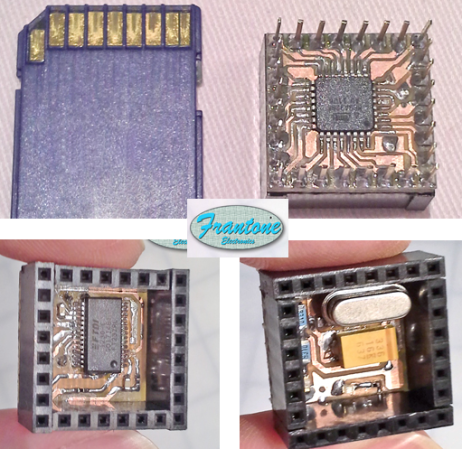
[Fran’s] been working on her own version of the Arduino. She calls it CuteUino for obvious reasons. The size of the thing is pretty remarkable, fitting within the outline of an SD card. But that doesn’t mean you won’t get the power that you’re used to with the device. She’s broken it up into several modules so you can choose only the components that you need for the project.

The main board is shown on the right, both top and bottom. It sports the ATmega328p (it’s hard to believe we could make out the label on the chip package in the clip after the break) in a TQFP-32 package soldered to the underside of what she calls the Brain Module. You can also see the extra long pins which stick through from the female pin headers mounted on the top side of the board. Inside of these pin headers you’ll find the clock crystal, status LEDs, and a capacitor. The other module is an FTDI board used to connect the AVR chip to a USB port.

You’ll definitely want to check out her prototyping post for this project. She uses a very interesting technique of combining two single-sided boards to make a 3-layer PCB. The side that was not copper clad is fitted with copper foil by hand to act as a ground plane for the vias. Neat!

Continue reading “CuteUino: Only Use The Parts Of The Arduino That You Need For Each Project”

Another Salvo In The PIC Vs. AVR Holy War

Ah, PIC vs. AVR, the never-ending battle of electronic design supremacy. Some people swear by Atmel’s AVR microcontrollers, while others are wrong. [majenko] is firmly planted in Microchip’s PIC camp, so he wrote up a nice comparison of Atmel’s AVR versus Microchip’s PIC family of microcontrollers. The results aren’t that surprising; PIC microcontrollers come out as a better product that no hobbyist uses because no hobbyist uses them.

Atmel and their series of AVR microcontrollers has seen a huge increase in popularity in the hobbyist market in the last few years, no doubt thanks to the Arduino and other AVR-powered dev boards. This isn’t to say Microchip and PIC haven’t seen their time in the lime light; there was a time when you could actually buy electronic components at Radio Shack, including kits containing Microchip’s very popular but somewhat outdated Basic Stamp.

After going over the capabilities of the Atmel AVR ATMega328p, the similarly equipped Microchip’s PIC PIC18F25K80, and TI’s MSP430G2533, [majenko] found the perennial favorite, the AVR, lacked in some very important categories. The AVR has a lower resolution ADC, fewer PWM pins, fewer 16-bit timers, while costing about $0.75 more.

Of course [majenko]’s analysis doesn’t take into account the intangibles of choosing a PIC over an AVR. Thanks to the Arduino’s adoption of the AVR, there are many, many more code and schematic examples floating around on the Internet for just about every project imaginable. The development tools for PIC are a bit more expensive than their AVR equivalents; A PICkit2 runs about $50 while AVR ISP programmers can be found just about everywhere for pocket change.

It’s a lazy Sunday, so all ‘yall can go on and argue in the comments.

Interpreting Brainf*#k On An AVR

We won’t call it useless, but we will ask why [Dan] wrote a brainfuck interpreter for the AVR

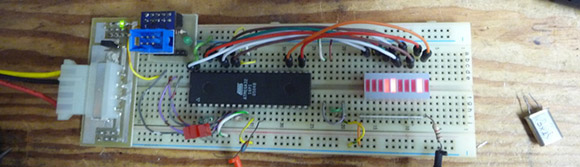
It’s not generating code for the AVR; think of it more as a bootloader. To run a brainfuck program, [Dan] uploads it to the EEPROM inside his ATMega32, after which the microcontroller takes over and starts performing whatever instruction the brainfuck program tells it to do. Because the whole thing runs off the EEPROM, the code size is limited to 1022 bytes. Enough for any brainfuck program written by a human, we think.

As for why [Dan] would want an AVR to build an interpreter for a language that is nearly unreadable by humans, we honestly have no idea other than the common, ‘because it’s there’ sentiment. There are some pretty cool projects out there that use brainfuck, including this genetic algorithm software developer. Right now, though, blinkey LEDs are enough to keep us happy, so you can see a video of brainfuck doing its thing on a LED bar display after the break.

Continue reading “Interpreting Brainf*#k On An AVR”

Veronica 6502 Computer Reaches Hello World Stage

veronica-hello-world

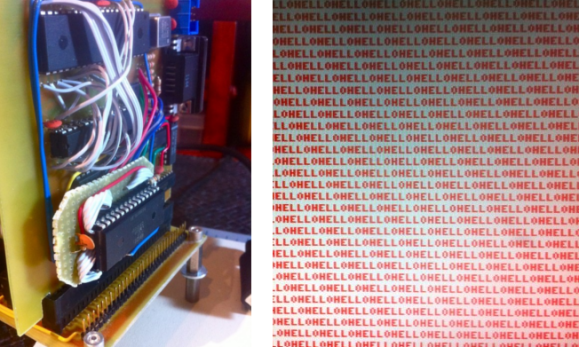
The screenshot on the right shows [Quinn Dunki’s] computer project displaying a Hello World program. Well, it’s only showing the word Hello right now, but the concept is the same. This proves that native 6502 code is running on the processor and reliably outputting data through its VGA hardware. That’s a welcome achievement after watching so much work go into this project.

But with anything this complex you can’t expect to make progress without finding bugs. And this step in the journey had a pretty big one in store for [Quinn]. After writing the assembly code and loading it into the machine she was dismayed to find that there were dropped characters all over the place. Now she shows a screenshot and says it’s easily recognizable as a race condition — proving she has a bigger brain than us.

The problem is a pair of uninterruptible processes running on the same AVR chip (part of the GPU she built). They are fighting with each other for control of the processor cycles and she fixed it by making the daughter board seen in the image above. It moves one of the time-critical processes out of that single AVR chip to fix the issue by using an IDT7200L FIFO SRAM chip.

[CNLohr]’s Microscope Slide Linux AVR Minecraft… Thing

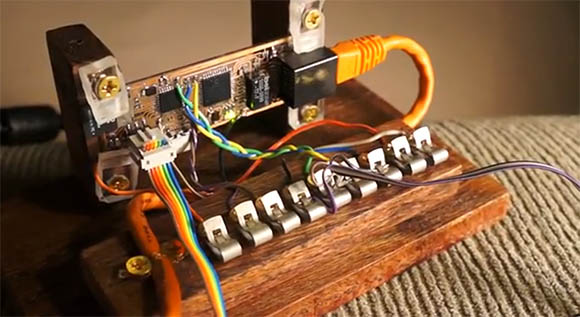
We’ve been following [CNLohr]’s process of creating an AVR-powered microscope slide running Linux and interfacing redstone circuits in Minecraft to real world electronic for a while now, but we’re really at a loss for words on how it works. Well, now there’s a video explaining everything you want to know about this amazingly complicated and overwrought thing.

The device is powered by an AVR microcontroller and Ethernet controller running [Fabrice Bellard]’s JSLinux in a browser. [CNLohr] added a few bits to JSLinux allowing him map the x86 IO ports emulated inside JSLinux to the AVR’s IO ports. This allows him to query the status – both analog and digital – using just a browser. Very cool, but [CNLohr] can also run his Minecraft server optimized for 8-bit devices on this microscope slide server to create a bridge between real electronics and redstone circuits.

To sum up what’s going on here, [Bellard] created an x86 emulator in JavaScript, and put Linux on it. [CNLohr] is serving this from a microcontroller attached to a circuit built on a microscope slide so he can blink an LED from within Minecraft. It’s the most beautifully over engineered and useless thing we’ve ever seen, basically.

In the video after the break, you can see [CNLohr]’s overly convoluted walk through of what’s going on with this microscope slide server. As a little bonus, you can also catch a glimpse of Hackaday at 00:20 in [CNLohr]’s most visited / new tab thingy in Firefox. We’re honored, really.

Continue reading “[CNLohr]’s Microscope Slide Linux AVR Minecraft… Thing”

Another Take On The 6502 Computer

another-take-on-the-6502-computer

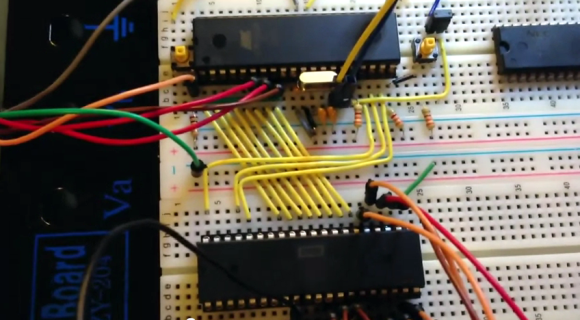
[Mark] is just starting off on his own 6502 computer odyssey. He was inspired by some of the other projects we’ve seen around here, like [Quinn Dunki’s] Veronica Project, but with a spin that leverages modern processors to alleviate some of the messy work. As you can see above, there’s an Atmel chip perched above the 65C02 processor. This chip not only feeds the processor data (through all those slightly diagonal yellow wires) but also provides the clock signal and operates the reset and bus enable lines.

This is more of a hello world post for [Mark]. The chip is simply running NOP commands right now. But it shows that the basic idea works, and the video after the break lets us see another time-saving aspect of the circuit. He’s using a character LCD to display memory location and data values. The plan is to get a blog going, which he’s hesitant to do as it takes valuable hacking time away from the project. We disagree. The write-up (although incredibly fun for us to read) ends up being a reference manual for him once the project starts to get really hairy.

Continue reading “Another Take On The 6502 Computer”

An Attempt To Replace Multiple RFID Cards With A Single Hacked-together Tag

It’s kind of a convoluted title, but [Hudson’s] attempt to replace multiple HID Prox cards with one AVR chip didn’t fully pan out. The project started when he wanted to reduce the number of RFID access cards he carries for work down to just one. The cards use the HID Proximity protocol which is just a bit different from the protocols used in most of the hobby RFID projects we see. He ended up taking an AVR assembly file that worked with a different protocol and edited it for his needs.

The device above is the complete replacement tag [Hudson] used. It’s just an AVR ATtiny85 and a coil made of enameled wire. The coil pics up current from the card reader’s magnetic field, and powers the chip through the leakage on the input pins (we’ve seen this trick a few times before). The idea he had was to store multiple codes on the device and send them all in a row. He was able to get the tag to work for just one code, but the particulars of the HID Prox reader make it difficult if not impossible to send multiple codes. The card must send the same code twice in a row, then be removed from the magnetic field before the reader will poll for another combination.