IMU Boards As Next-gen Motion Capture Suit?

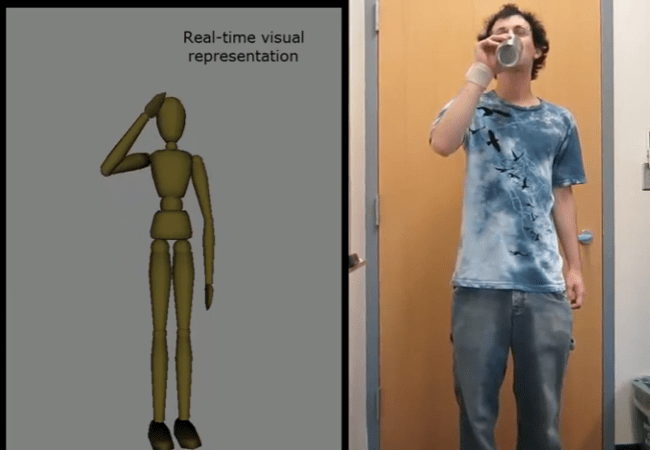
This guy takes a drink and so does the virtual wooden mannequin. Well, its arm takes a drink because that’s all the researchers implemented during this summer project. But the demo really makes us think that suits full of IMU boards are the next generation of motion capture. Not because this is the first time we’ve seen it (the idea has been floating around for a couple of years) but because the sensor chips have gained incredible precision while dropping to bargain basement prices. We can pretty much thank the smartphone industry for that, right?

Check out the test subject’s wrist. That’s an elastic bandage which holds the board in place. There’s another one on this upper arm that is obscured by his shirt sleeve. The two of these are enough to provide accurate position feedback in order to make the virtual model move. In this case the sensor data is streamed to a computer over Bluetooth where a Processing script maps it to the virtual model. But we’ve seen similar 9-axis sensors in projects like this BeagleBone sensor cape. It makes us think it would be easy to have an embedded system like that on the back of a suit which collects data from sensor boards all over the test subject’s body.

Oh who are we kidding? [James Cameron’s] probably already been using this for years.

Continue reading “IMU Boards As Next-gen Motion Capture Suit?”

Hacking Sensoria, The Smart Sock

sensorSock

Sensor-meets-sock product “Sensoria” won’t hit the shelves for a while, but [Andrew] managed to snag a Sensoria Gaming SDK and has hacked the smart sock to control an inexpensive toy helicopter. Seldom do we see projects this rugged yet clearly effective. The sock sends data via its companion device—a Bluetooth anklet—to LabVIEW. LabVIEW subsequently talks to an attached Arduino to manipulate a servo that [Andrew] just…duct taped to the helicopter’s controller. The result: a a quick and dirty hack that proves surprisingly intuitive, providing accelerator-style foot control to drive the throttle. Check out a video of [Andrew] punishing his helicopter after the break.

This is the first hack we’ve seen for the Sensoria, which is still in the crowdsourcing phase over at Indigogo. They have already reached their funding goal, but a few SDKs remain unclaimed. You can watch an official video of the sock’s sensors lighting up a heat map in real time below.

And, if you missed it, have a look at the AsTeRICS project’s helicopter controlled by neck muscles.

Continue reading “Hacking Sensoria, The Smart Sock”

Two-way Bluetooth Communication Made Easy

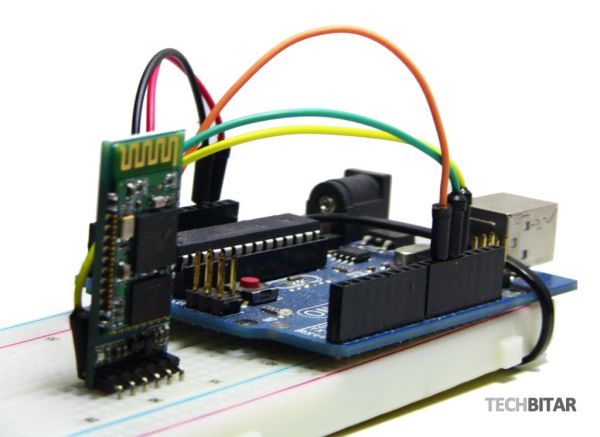
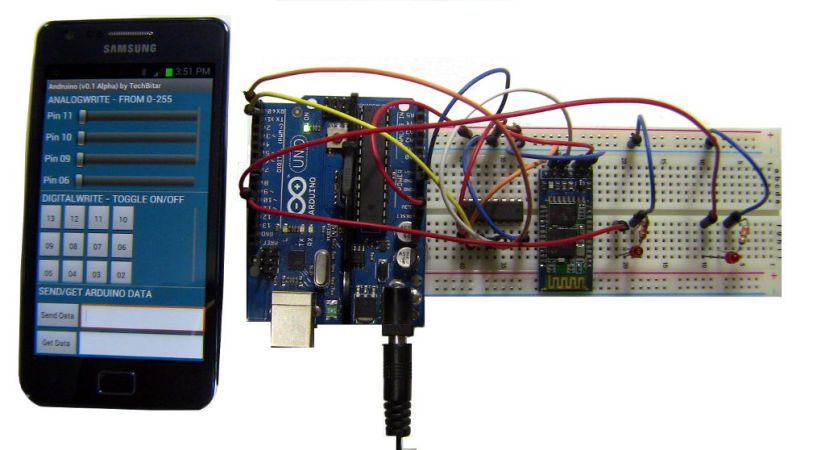
It’s hard to imagine an easier way to set up communications between an Android device and an Arduino using Bluetooth than by following this guide. In the center of the breadboard you can see the cheap and ubiquitous HC-05 Bluetooth module. Having picked up one of these ourselves we can attest that after opening the package and holding one in your hand you may be struck with a “where do I start?” conundrum. If you’ve got an Android handset and an Arduino you start right here, then methodically replace one side of the equation at a time until your own project has a Bluetooth component and you actually understand how it works.

Hardware for the project comes in a couple of parts. The Bluetooth module wants 3.3v logic levels so that is taken into account. The image above shows a buffer chip doing the conversion, but the Fritzing schematic on the post uses a voltage divider. The software end of things consists of an Arduino sketch and an Android app. Check out all the controls on that screen. With bi-directional communications and a slew of already-configured commands this should get you up and running quickly on pretty much any possible project.

One thing to note is that there are different firmwares for these HC-05 units. For more on that see this project.

Continue reading “Two-way Bluetooth Communication Made Easy”

Giving Digital Calipers Bluetooth

[Fede]’s wife uses a pair of digital calipers to take measurements of fruits, leaves, and stems as part of her field research. Usually this means taking a measurement and writing it down in a log book. All things must be digitized, so [Fede] came up with a way to wirelessly log data off a pair of cheap Chinese calipers with a custom-made Bluetooth circuit.

Most of these cheap Chinese digital calipers already have a serial output, so [Fede] only needed to build a circuit to take the serial output and dump it in to an off-the-shelf Bluetooth module. He fabbed a custom circuit board for this, and after seeing the increased battery drain from the Bluetooth module, decided to add an external battery pack.

In addition to etching his own board for sending the serial output of the calipers to a Bluetooth module, [Fede] also put together a custom flex circuit to connect the two boards. It’s just a small bit of brass glued to a transparency sheet etched with ferric chloride, but the end result looks amazingly professional for something whipped up in a home lab.

Letting Bluetooth Take The Wires Out Of Your Headphones

bt-wireless-headphones

This picture shows the gist of [Alan’s] hack to transition his wired headphone to internalize a Bluetooth audio receiver (translated).

He starts with a pair of wired “ear muff” style headphones and an aftermarket Bluetooth audio adapter that he’s been using with them. But if you’re not going to plug them into the audio source why have six feet of extra wire hanging about? [Alan] ditched the plastic case surrounding the Bluetooth hardware and cracked open the earpieces to find room for it. It’s a tight fit but there was just enough room.

It is unfortunate that the headphone design doesn’t already have a wired crossover hidden in the arc connecting the earpieces. Alan strung some of that red wire himself to connect the two speakers. The board is mounted so that the USB port is located where the wires used to enter the plastic body. This makes it a snap to plug them in when they need a recharge.

You can play a little “Where’s Waldo” with this one by trying to spot the Raspberry Pi in his build log.


Learning Letters, Particularly R, F, I, & D

8993376562_55ff3846b3

After [yohanes] picked up a toy at a yard sale – a Leap Frog Letter Factory Phonics – he thought he could do better. The toy originally asked a child to find a letter, and after digging one of 26 plastic characters out of a plastic tub and placing them on the Letter Factory’s sensor, would play a short musical ditty. [yohanes]’ version does the same, but because he made it himself it is infinitely more expandable.

The letters for [yohanes]’ version are RFID tagged. This, combined with a cheap RFID module and a bluetooth module means a Raspberry Pi can read RFID cards from across the room. From there, it’s a simple matter of writing up some Python to ask his toddler for a letter, reading the bits coming from a bluetooth, and keeping score.

The build isn’t over by a long shot. [yohanes] still needs to make his build multilingual by adding Indonesian and Thai. There’s also a possibility of adding a spelling game to make it more interesting.

Wireless Rover With Android Control

android-rover

[Radu] spend the first portion of this year building and improving upon this wireless rover project. It’s actually the second generation of an autonomous follower project he started a few years back. If you browse through his old postings you’ll find that this version is leaps and bounds ahead of the last.

He purchased the chassis which also came with the gear-head motors and tires. Why reinvent the wheel (har har) when you’ve got bigger things on your plate? To make enough room inside for his own goodies he started out by ditching the control board which came with the Lynxmotion chassis in favor of an AVR ATmega128 development board. He also chose to use his own motor controller board. Next he added a metal bracket system to hold the battery pack. Things start to get pretty crowded in there when he installed his own Bluetooth and GPS modules. Rounding out his hardware additions were a set of five ultrasonic sensors (the grey tubes on top), a character display, as well as head and tail lights. The demo video shows off the control app he uses. We like that tic-tac-toe design for motion control, and that he added in buttons to control the lights.

Continue reading “Wireless Rover With Android Control”