rc_car

Racing Wheel Guided R/C Car With Video Feed

Instructables user [Kaeru no Ojisan] enjoys constructing R/C kit cars and wanted to build one that could be driven using a PC racing wheel he had on hand. Not satisfied with simply guiding it with the racing wheel, he added a web cam to the car so that he can monitor its location from the comfort of his desk chair.

The car is loaded down with all sorts of electronics to get the job done, requiring four separate battery packs to keep them online. An Arduino controls the motor and the steering servos, receiving its commands wirelessly via a Bluetooth add-on. The camera connects to a USB to Ethernet converter, which enables the car’s video feed to be transmitted via the onboard wireless router.

The racing wheel interface seems to work just fine, though we don’t doubt that the whole setup can be easily simplified, reducing both weight and battery count. While [Kaeru no Ojisan] says that the car is in its concept stages and there are a few bugs to work out, we think it’s a good start.

Stick around to see a quick video of the car in testing.

Continue reading “Racing Wheel Guided R/C Car With Video Feed”

Long-range Bluetooth Wardriving Rig

bluetooth_wardriving

[Kyle] was digging through a box of junk he had lying around when he came across an old USB Bluetooth dongle. He stopped using it ages ago because he was unsatisfied with the limited range of Bluetooth communications.

He was going to toss it back into the box when an idea struck him – he had always been a fan of WiFi wardriving, why not try doing the same thing with Bluetooth? Obviously the range issue comes into play yet again, so he started searching around for ways to boost his Bluetooth receiver’s range.

He dismantled the dongle and found that the internal antenna was a simple metal strip. He didn’t think there would be any harm in trying to extend the antenna, so he soldered an alligator clip to the wire and connected the CB antenna in his truck. His laptop sprung to life instantly, picking up his phone located about 100 feet away in his house. He took the show on the road and was able to pick up 27 different phones set in discoverable mode while sitting in the parking lot of a fast food chain.

While it does work, we’re pretty sure that the CB antenna isn’t the most ideal extension of the Bluetooth radio. We would love to see what kind of range he would get with a properly tuned antenna.

Keep reading to see a quick demonstration of his improvised long-range Bluetooth antenna.

Continue reading “Long-range Bluetooth Wardriving Rig”

Bluetooth Bot Constructed From Thrift Store Rejects

bluetooth_bot

[John] wrote in to share his latest creation, an Arduino-controlled Bluetooth robot. You might remember him from one of his previous hacks, the Lawnbot 400. This time around, he has decided to scale things down a bit and focus his hacking on small R/C toys.

His Bluetooth bot was constructed using a cheap R/C tank he scored at a thrift store for about $1.50. He removed all of the bot’s parts, aside from the frame, the battery compartment, and the motors that drive the treads. He added in an Arduino, which he paired with an Ardumoto shield from SparkFun. The motor shield costs about $25, but he does have schematics available so that you can roll your own if you so desire.

A Bluetooth Mate was added to the car, which allows serial communication with any other Bluetooth device. Once everything was wired up, he paired the robot with his computer and got down to driving it by simply pressing keys on his keyboard.

It looks like a fun little toy to have around, and it seems fairly easy to construct. Check out the videos below of his robot in action, and be sure to check out his code/schematics if you are interested in building your own.

Continue reading “Bluetooth Bot Constructed From Thrift Store Rejects”

Surplus Military Gear Keeps Your Hands Free, Calls Private

heli_helmet

[Julian] was rummaging through a military surplus store when he spotted a pair of old helicopter pilot helmets that he absolutely had to have. At $25 they were a steal, but pretty useless in their current state. He decided to modify one of the helmets for use while playing video games, but he didn’t stop there.

The helmet had two decent speakers built-in so he kept them, but tweaked the wiring from a mono-only configuration to accept stereo input. A RF wireless headset was disassembled and wired into the helmet so he could use it for playing video games while his wife is asleep. As an added bonus, the headset he used happened to have an AM/FM receiver built in, so he can enjoy music while sitting around with his helmet on as well. A Bluetooth cell phone headset was also torn down and wired into the helmet for gaming and handling phone calls. The Bluetooth mic was extended into the original mic stem built into the helmet, keeping things authentic-looking.

Overall it’s a quite a useful recycling of some old military junk. It’s a great idea though the helmet looks like it could be a touch cumbersome after awhile.

Literally Turn Your Headset Into A Handset

[Rachel’s] Bluetooth glove is proving that you don’t have to be missing fingers to talk to the hand. You can see in the video after the break that, like us, she wears fingerless gloves while typing to keep the cold from causing pain in her hands (it’s so cold in here it’s like we’re [Bob Cratchit]). So why not make those gloves multitaskers?

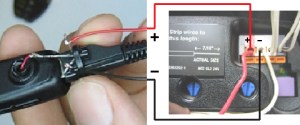
She cracked open a small Bluetooth headset to see if it would play nicely with her fuzzy purple gloves. A bit of wire and some shrink tubing allowed for the speaker and microphone to be moved a bit further from the circuit board. Once those components had been extended she pinned everything in place to make sure it fit the bill. The components were then sewn in place and a microswitch for answering calls was repositioned in the hollow of the wearer’s palm. Now you’re free to work the day away, with all of your incoming calls already at your fingertips.

Continue reading “Literally Turn Your Headset Into A Handset”

Jittering Hexapod Dances To The Strokes Of Your Bluetooth Keyboard

Here’s a small but functional hexapod that is controlled via Bluetooth. [Sigfpe] started with the hexapod kit sold by Polulu and added a BlueSMiRF modem to get the little guy’s communications up and running. But since the bot is merely three servos, a microcontroller board, sensors, and miscellaneous parts it’s an easy build for most electronic hobbyists.

Check out the video after the break to see the delightful dance it can perform at your bidding. When we first looked at the project we thought that the keyboard was directly paired with the bot for control, but a look at the code makes us think the computer is controlling it after processing keystrokes. Either way the BlueSMiRF should have no problem pairing with other Bluetooth devices so it’s just a matter of coding to get it taking commands from your device of choice. We’d love to see Android control but for the really hard-core code monkeys we think this should be voice controlled with a Bluetooth headset.

Continue reading “Jittering Hexapod Dances To The Strokes Of Your Bluetooth Keyboard”

Bluetooth Nixie Driver Lets You Go Almost-wireless

[Bob Coggeshall] has a nice Nixie tube driver board coming down the pipes. It’s not quite ready yet but you can see by the image above, it offers something that isn’t always easy to find; control for B7971 tubes which can display the full spectrum of alpha-numeric characters. This board is not limited to just one type of tube and it can be chained together with other boards to create longer displays. But perhaps the best development is the addition of a Bluetooth module. [Bob] has incorporated a Roving Networks RN-41 Bluetooth module which takes care of all aspects of the wireless protocol. This way the display is not tethered to a computer, or limited to data stored on a chip. We can’t really say that it’s wireless though, as we’d assume a set of these big tubes would rip through batteries pretty quickly. Keep an eye on this project, it will be open source once the bugs are worked out and [Bob] will also sell fully assembled and tested boards for those who choose not to roll their own.

We wonder if it would be easy to pair this with your phone and use it to display incoming call information?