Android Oscilloscope

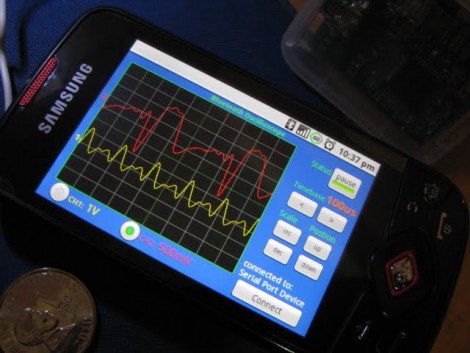
Here’s a 2-channel Oscilloscope for your Android phone. It uses a base module driven by a dsPIC for signal processing. From there, an LMX9838 Bluetooth module broadcasts the data to the phone so that the waveform can be displayed. [Yus] ported some Python code he had been using over to a set of Java and XML files in order to get it working on Android. This was actually the first time he worked with the SDK… we’d say he’s a quick learner. See it in action after the break.

Continue reading “Android Oscilloscope”

Wireless Electrocardiography… With IPhone

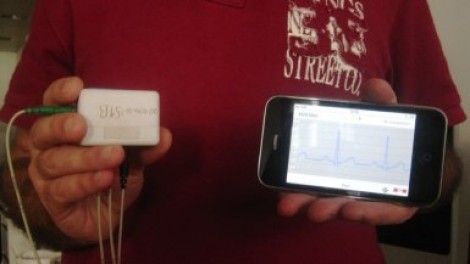
This module is a sensor package for monitoring the electrical activity of the heart. It is the product of an effort to create a Wireless Body Sensor Network node that is dependable while consuming very little electricity, which means a longer battery life. To accomplish this, the microcontroller in charge of the node compresses the data (not usually done with wireless ECG hardware) so that the radio transmissions are as short and infrequent as possible.

[Igor] sent us this tip and had a short question and answer session with one of the developers. It seems they are working with the MSP430 chips right now because of their low power consumption. Unfortunately those chips still draw a high load when transmitting so future revisions will utilize an alternative.

Oh, and why the iPhone? The device that displays the data makes little difference. In this case they’re transmitting via Bluetooth for a real-time display (seen in the video after the break). This could be used for a wide variety of devices, or monitored remotely via the Internet.

Continue reading “Wireless Electrocardiography… With IPhone”

Using An NES Controller On An Android Phone

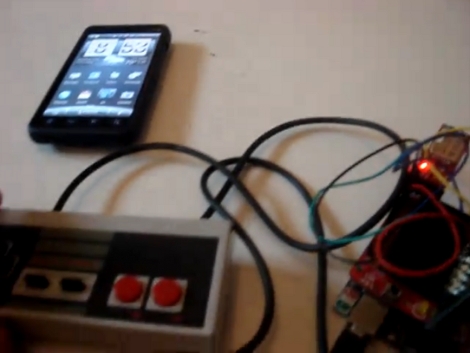
[Sk3tch] rigged up a way to use an original NES controller with Android. He bought the controller and a breakout board for it at DEFCON. By combining the controller, an Arduino, and a blueSMIRF BlueTooth module the controller can be used as a keyboard on his Android device. In the video after the break he demonstrates pairing the devices and playing Super Mario Bros. 3 in an emulator.

He calls this Alpha quality but it certainly looks like it works well. In the beta version we’d love to see all of the extra electronics inside the controller case like those USB mods.

Continue reading “Using An NES Controller On An Android Phone”

Hexapod Controlled By Android And IPhone

[youtube=http://www.youtube.com/watch?v=NvEBUd_EqbQ]

This video is a blatant example of having too many high-end toys but we love it anyway. [Robert Stephenson] is controlling a rather awesome-looking hexapod via a Bluetooth connection to his HTC Hero. The app allows on-screen selections to decide which portion of the robot will move as a result of accelerometer data from the handheld. The only thing we saw that was missing is a camera feed to the phone.

But this hack doesn’t stop there. The Hero can be used to host a WiFi network while still connected to the hexapod. The second half of the video shows an iPod Touch connecting via WiFi and controlling the bot. Now head on over to the laser cutter to start that hexapod build, and finish up by getting elbow-deep into some Android development.

Brain Wave Skimming On The Go

Mentok: The Mind Taker

Master EEG hackers [MOG] and [Tim] over at the Makers Local 256 have been working on creating a Bluetooth EEG listener made from a Mattel Mindflex. This build is based on an earlier build of a group called [Frontier Nerds] (thanks for the heads up [Nathan]!), but this version ditches the Arduino in favor of a basic serial to bluetooth adapter for the sake of power efficiency (as well as not having to keep an Arduino strapped to you head). We have covered a few Mindflex hacks before, but this seems to be the most useful in a practical sense. They have included the code for a Bluetooth serial data logger, and the earlier build shows a good example of captured data visualization.

Bluetooth Multimedia Remote

[Mathieu] spent three months developing this multimedia remote control. It connects to a PC via USB or Bluetooth and communicates with Winamp to pull down track information for display on a Nokia LCD screen. It can also be used as a wireless headset via the two on-board jacks. [Mettieu] thinks it’s just a small hop away from working as a Skype client if you take the time to write a plugin for that API.

Driving With Android

[youtube=http://www.youtube.com/watch?v=tIx2ihZ7728]

[Elrik] converted an RC car so that it can be controlled with an Android phone. He wisely uses the accelerometer for steering with a button for forward and another for reverse. There’s even control for the headlights. The car itself has had a servo retrofit for steering but it’s the Bluetooth module that catches our eye. It’s a GP-GC021 which you can get your hands on for under $20. It has a serial UART for easy interface with a microcontroller at up to 9600 baud.

Now you can convert over that larger vehicle to use Bluetooth instead of WiFi, just don’t hurt yourself. And if you’re just starting out with writing Android apps, don’t miss our series: Android Development 101.