Hexapod Controlled By Android And IPhone

[youtube=http://www.youtube.com/watch?v=NvEBUd_EqbQ]

This video is a blatant example of having too many high-end toys but we love it anyway. [Robert Stephenson] is controlling a rather awesome-looking hexapod via a Bluetooth connection to his HTC Hero. The app allows on-screen selections to decide which portion of the robot will move as a result of accelerometer data from the handheld. The only thing we saw that was missing is a camera feed to the phone.

But this hack doesn’t stop there. The Hero can be used to host a WiFi network while still connected to the hexapod. The second half of the video shows an iPod Touch connecting via WiFi and controlling the bot. Now head on over to the laser cutter to start that hexapod build, and finish up by getting elbow-deep into some Android development.

Brain Wave Skimming On The Go

Mentok: The Mind Taker

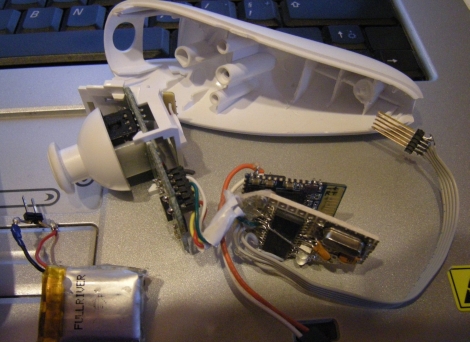
Master EEG hackers [MOG] and [Tim] over at the Makers Local 256 have been working on creating a Bluetooth EEG listener made from a Mattel Mindflex. This build is based on an earlier build of a group called [Frontier Nerds] (thanks for the heads up [Nathan]!), but this version ditches the Arduino in favor of a basic serial to bluetooth adapter for the sake of power efficiency (as well as not having to keep an Arduino strapped to you head). We have covered a few Mindflex hacks before, but this seems to be the most useful in a practical sense. They have included the code for a Bluetooth serial data logger, and the earlier build shows a good example of captured data visualization.

Bluetooth Multimedia Remote

[Mathieu] spent three months developing this multimedia remote control. It connects to a PC via USB or Bluetooth and communicates with Winamp to pull down track information for display on a Nokia LCD screen. It can also be used as a wireless headset via the two on-board jacks. [Mettieu] thinks it’s just a small hop away from working as a Skype client if you take the time to write a plugin for that API.

Driving With Android

[youtube=http://www.youtube.com/watch?v=tIx2ihZ7728]

[Elrik] converted an RC car so that it can be controlled with an Android phone. He wisely uses the accelerometer for steering with a button for forward and another for reverse. There’s even control for the headlights. The car itself has had a servo retrofit for steering but it’s the Bluetooth module that catches our eye. It’s a GP-GC021 which you can get your hands on for under $20. It has a serial UART for easy interface with a microcontroller at up to 9600 baud.

Now you can convert over that larger vehicle to use Bluetooth instead of WiFi, just don’t hurt yourself. And if you’re just starting out with writing Android apps, don’t miss our series: Android Development 101.

Android Controlling Mindstorms NXT

[youtube=http://www.youtube.com/watch?v=bEEVwf6E10M]

Here’s an Android device controlling a LEGO Mindstorms robot. [Josh] and a couple of his colleagues developed software to get both Android 2.1 (video above) and Android 1.6 (video) to work as Bluetooth control devices. The NXT cube is running leJOS, a Java virtual machine, allowing you to program Mindstorms using Java. Although their code is at an early Alpha stage, this shows that it works and is a very welcomed tool for NXT development once they get to a more stable point and release it to the masses.

Long Arms Required, Electronic Trombone

[youtube http://www.youtube.com/watch?v=0sX4Dleqz_0&feature=player_embedded%5D

Sadly, the video above is the only information we were able to find on the “Double Slide Controller” trombone, built by composer Tomás Henriques. As well as, the instrument took first place in the Georgia Tech Center Guthman Musical Instruments Competition. Right in front of a Bluetooth bow for violins, and a circuit bending group from New York, and…wait; it beat out our favorite modified didgeridoo? Better luck next year.

Adding Mute To A Bluetooth Headset

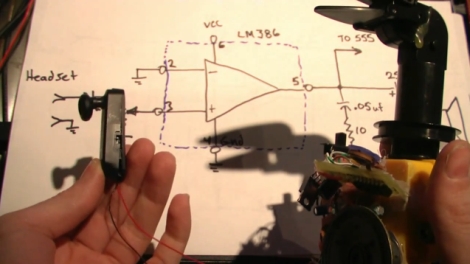
[Jared] often needs to be on conference calls for work during his motorcycle commute. He’s got a bluetooth headset that cancels noise but it didn’t have a mute feature. He cracked open the speaker and microphone portion of the apparatus but there wasn’t enough room for a switch. The base unit which houses the noise cancelling hardware had plenty of room. He added a single pole double throw (SPDT) switch to the positive wire from the microphone, allowing him to disconnect it as a mute function would. He mentions the need to seal the unit with silicone after the hack in order to keep out the elements. We might have opted for a weather-proof switch as well.

This simple hack makes a nice addition to any Bluetooth projects you’re working on.