Lamp Flashing Module Is Perfect For Automotive Use

Modern cars tend to have quite advanced lighting systems, all integrated under the control of the car’s computer. Back in the day, though, things like brake lights and indicators were all done with analog electronics. If your classic car needs a good old-fashioned flasher module, you might find this build from [DIY Guy Chris] useful.

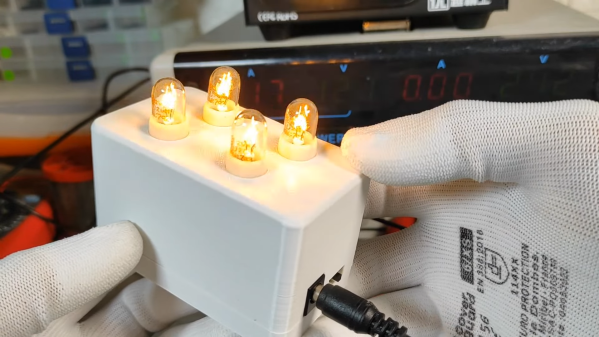
It’s an all-analog build, with no need for microcontrollers or other advanced modern contrivances. Instead, a little bipolar PNP transistor and a beefier NPN MOSFET as an oscillator, charging and discharging a capacitor to create the desired flashing behavior. Changing the size of the main capacitor changes the flash rate. The MOSFET is chosen as running 12 volt bulbs requires a decent amount of current. The design as drawn is intended to run up to eight typical automotive bulbs, such as you might find in indicator lamps. However, [Chris] demonstrates the circuit with just four.

Flasher circuits were in regular use well into the 1990s. The original Mazda Miata has a very similar circuit tucked up under the dashboard to run the turn signals. These circuits can be hard to find for old cars, so building your own may be a useful workaround if you’re finding parts hard to come by. Video after the break.

Continue reading “Lamp Flashing Module Is Perfect For Automotive Use”
Just In Case You Want To Charge Your Neighbor’s Tesla

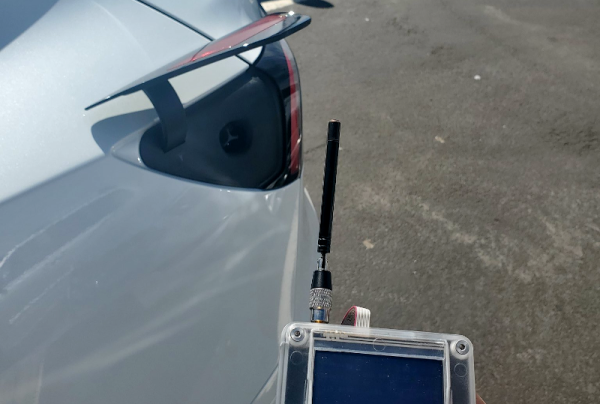
Tesla vehicles have a charging port that is under a cover that only opens on command from a charging station. Well, maybe not only. [IfNotPike] reports that he was able to replay the 315MHz signal using a software defined radio and pop the port open on any Tesla he happened to be near.

Apparently, opening the charging port isn’t the end of the world since there isn’t much you can do with the charging port other than charging the car. At least, that we know of. If history shows anything, it is that anything you can get to will be exploited eventually.

Continue reading “Just In Case You Want To Charge Your Neighbor’s Tesla”

China Loves Battery Swapping EVs, But Will They Ever Make It Here?

Electric vehicles promise efficiency gains over their gas-fuelled predecessors, but the issue of recharging remains a hurdle for many eager to jump on board with the technology. The problem is only magnified for those that regularly street park their vehicles or live in apartments, without provision to charge a vehicle overnight at home.

Battery swapping promises to solve that issue, letting drivers of EVs change out their empty battery for a freshly charged one in a matter of minutes. The technology has been widely panned and failed to gain traction in the US.

However, as it turns out, battery swapping for EVs is actually thing in China, and it’s catching on at a rapid rate.

Continue reading “China Loves Battery Swapping EVs, But Will They Ever Make It Here?”

Hacking A Proper Dash Into The Tesla Model 3

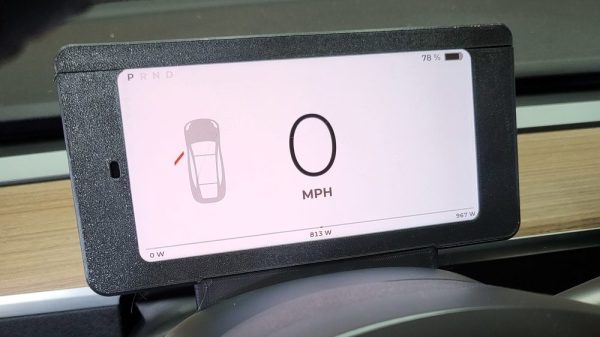
The Tesla Model 3 and Model Y are popular electric vehicles that dispense with some of the usual provisions you’d expect in a typical car. Namely, there’s no dash cluster in front of the driver; instead, all information is solely displayed on the center console screen. [Nick Nguyen] wasn’t a fan of this setup, and decided to hack together a dash cluster of his own. 

The CANdash works in a simple fashion, snooping the Tesla’s CAN bus for all the information relevant to the vehicle’s operation. It’s capable of displaying everything from speed to the remaining range in the battery, while also allowing the user to keep an eye on things like coolant temperatures and whether the Tesla Autopilot system is currently available.

The build relies on a CANserver, an ESP32-based device specifically built for hooking up to the CAN bus on Tesla vehicles and sharing the data externally. The data can then be piped wirelessly to an Android phone running CANdash to display all the desired information. With the help of an aftermarket dash clip or a 3D printed custom mount, the phone can then be placed behind the steering wheel to display data in the usual location.

It’s a simple, straightforward hack that gives Tesla owners a useful feature that they’re otherwise missing from the factory. The US automakers cars are proving to be fertile ground for hackers and DIYers, with one man recently saving thousands on a battery swap with a simple mod. Video after the break.

Continue reading “Hacking A Proper Dash Into The Tesla Model 3”

Does This Lead Make My Car Look Fat?

When looking at the performance of a vehicle, weight is one of the most important factors in the equation. Heavier vehicles take more energy to accelerate and are harder to stop. They’re also more difficult to control through the corners. Overall, anything that makes a vehicle heavier typically comes with a load of drawbacks to both performance and efficiency. You want your racecar as light as possible.

However, now and then, automakers have found reason to intentionally add large weights to vehicles. We’ll look at a couple of key examples, and discuss why this strange design decision can sometimes be just what the engineers ordered.

Continue reading “Does This Lead Make My Car Look Fat?”

The Current State Of Play In Autonomous Cars

Bluster around the advent of self-driving cars has become a constant in the automotive world in recent years. Much is promised by all comers, but real-world results – and customer-ready technologies – remain scarce on the street.

Today, we’ll dive in and take a look at the current state of play. What makes a self-driving car, how close are the main players, and what can we expect to come around the corner?

Continue reading “The Current State Of Play In Autonomous Cars”

How To Get Into Cars: E85 Fuel

If you’ve spent any time around the modified car scene in the last few years, you’ve probably heard about E85. Maybe you’ve even noticed a sweet smell emanating from the pitlane, or heard people cracking jokes about “corn juice.”

The blended fuel, which combines alcohol and traditional gasoline, can have significant performance benefits if used properly. Today, we’ll explore what those are, and how you can set your ride up to run on E85.

Continue reading “How To Get Into Cars: E85 Fuel”