The Eerie Sounds Of Ioalieia: An ESP32/Valve/Analog Hybrid Circuit Sculpture

We’ve not had a circuit sculpture piece for a while, so here’s “ioalieia” a lovely hybrid digital-analog sound sculpture by [Eirik Brandal] to dig into.
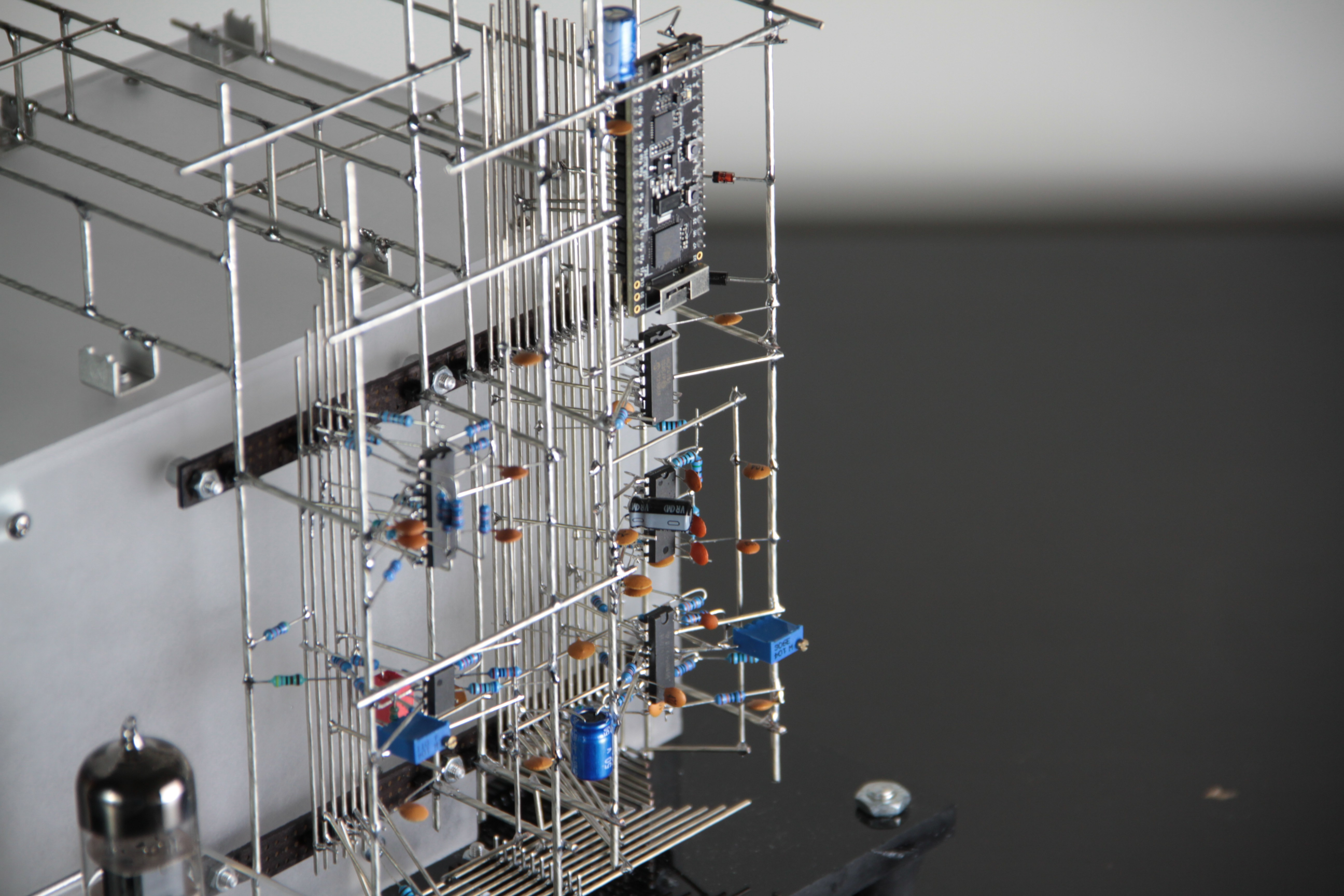
Tidy straight lines. Nice job!

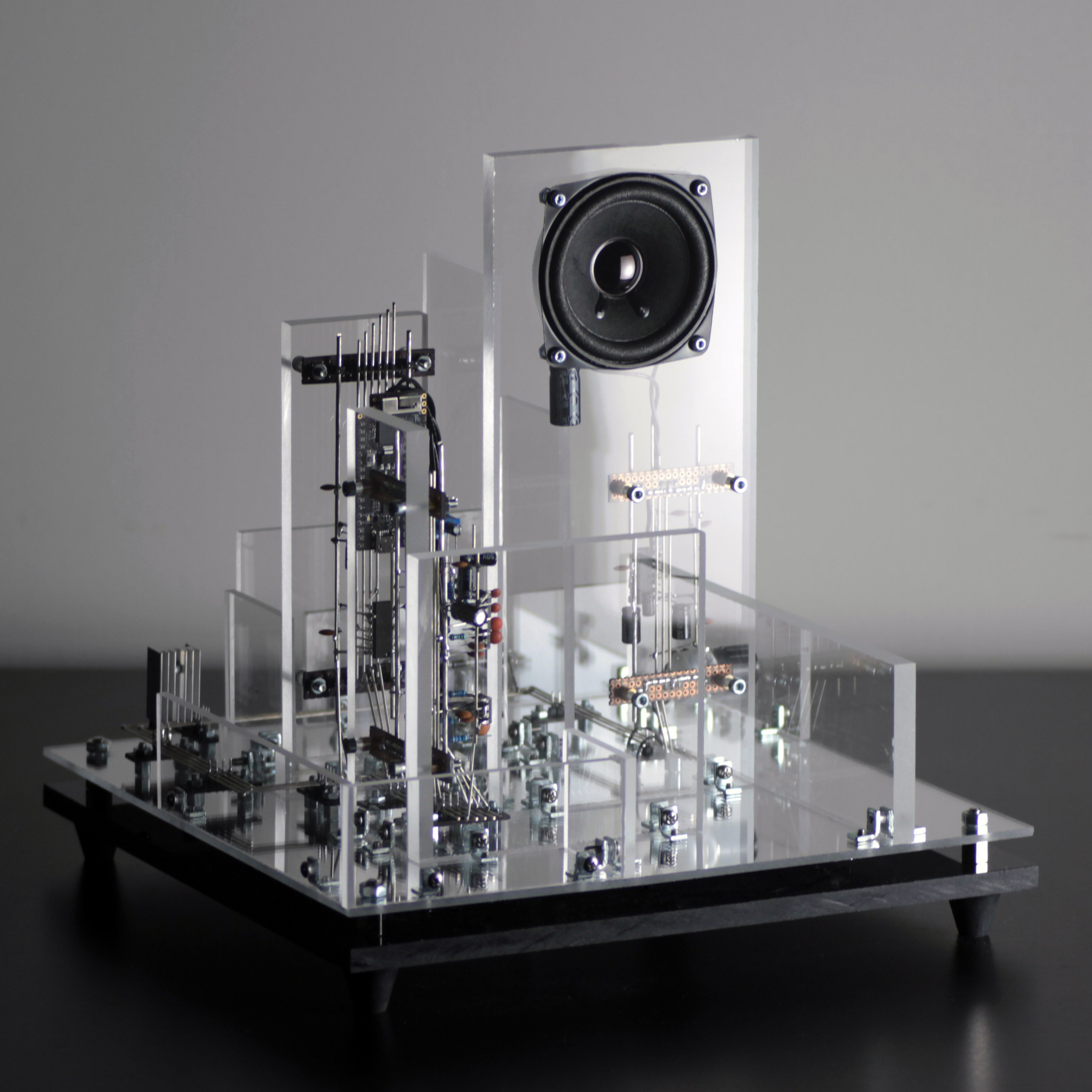
The host of the show is the ESP32 module, which generates audio frequency square waves, which are fed into a MCP4251 digital potentiometer. From there, it is fed into a AS3320 Voltage controlled filter (VCF), from Latvia-based ALFA (which is new to us, despite them being manufacturing electronics for sixty years!) This is an interesting device that has a four independently configurable filter elements with voltage controlled inputs for frequency control and resonance. The output from the VCF is then fed into a 6n2p (Soviet equivalent to the 12ax7) twin-triode vacuum tube, which is specifically aimed at audio applications.

The suitably distorted filtered square waves then pass into a Princeton Tech Corp PT2399 echo processor chip, which being digitally constructed, uses the expected ADC/RAM/DAC signal chain to implement an audio echo effect. As with the VCF, the echo depth can be modulated via the digipot, under the ESP32’s command. For a bit of added bling, the vacuum tube output feeds back into the ESP32, to be consumed by the internal ADC and turned into a light show via some PWM controlled LEDs. Lovely.

The final audio output from the echo chip is then fed into a speaker via a pair of LM380 amplifiers giving a power of about 5 W. It sounds pretty good if you ask us, and software configurable via Wi-Fi, giving this sculpture plenty of tweakabilty.

Of course circuit sculpture come in all shapes and sizes, and it wouldn’t do to not mention at least one sculpture clock project, and while we’re on it, here’s last year’s Remoticon circuit sculpture workshop.

Continue reading “The Eerie Sounds Of Ioalieia: An ESP32/Valve/Analog Hybrid Circuit Sculpture”
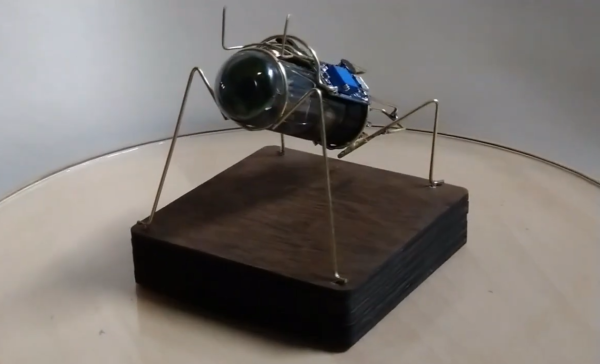
A circuit sculpture based on an indicator tube

“Buggy” Circuit Sculpture Based On A Tuning Indicator Tube

If you’ve ever used an old tube radio, you might be familiar with that mysterious little green display that helps you to tune exactly to a station. That display is called a tuning indicator, or magic eye tube; in essence it’s a minimalistic cathode ray tube that can sweep its electron beam along only one axis. It thereby outputs a kind of bar graph that varies with the input voltage.

With few modern uses other than being pretty, it only makes sense that these tubes find their way into works of art: [Patrice] used one to make an insect-like piece of circuit sculpture. The tube he used is an EM34, which is one of the most common indicator tubes around and has a circular, iris-like display area. This becomes a large eye, peering forward from the bug’s body. The legs are made from 1.5 mm thick brass wire, while a DC/DC converter generates the 210 Volts DC needed to operate the tube.

An interesting “touch” is the addition of two antennae that are hooked up in such a way that the tube’s image changes when you push them; this interactivity makes the bug come alive a little bit. Speaking of touch, we think it would be prudent to put some insulation around the 210 V wires; even though the bug is battery-powered, touching the high voltage and ground wires simultaneously would deliver a nasty shock.

Nevertheless, the bare-wire retro design looks beautiful and would make a great ornament for any electronics-lover’s office. We’ve seen magic eye tubes being used for various purposes: you can turn them into a spectrum analyzer, measure capacitors with them, or simply use them as a bar-graph display. Continue reading ““Buggy” Circuit Sculpture Based On A Tuning Indicator Tube”

Light-Tracking BEAM Robot Can See The Light

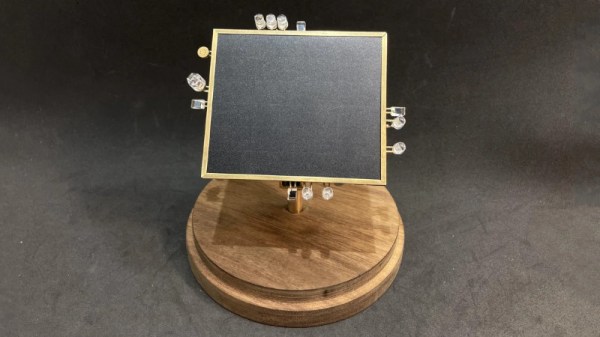
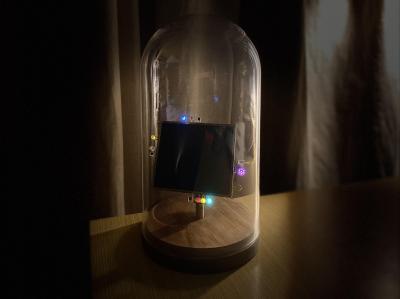
BEAM robotics, which stands for Biology, Electronics, Aesthetics, and Mechanics, is an ethos that focuses on building robots with simple analog circuits. [NanoRobotGeek] built a great example of the form, creating a light-tracking robot that uses no batteries and no microcontrollers.

The robot aims to track the brightest source of light it can see. This is achieved by feeding signals from four photodiodes into some analog logic, which then spits out voltages to the two motors that aim the robot, guiding it towards the light. There’s also a sound-detection circuit, which prompts the robot to wiggle when it detects a whistle via an attached microphone.

The entire circuitry is free-formed using brass wire, and the result is an incredibly artful build. Displayed in a bell jar, the build looks like some delicate artifact blending the past and future. Neither steampunk nor cyberpunk, it draws from both with its combination of vintage brass and modern LEDs.

It’s a great build that reminds us of some of the great circuit sculptures we’ve seen lately. Video after the break.

Continue reading “Light-Tracking BEAM Robot Can See The Light”

Circuit Sculpture Lamp Is A Colorful Cube Companion

Circuit sculpture is engineering and art all at play together. One must combine the functional with the aesthetically appealing. [EdwardA61] did just that with this enchanting lamp build.

Like many other circuit sculptures, the build relies on the aesthetic qualities of brass, though [EdwardA61] notes that copper wire can be used as well. Four WS2812B LEDs, in their bare PCB-mount form, are soldered into a circuit using the brass to carry the power and data signals as needed.

A Seeduino Xiao microcontroller is responsible for controlling the show, though relies on a typical PCB rather than a circuit sculpture in and of itself. It does provide for easy powering and programming however, with the benefit of its USB-C connector.

It’s a simple skeleton design, as so many circuit sculptures are, but it’s a form that we’ve come to love and appreciate. [EdwardA61] did a great job of photographing the build, too, showing how the colors on each LED interplay with each other as they’re cast on the table.

It’s a lamp we’d love to build ourselves, and we hope that [EdwardA61] follows through on plans to cast a similar design in clear resin, as well. If you’ve built your own artistically electrical sculptures, be sure to let us know!

The Tower, a discrete component circuit sculpture clock

A Breathtaking Circuit Sculpture Clock

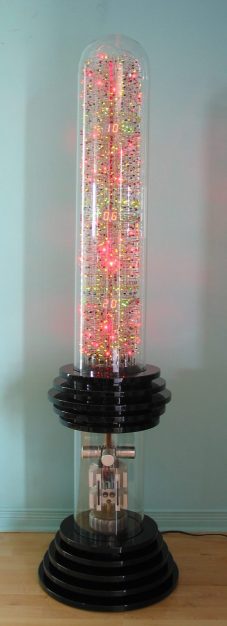
The Tower, a discrete component circuit sculpture clockHere at Hackaday, we pride ourselves on bringing you the very freshest of hacks. But that doesn’t mean we catch all the good stuff the first time around, and occasionally we get a tip on an older project that really should have been covered the first time around. This remarkable circuit sculpture clock is a perfect example of one that almost got away.

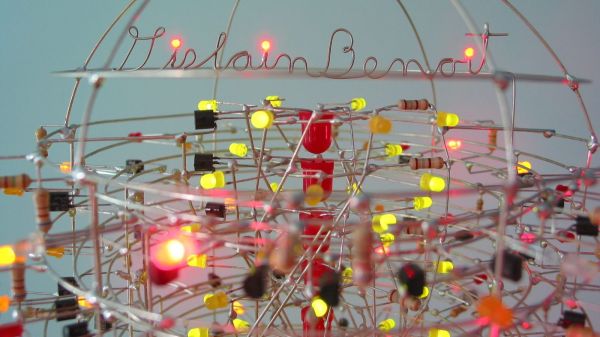
[Gislain Benoit] creation is called “The Tower” for good reason: it’s built inside what amounts to a giant glass test tube. Inverted and adorned with MDF discs, the Pyrex tube stands 5 feet (1.5 meters) tall, and is absolutely stuffed with electronic goodness. There are more than 2,100 discrete components mounted inside on a helical framework of carefully bent wires, forming a vertical sculpture that displays the time on three separate pairs of seven-segment displays. All the diode-transitor logic circuits are built from discrete components; nary a chip was used, and to spice things up, [Gislain] used LEDs in place of regular diodes everywhere in the circuit. The result is a constant light show as the clock goes through its paces.

The whole thing looks amazing, and even the power supply at the base works in the overall presentation. The design is a bit of a departure from [Gislain]’s previous circuit sculpture clock, but it’s just as beautiful, and equally as mind-boggling in terms of construction difficulty.

Thanks to [Maarten] for the belated tip on this one.

ddrysfeöd circuit art sound and light scultpture

Labyrinthian Circuit Sculpture Evokes Moods With Sound And Light

In a famous letter penned by Victorian era author Oscar Wilde, he wrote:

“Art is useless because its aim is simply to create a mood. It is not meant to instruct, or to influence action in any way. It is superbly sterile, and the note of its pleasure is sterility.” 

We can’t help but wonder if [Eirik Brandal] was evoking such Wilde thoughts when he wrote to tell us about ddrysfeöd, an electronic sound and light sculpture which he called “uselessly applied electronics.” Given the mood created by the video below the break, we have to agree that it is indeed quite artful. But if it serves a purpose to inspire and cause wonderment, is it really useless? Let the philosophers philosophize. On to the hack!

[Eirik] was himself inspired by mazes such as those found in children’s activity books and magazines whose goal is to keep a child busy challenged by drawing a solid line from start to finish. With these in mind, [Eirik] constructed ddrysfeöd as an intricate entanglement of electronics, metal, clear and mirrored acrylic, and plated steel, all flung into a three dimensional vortex.

ddrysfeöd circuit art sound and light scultpture
ddrysfeöd is at home evoking moods in the light as well as the dark.
LED’s of red and white oscillate in time with each other. Orchestrating the multimedia symphony is an ESP32, with one core relegated to dealing with the mundane functions of the sculpture while the other waves its electronic wand to keep the ensemble suitably arranged. LED’s are bored into the base, and the acrylic is sanded on the edges to diffuse the supplied light. The electronics run on the usual  +5 V, but a +12 V power supply gives volume to the LM380 audio amplifier. We also appreciated that [Eirik] expanded his skills on this project by using Sketchup to plan out the project, even printing the patterns for cutting and drilling the acrylic glass.

If [Eirik]’s build style looks familiar, it may be because you’ve seen it here on Hackaday’s Circuit Sculpture Contest, where some of his work was named Most Beautiful. You can also feast your eyes on a BEAM bot inspired pummer in the shape of a satellite. And remember, if you run across something that presses your buttons, let us know via the Tip Line!

Continue reading “Labyrinthian Circuit Sculpture Evokes Moods With Sound And Light”

Close up shot of a mechanical sequencer for 555 based synthesizers

Kinetic Synth-Kebab Sculpture Plays Punk Sequentially

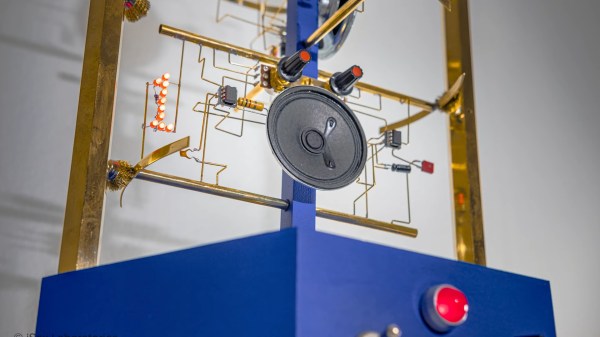
What’s better than an Atari Punk Console synthesizer? How about four Atari Punk Console synthesizers. And what better way to present them but as brass wire art sculptures. We’d have forgiven [iSax] if he’d stopped at four brass wire synths, but he took things to another level with his kinetic sculpture that does double duty as a mechanical sequencer. Called the Cyclotone – The Mechanical Punk Console Sequencer, it features wood, brass, brushes, and 555 timers. You can see the demonstration in the video below the break.

If you’re not familiar with the Atari Punk Console, it’s a circuit first described as a “Sound Synthesizer” in Forest Mims’ “Engineer’s Notebook: Integrated Circuit Applications” first published in 1980. It utilized two 555 timers in a single chip, the 556. Later dubbed the “Atari Punk Console”, the circuit has stood the test of time and is still quite popular among hackers of all sorts.

[iSax]’s build adds a sequencing element that allows the synths to be played automatically. The synthesizers are skewered 90 degrees from each other on a square dowel, which is turned at a variable RPM by a stepper motor controlled by a knob at the base of the sculpture.

On either side of each synth is a commutator that contacts salvaged rotary tool brushes which provide power through the hexagonal brass supports. Each synth retains its own speaker and controls and has its own segmented numeral displayed with discrete LED’s that light up when each synth is played.

We applaud [iSax] for a well executed and imaginative build that successfully meshes circuit scultpure, kinetic sculpture, classic electronics and even blinkenlights. If you enjoyed this build, you should also go have a look at a free form Atari Punk Console build and another one built into a joystick. If you come across a project of any kind that catches your fancy, be sure you let us know about it via the Tip Line!

Continue reading “Kinetic Synth-Kebab Sculpture Plays Punk Sequentially”