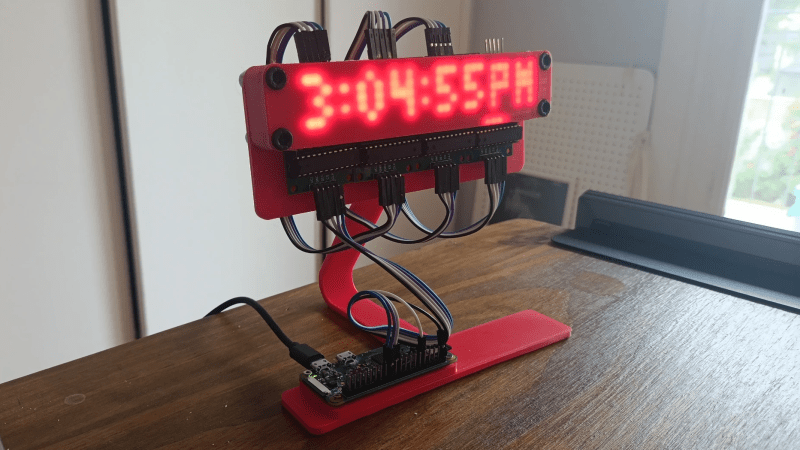
3D Printed Clock Just Taps It In

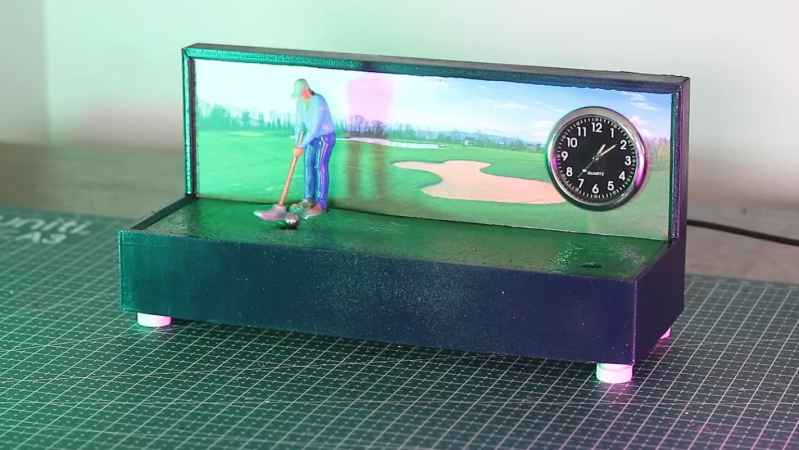
The famous cuckoo clock, with its moving, chirping mechanical bird indicating various divisions of time, has been around since at least the 1600s. The most famous of them come from the Black Forest area of Germany, and are still being made worldwide even today. Other clocks with different themes take their inspiration from the standard bird-based clocks from history, and thanks to modern 3D printing and other technologies we can make clocks with almost any type of hour indicator we’d like with relative ease like [Jason]’s golf clock.

While the timekeeping mechanism is a fairly standard analog clock, the hour indicator mechanism in this build is a small figure which putts a golf ball into a hole once every hour. It uses an ESP32-C3 at its core, which controls a pair of servos. One controls the miniature golfer, and the other lifts the ball up into position on the green at the appointed time. Once the ball is in place, the figure rotates, striking the ball towards the hole. Although it looks almost like the ball is guided by a magnet of some sort at first glance, the ball naturally finds its way into the hole by the topography of the green alone.

Almost all of the parts in this build are 3D printed, including the green, the golfer, the frame, and a number of the servo components. There’s also a small sensor that detects if the ball has actually made it into the hole and back to the lifting mechanism, and to that end there’s also a number of configurations that can be made in the software to ensure that the servos controlling everything all work together to putt the ball properly.

While not a cuckoo clock in the strict sense, we always appreciate a unique clock around here, but if you demand your clocks have ideological purity we’ll point you to this cuckoo clock built into a wristwatch.

Continue reading “3D Printed Clock Just Taps It In”

Every Ham Shack Needs A Ham Clock

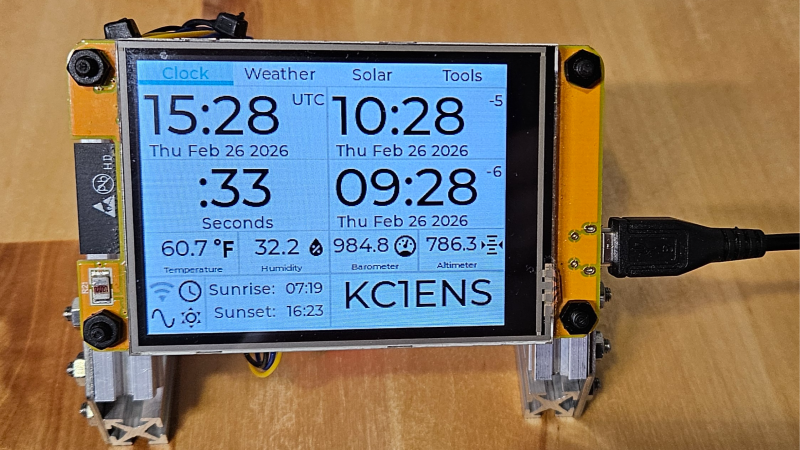
Every ham radio shack needs a clock; ideally one with operator-friendly features like multiple time zones and more. [cburns42] found that most solutions relied too much on an internet connection for his liking, so in true hacker fashion he decided to make his own: the operator-oriented Ham Clock CYD.

A tabbed interface goes well with the touchscreen LCD.

The Ham Clock CYD is so named for being based on the Cheap Yellow Display (CYD), an economical ESP32-based color touchscreen LCD which provides most of the core functionality. The only extra hardware is a BME280 temperature and humidity sensor, and a battery-backed DS3231 RTC module, ensuring that accurate time is kept even when the device is otherwise powered off.

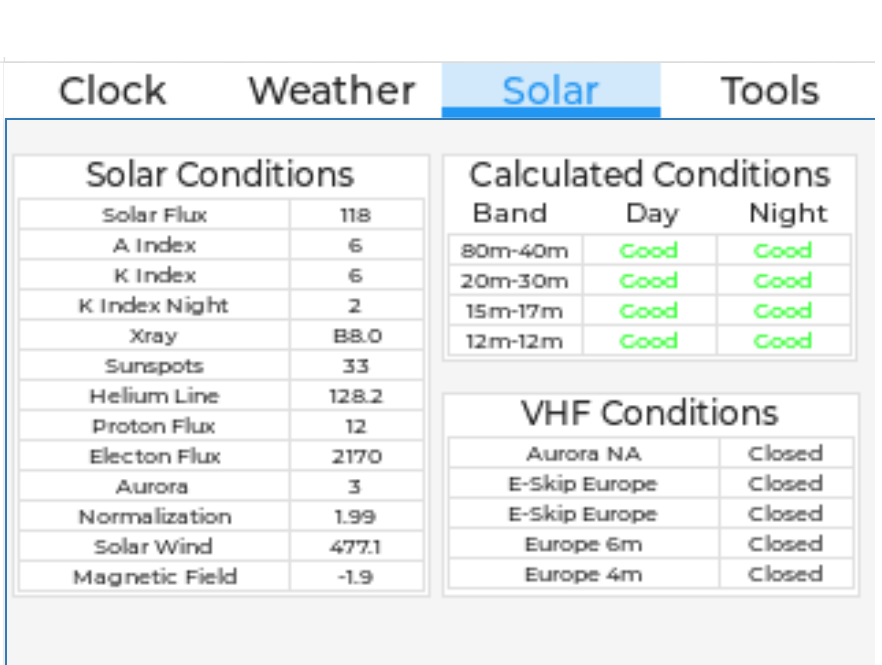
It displays a load of useful operator-oriented data on the touchscreen LCD, and even has a web-based configuration page for ease of use. While the Ham Clock is a standalone device that does not depend on internet access in order to function, it does have the ability to make the most of it if available. When it has internet access over the built-in WiFi, the display incorporates specialized amateur radio data including N0NBH solar forecasts and calculated VHF/HF band conditions alongside standard meteorological data.

The CYD, sensor, and RTC are very affordable pieces of hardware which makes this clock an extremely economical build. Check out the GitHub repository for everything you’ll need to make your own, and maybe even put your own spin on it with a custom enclosure. On the other hand, if you prefer your radio-themed clocks more on the minimalist side, this Morse code clock might be right up your alley.

There Are No LEDs Around The Face Of This Clock

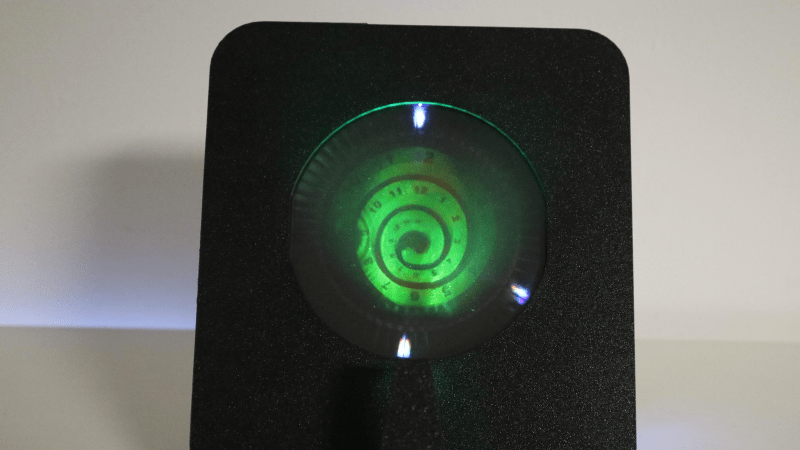
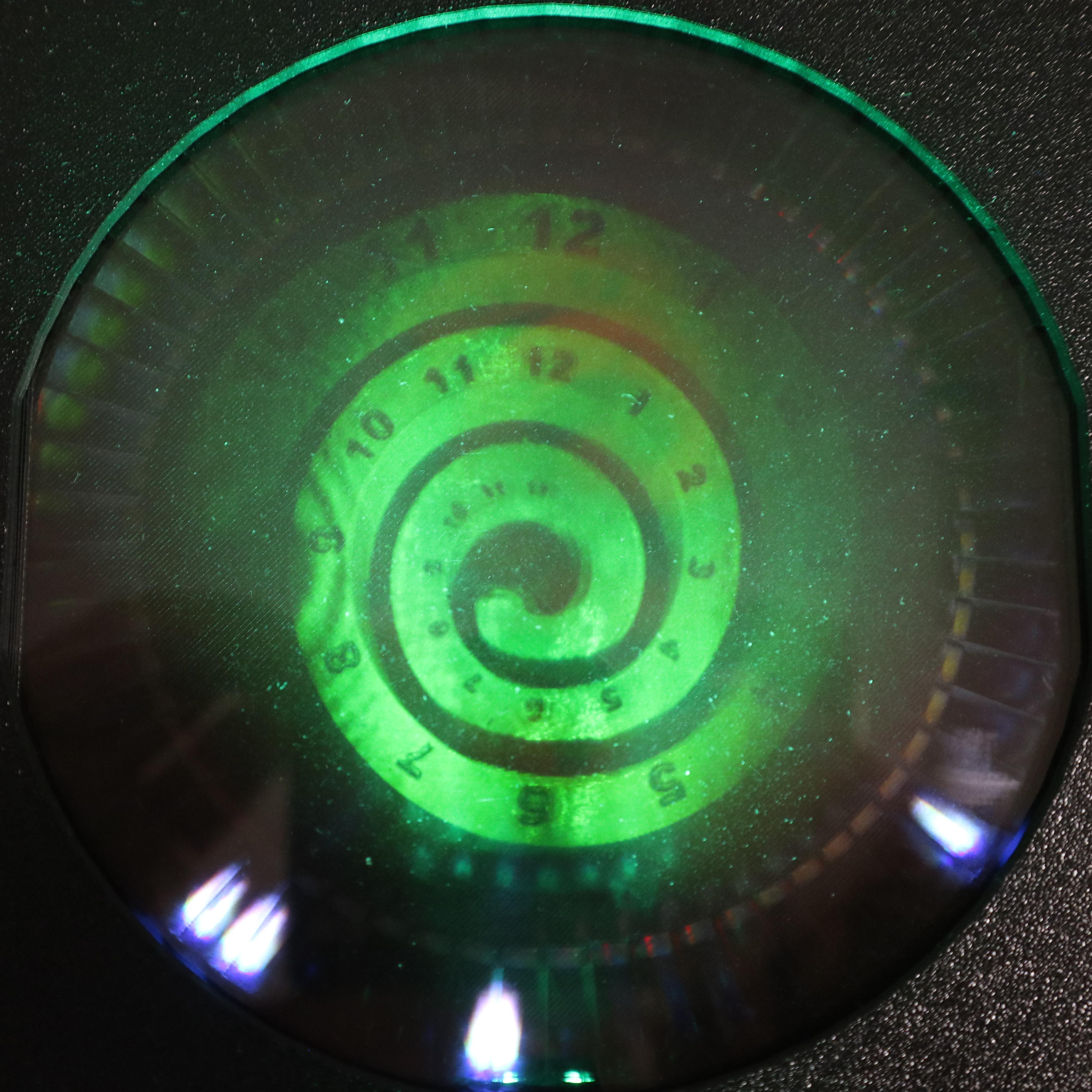
This unusual clock by [Moritz v. Sivers] looks like a holographic dial surrounded by an LED ring, but that turns out to not be the case. What appears to be a ring of LEDs is in fact a second hologram. There are LEDs but they are tucked out of the way, and not directly visible. The result is a very unusual clock that really isn’t what it appears to be.

The face of the clock is a reflection hologram of a numbered spiral that serves as a dial. A single LED – the only one visibly mounted – illuminates this hologram from the front in order to produce the sort of holographic image most of us are familiar with, creating a sense of depth.

The lights around the circumference are another matter. What looks like a ring of LEDs serving as clock hands is actually a transmission hologram made of sixty separate exposures. By illuminating this hologram at just the right angle with LEDs (which are mounted behind the visible area), it is possible to selectively address each of those sixty exposures. The result is something that really looks like there are lit LEDs where there are in fact none.

[Moritz] actually made two clocks in this fashion. The larger green one shown here, and a smaller red version which makes some of the operating principles a bit more obvious on account of its simpler construction.

If it all sounds a bit wild or you would like to see it in action, check out the video (embedded below) which not only showcases the entire operation and assembly but also demonstrates the depth of planning and careful execution that goes into multi-exposure of a holographic plate.

[Moritz v. Sivers] is no stranger to making unusual clocks. In fact, this analog holographic clock is a direct successor to his holographic 7-segment display clock. And don’t miss the caustic clock, nor his lenticular clock.

Continue reading “There Are No LEDs Around The Face Of This Clock”

Building A Super-Compact Cistercian Numerals Clock

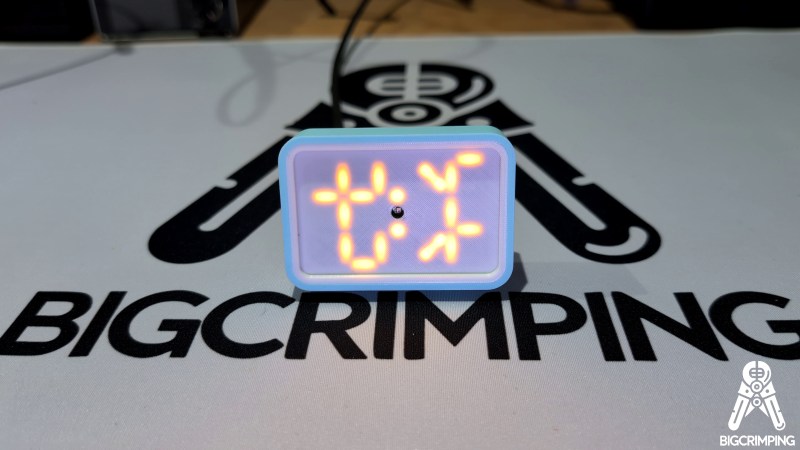
Around the thirteenth century CE, European society was in the midst between transitioning from Roman numerals to the Arabic numerals that we use today. Less remembered are the Cistercian numerals, which [BigCrimping] used for their most recent project in the form of a rather unique clock.

The Cistercian numeral system was developed by the Cistercian monastic order in the 13th century, forming a rather unique counterpoint to the Arabic numeral system. Although Arabic numerals are already significantly more compact than Roman numerals, Cistercian numerals up the ante by being capable of displaying any number between 1 and 9,999 with a single glyph.

Although for a simple 24-hour clock you don’t need to use more than a fraction of the possible glyphs, there is the complication of the Cistercian numerals not having a zero glyph, but that invites an even better take. For the version that [BigCrimping] made there are namely two glyphs that encode date and time, with the left glyph a counter for blocks of two hours and the right for seconds from 1 through 7200.

The clock is based around MAX6969 LED drivers and an ESP32 MCU on a custom PCB, with the design files including the 3D-printed enclosure available in the repository.

Continue reading “Building A Super-Compact Cistercian Numerals Clock”

Tech In Plain Sight: Projection Clocks

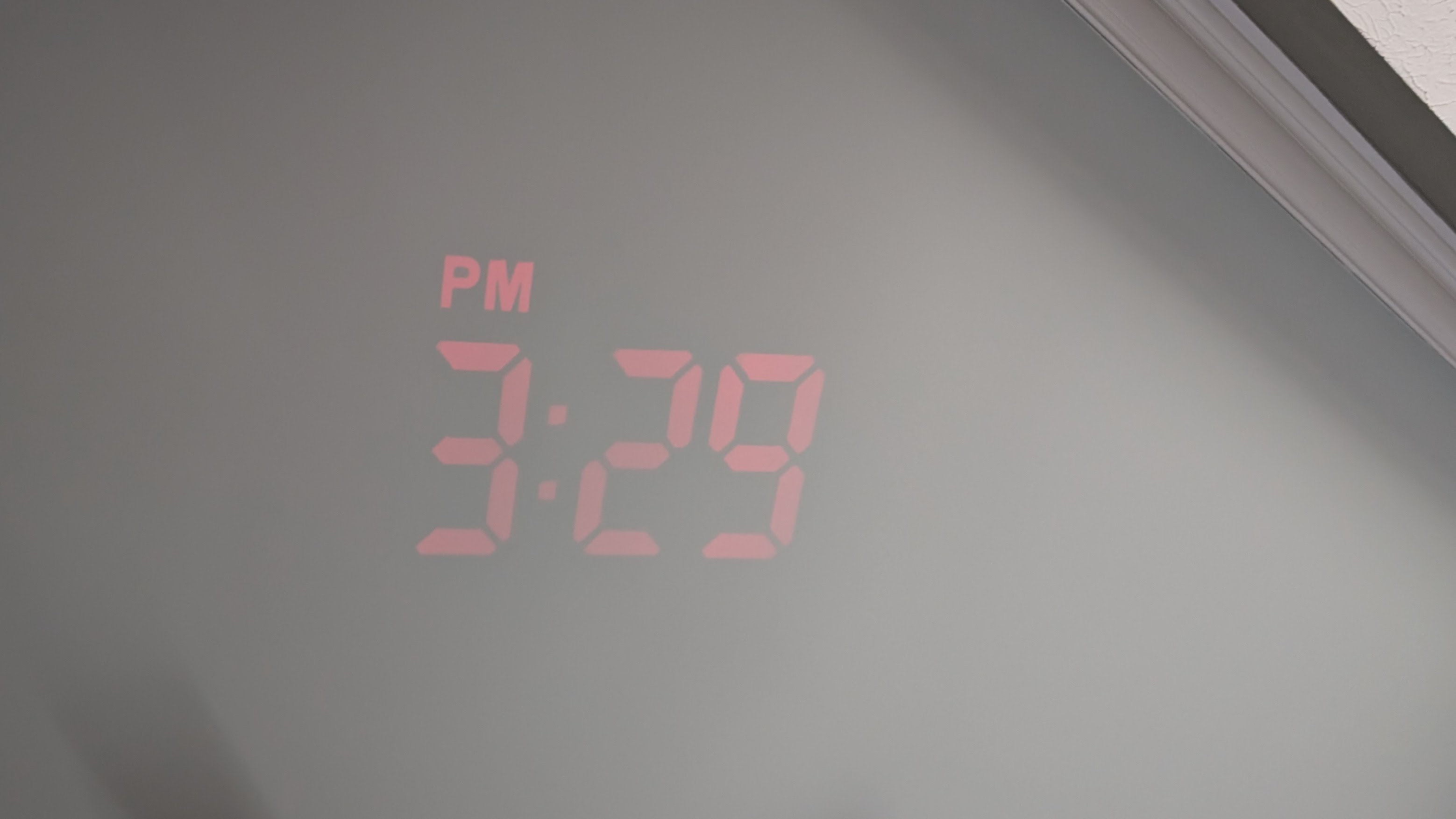
You wake up in the middle of the night. Is it time to get up? Well, you can look at the nightstand clock. Unless your partner is in the way. Whoops. Even then, without your glasses, the time is just a fuzzball of light. You could ask Alexa, but that’s sure to wake your partner, too. The answer is a projection clock. In its modern form, it shoots a digital time display on a wall or ceiling with digits so large that you don’t need your glasses. If you can see the ceiling, you can tell what time it is.

New Tech

A modern invention, of course. No, not really. According to [Roger Russel], a UK patent in 1909 used an analog clock face and lightbulbs to project the clock face and hands on the ceiling. Unfortunately, [Roger’s] website is no more, but the Wayback Machine is on the job. You can see a device of the same type at the British Museum.

A modern projection clock on the ceiling.

In 1938, [Leendert Prins] filed for a patent on a similar projection clock. Sometimes known as “ceiling clocks” or “night clocks,” these devices often have a regular clock visible as well as a way to project the time. In the old days, this was often an image of a translucent analog clock lit up by light bulbs. In the modern era, it is almost always either LEDs or an LCD with a halogen backlight. Of course, there are many variations. A clock might use numbers on a rotating drum with a lamp behind it, for example.

Development

It isn’t hard to imagine someone putting a pocket watch in a magic lantern as a prototype. In general, some bright light source has to pass through a condenser lens. The light then travels through the LCD or translucent clock face. Finally, a projector lens expands the image.

We couldn’t find much about the actual history of old projection clocks outside of [Roger’s] defunct website. But if you can project an image and build a clock, all you need is the idea to combine them.

Continue reading “Tech In Plain Sight: Projection Clocks”

Restoration Of Antique Clock With Unique Oscillator

The classic design of a mechanical clock generally consists of a display, a way to store energy, a way to release that energy at regular intervals, and a mechanism to transmit it where it needs to go. Most of us might be imagining a pendulum or a balance wheel, but there have been many other ways to maintain a reliable time standard with a physical object beyond these two common methods. This clock, for example, uses a rolling ball bearing as its time standard and [Tommy Jobson] discusses its operation in depth during a restoration.

The restoration of this clock, which [Tommy] theorizes was an amateur horological project even when it was new, starts by dismantling the clock nearly completely. The clock was quite dirty, so in addition to being thoroughly cleaned it also needed a bit of repair especially involving a few bent pins that stop the table’s rotation. These pins were replaced with stronger ones, and then everything in the clock’s movement was put back together. The tray carrying the ball bearing needed to be cleaned as well, and [Tommy] also added a lacquer to help preserve the original finish as long as possible. From there it was time to start calibrating the clock.

The ball bearing itself rolls back and forth along an inclined plane on a series of tracks. When it gets to the end it hits a lever which lets a bit of energy out of the movement, tilting the table back in the other direction to repeat the process. This is a much more involved process for getting an accurate time interval than a pendulum, so [Tommy] had a lot of work to do here. But in the end he was able to bring it back to life with an accuracy fairly close to a pendulum clock.

Ball bearings are a pretty popular medium for clock builds even in the modern era. This one uses them in a unique display, and a more recent version goes even further by using marbles to display digits directly.

Continue reading “Restoration Of Antique Clock With Unique Oscillator”

A Simple Desktop Pomodoro Timer

Pomodoro timers are a simple productivity tool. They help you work in dedicated chunks of time, usually 25 minutes in a sitting, before taking a short break and then beginning again. [Clovis Fritzen] built just such a timer of his own, and added a few bonus features to fill out its functionality.

The timer is based around the popular ESP32-S2 microcontroller, which has the benefit of onboard WiFi connectivity. This allows the project to query the Internet for things like time and date updates via NTP, as well as weather conditions, and the value of the Brazilian Real versus the American dollar. The microcontroller is paired with an SHT21 sensor for displaying temperature and humidity in the immediate environment, and an e-paper display for showing timer status and other relevant information. A button on top of the device allows cycling between 15, 30, 45, and 60 minute Pomodoro cycles, and there’s a buzzer to audibly call time. It’s all wrapped up in a cardboard housing that somehow pairs rather nicely with the e-paper display aesthetic.

If Pomodoro is your chosen method of productivity hacking, a project like this could suit you very well. We’ve featured a few similar builds before, too. Continue reading “A Simple Desktop Pomodoro Timer”