Air Conditioner Speaks Serial, Just Like Everything Else

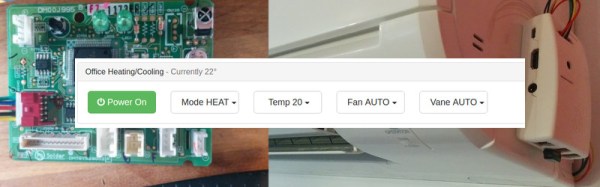
Like so many other home appliances, it’s likely that even your air conditioner has a serial interface buried inside it. If you’re wondering why, it’s because virtually every microcontroller on the planet has a UART built in, and it’s highly useful for debugging during the development process, so it makes sense to use it. Thus, it was only a matter of time before we saw a hacked airconditioner controlled by a Raspberry Pi.

[Hadley] was growing frustrated with the IR remote for his Mitsubishi air conditioner; it can issue commands, but it’s a one way interface – there’s no feedback on current status or whether commands are received, other then the occasional beep or two. Deciding there had to be a better way, [Hadley] grabbed a Saleae Logic Analyser and started probing around, determining that the unit spoke 5 V TTL at 2400 bps with even parity. The next step was to start talking back.

Continue reading “Air Conditioner Speaks Serial, Just Like Everything Else”

ESP-ing A Philips Sound System.

IoT-ifying old stuff is cool. Or even new, offline stuff. It seems to be a trend. And it’s sexy. Yes, it is. Why are people doing this, you may ask: we say why not? Why shouldn’t a toaster be on the IoT? Or a drill press? Or a radio? Yes, a radio.

[Dr. Wummi] just added another device to the IoT, the Internet of Thongs as he calls it. It’s a Philips MCM205 Micro Sound System radio. He wanted to automate his radio but his original idea of building a setup with an infrared LED to remotely control it failed. He blamed it to “some funky IR voodoo”.  So he decided to go for an ESP8266 based solution with a NodeMCU. ESP8266 IR remotes have been known to work before but maybe those were just not voodoo grade.

After opening the radio up, he quickly found that the actual AM/FM Radio was a separate module. The manufacturer was kind enough to leave the pins nicely labelled on the mainboard. Pins labelled SCL/SDA hinted that AM/FM module spoke I²C. He tapped in the protocol via Bus Pirate and it was clear that the radio had an EEPROM somewhere on the main PCB. A search revealed a 24C02 IC in the board, which is a 2K I²C EEPROM. So far so good but there were other functionalities left to control, like volume or CD playing. For that, he planned to tap into the front push button knob. The push button had different resistors and were wired in series so they generated different voltages at the main board radio ADC Pins. He tried to PWM with the NodeMCU to simulate this but it just didn’t work.

Continue reading “ESP-ing A Philips Sound System.”

Rust Running On The Realtek RTL8710: ESP8266 Alternative?

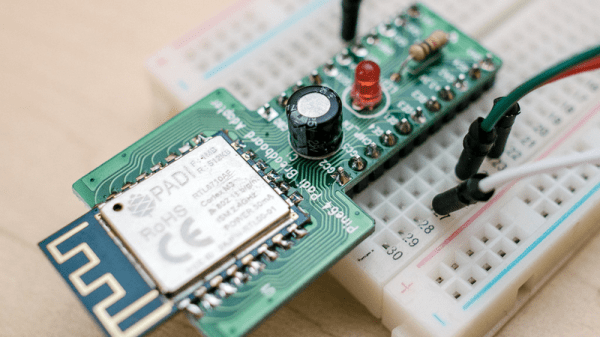
For simply getting your project connected to WiFi, a least among hacker circles, nothing beats the ESP8266. But it’s not the only player out there, and we love to see diversity in the parts and languages that we use. One of the big shortcomings of the ESP8266 is the slightly-oddball Xtensa CPU. It’s just not as widely supported by various toolchains as its ARM-based brethren.

And so, when [Zach] wanted to do some embedded work in Rust, the ESP8266 was out of the picture. He turned to the RTL8710, a very similar WiFi module made by Realtek. Documentation for the RTL8710 is, at the moment, crappy, much as the ESP8266 documentation was before the hacker community had at it. But in trade for this shortcoming, [Zach] got to use the LLVM compiler, which supports the ARM architecture, and that means he can code in Rust.

In the end, the setup that [Zach] describes is a mix of FreeRTOS and some of the mbed libraries, which should be more than enough to get you up and running fairly painlessly on the chip. We’ve actually ordered a couple of these modules ourselves, and were looking to get started in straight C, but having Rust examples working doesn’t hurt, and doesn’t look all that different.

Is anyone else using the RTL8710? An ARM-based, cheap WiFi chip should be interesting.

SST Is A Very Tidy ESP8266 Smart Thermostat

The smart thermostat has become in a way the public face of the Internet of Things. It’s a demonstration that technological uptake by the general public is driven not by how clever the technology is, but by how much use they can see in it. A fridge that offers your recipes or orders more eggs may be a very neat idea, but at street level a device allowing you to turn your heating on at home before you leave work is much cooler. Products like Nest or Hive have started to become part of normal suburban life.

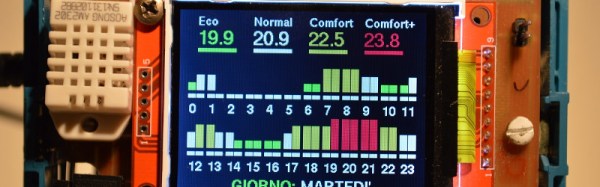
There is no reason though for an IoT thermostat to be a commercial product like the two mentioned. Our subject today demonstrates this; SST is a Wi-Fi smart thermostat using an ESP8266 that can be controlled by an app, thanks to its use of the open-source Souliss IoT Framework.

The build is very well finished, with PCBs, colour display and other components in a neat 3D-printed box. It’s a project that you could put in front of an end-user, it’s finished to such a high standard. Physical entity files are available from the hackaday.io page linked above, while its firmware is available in a GitHub repository. THere is a video showing some of the device’s capabilities, which we’ve put below the break.

Continue reading “SST Is A Very Tidy ESP8266 Smart Thermostat”

IoT-ifying An Old LED Signboard

Scrolling LED signs were pretty keen back in the day, and now they’re pretty easy to come by on the cheap. Getting a signboard configured for IoT duty can be tricky, but as [kripthor] shows us, it’s not that bad as long as security isn’t your top concern and you can tweak a serial interface.

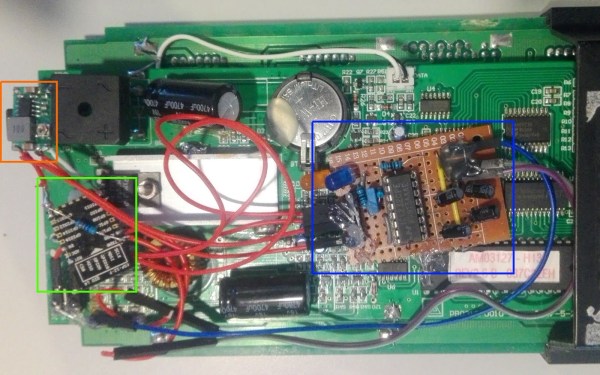
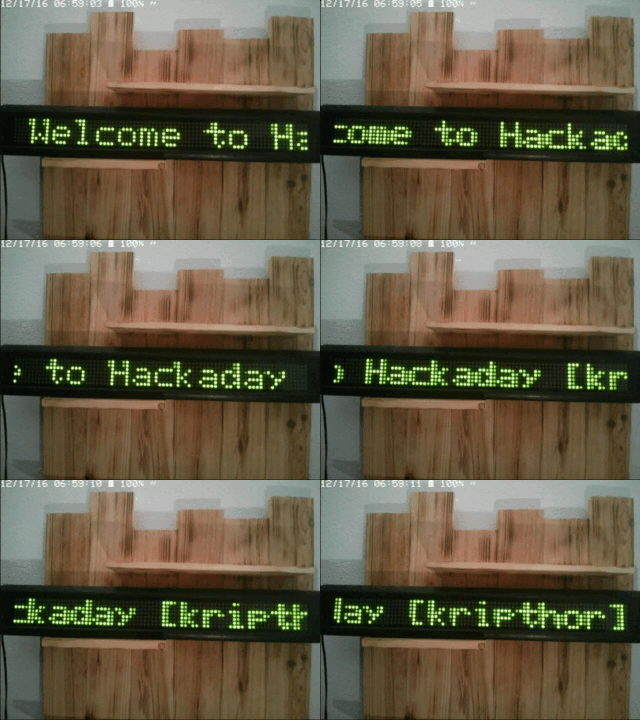
dec-16-2016-10-57-pm-edited[kripthor] chanced upon an Amplus AM03127 signboard that hails from the days when tri-color LEDs were the big thing. The unit came with a defunct remote thanks to leaking batteries, but a built-in serial interface offered a way to connect. Unfortunately, the RS-232 standard on the signboard wants both positive and negative voltages with respect to ground to represent the 1s and 0s, and that wouldn’t work with the ESP8266 [kripthor] was targeting. The ubiquitous MAX-232 transceiver was enlisted to convert logic levels to RS-232 signals and a small buck converter was added to power the ESP. A little scripting and the signboard is online and ready for use and abuse by the interwebz — [kripthor] says he’ll regret this, but we’re pleased with the way the first remote access turned out. Feel free to check out the live video feed and see what the current message is.

Personally, we don’t have much use for a signboard, but getting RS-232 devices working in the Arduino ecosystem is definitely a trick we’ll keep in mind. If asynchronous serial protocols aren’t your strong suit, you might want to check out this guide to what can go wrong by our own [Elliot Williams].

These Ornaments Measure Christmas Cheer

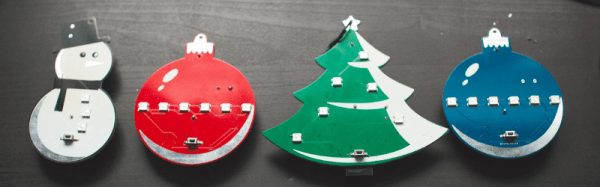
The ornament projects we post around here tend to be simple, stand-alone projects. We are, however, well into the era of the Internet of Things (like it or not) and holiday ornaments need not be single, unconnected blinking objects. For Christmas this year, [Sean Hodgins]  came up with some connected DIY ornaments that respond to Christmas cheer.

[Sean Hodgins] had some beautiful PCBs done up in festive shapes and he hand-pastes and oven-solders the SMD components on both sides. Each one is battery powered and controlled by an ESP8266. LEDs and a button on the front of each ornament comprise the user interface. When the button is pressed, data is sent to a Phant server and a “Christmas Cheer” counter is incremented. Other ornaments, so long as they can connect to the Phant server, will periodically check the counter. If the Christmas Cheer has increased, the ornaments will play a tune and flash some lights.

The ornaments are open-source — [Sean Hodgins] posted the code and PCB designs on GitHub. They look great, and would be a good way to let people know you’re thinking of them over the holidays. Check out this light-up menorah or these lighted acrylic ornaments for more holiday fun!

Continue reading “These Ornaments Measure Christmas Cheer”

Interactive ESP8266 Development With PunyForth

Forth is one of those interesting languages that has a cult-like following. If you’ve never looked into it, its strength is that it is dead simple to put on most CPUs, yet it is very powerful and productive. There are two main principles that make this possible. First, parsing is easy because any sequence of non-space characters makes up a legitimate Forth word. So while words like “double” and “solve” are legal Forth words, so is “#$#” if that’s what you want to define.

The other thing that makes Forth both simple and powerful is that it is stack-based. If you are used to a slide rule or an HP calculator, it is very natural to think of “5+2*3” as “5 2 3 * +” but it is also very simple for the computer to interpret.

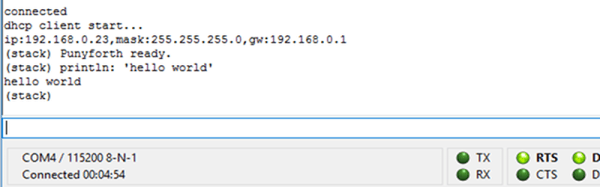
[Zeroflag] created PunyForth–a Forth-like language for the ESP8266. You can also run PunyForth for cross development purposes on Linux (including the Raspberry Pi). The system isn’t quite proper Forth, but it is close enough that if you know Forth, you’ll have no trouble.

Continue reading “Interactive ESP8266 Development With PunyForth”