USB Ableton Foot Controller Reuses Old Keyboard

footLooper2

No, Hackaday hasn’t started advertising shoes, this is [Matlek’s] foot controller for Ableton Live.

Matlek plays guitar and needed an easy way to control Ableton Live, which he uses as a looper. Ableton normally expects keyboard input, so that’s exactly what he gave it.

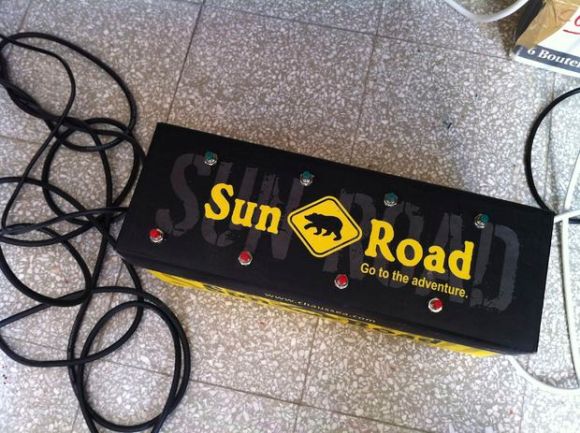
An old dell keyboard was gutted down to its controller board. This exposes  the leads the keyboard uses to scan the key matrix.  From there it is simply trial and error connecting different pins together and seeing which keys are printed on the PC screen (A text editor works well for this). Only 8 characters are needed to control the looper, so [Matlek] chose digits 1-8.

Since some of the wires are going to be sharing pins, a small piece of stripboard comes in handy between the buttons and the keyboard controller. [Maltek] used basic momentary push buttons for his mini key matrix, though we think that box looks sturdy enough to support some larger stomp box style buttons.

Everything comes together inside a sturdy shoebox, which also serves to insulate the exposed keyboard PCB from shorting out.

The only major downside to the project is that the box is light enough that it slides easily on the floor when recording or triggering loops. Adding some heavy items (or dare we say, some shoes) would solve this problem. Self adhesive rubber feet on the bottom of the box would help too.

Continue reading “USB Ableton Foot Controller Reuses Old Keyboard” →
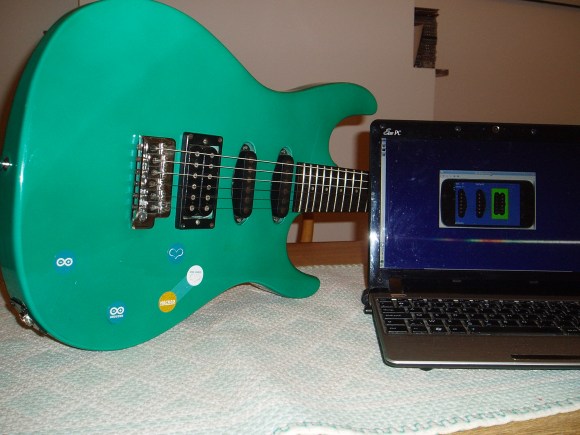
ArduGuitar, An Arduino Controllable Guitar

The ArduGuitar

Electric guitars have several switches and potentiometers for controlling volume, tone, and which pickups are enabled. Rather than fiddling with these by hand, [Bob] built the ArduGuitar. It uses an Arduino to control the parameters over Bluetooth. This allows for musicians to configure presets, then recall them as needed, providing the exact same sound every time. It’s similar to the Guitarduino, but adds wireless control.

The internals of the ArduGuitar consist of the Arduino Micro, a BlueSMiRF from Sparkfun, and resistive opto-isolators. The resistive opto-isolators allow the Arduino to adjust resistance through an electrically isolated barrier. This prevents the Arduino from interfering with the guitar’s sound.

Some of the first Vactrols were used to create a tremolo effect in guitar amplifiers. These pulsed a incandescent lamp onto a photoresistor. Fortunately, there are now integrated solutions. PerkinElmer makes these, and they have a nice application note [PDF] on audio applications.

The final part of the design is an Android app, which provides remote control over Bluetooth. The source for everything is available on Github, and the detailed build log is available here.

Cheap Guitar Amp Repaired By Replacing The Distortion Circuit

cheap-amp-distortion-repair

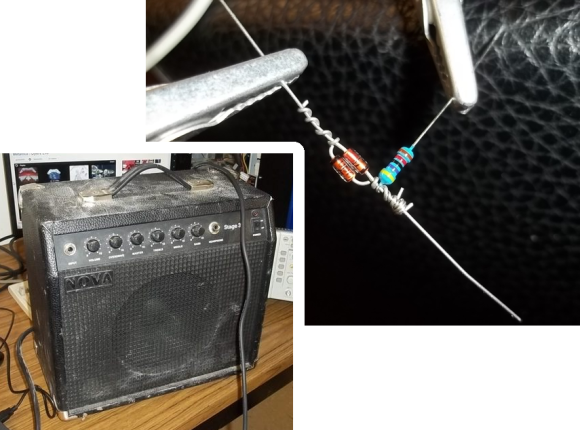
It’s an understatement that [Troy] is not impressed with the distortion circuitry built into this guitar amp. He picked it up for $40 on Kijiji (basically local classified ads run by eBay) so he wasn’t afraid to get elbow deep in its inner workings to see what was going on. It only took him a few minutes to solder together the distortion circuitry that fixed it. Figuring out what needed fixing is another story.

[Troy] uses some colorful language and metaphors to illustrate his disdain for the sound of the overdrive option. He hooked it up to an oscilloscope and his trained eye immediately tells him that it’s not working as it should. After studying the PCB and working out a schematic he reworked the circuit with this pair of diodes and a resistor. It still uses a bit of filtering on the board, but does away with all of the other cruft. What remains is a cheap amp, but one that actually functions.


[Update] Vladimir’s Robot Guitar

vladGuitar2013

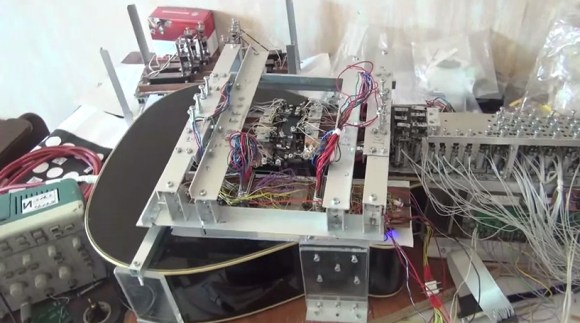
[Vladimir Demin] is somewhat of a legend for us; in his spare time he’s been mastering the automation of musical instruments. This time he’s back with upgrades to his build and four new videos. [Vladimir’s] top priority was to rework the strumming mechanism that earlier ran on solenoids. He’s improved the sound quality and reduced the clicks by swapped to stepper motors and overhauling the software.

Compared to his earlier setup, this one sounds more soulful and less automated, but [Vladimir] admits that it’s still not good enough and that he’s working on a new, brilliant implementation. Until then, take a few minutes and check out the rest of the videos below, then join us in scratching our heads in amazement: everything is built with simple hand tools.

[Vladimir] has come a long way, and it started with this Bayan (button accordion). Last year’s guitar build is also worth a look, as well as an in-depth interview.

Continue reading “[Update] Vladimir’s Robot Guitar” →

Making A Real Instrument Out Of A Kaoss Pad And Ribbon Controllers

swinger

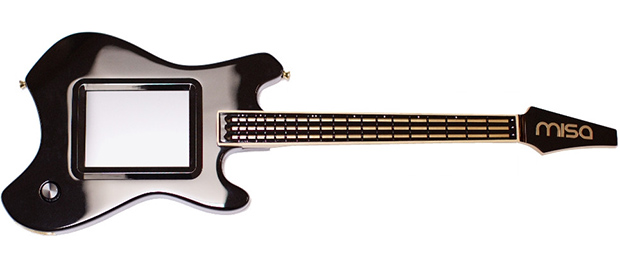
MIDI guitars have been around since the 80s, and nearly without exception they are designed as direct, one-to-one copies of their acoustic and electric brethren. [Michael] has been working on turning this convention on its head with the Misa Tri-Bass, a MIDI guitar designed to be the perfect guitar-shaped synthesizer interface.

The tri-bass doesn’t produce any sound itself; instead, it’s a polyphonic MIDI controller with three channels controlled by three ribbon controllers on the neck. The body contains a huge touch screen divided into four MIDI channels, essentially turning this guitar into an instrument designed for electronic music first, and not an acoustic instrument kludged into filling an electronic role.

Unlike a whole lot of other digital guitar-shaped MIDI controllers, the tri-bass is actually made out of wood. Yes, the neck is made out of maple (inlaid with the three ribbon controllers, of course), and the body comes directly from a tree, with the styling inspired by a forgotten retro-modern design. It’s an impressive piece of kit, and we can’t wait to see [Michael]’s handiwork in the hands of digital guitarists the world over.

You can check out a video of [Michael] rockin out below.

Continue reading “Making A Real Instrument Out Of A Kaoss Pad And Ribbon Controllers” →

FLAMEnco Guitar

flamenco

[John] says, “I noticed an unfortunate lack of many flamethrower guitars on the web so I filled the need. ” That’s just awesome by us.

This series of guitar-mounted flamethrowers started with a small build, able to shoot a six-foot flame for about 40 seconds. Yes, very theatrical, but not something you’d want to change out after every song. From there the builds progressed to systems with more barrels, more fuel tanks, and a huge system that shoots 18-foot long flames colored with standard pyrotechnic supplies.

It should go without saying that this stuff probably isn’t something you should try at home. That being said, you really have to admire the craftsmanship and tenacity to make a guitar mounted flamethrower. Just don’t bring it to an indoor gig.

Continue reading “FLAMEnco Guitar” →

From Maple And Spruce To An Archtop Guitar

archtop

While the violin maker gets most of the acclaim and prestige for turning lumber into musical instruments, you can’t deny the sheer beauty and grandeur of a jazz-style archtop guitar. Much larger than a violin or viola, the scale of a guitar can still lend itself to the exacting artistry of a master luthier, while adding some interesting engineering challenges not found in smaller stringed instruments.

Last year, [Bert van der Meij] built an archtop guitar for his daughter by following the bible written by a modern master, [Robert Benedetto]. The build began by sourcing huge blocks of quartersawn maple and spruce, carefully carving the spruce for the top and the maple for the back. The neck is made of three laminated strips of maple, carefully contoured with only hand tools.

In [Bert]’s video, there’s some interesting examples of the tools used in the creation of this fine instrument. Instead of carving the inside and outside of the top independently, [Bert] only carved the top and used a drill press set to a certain depth to rough out the back. With only a minimum of planing, this ensures the top has a constant thickness with a minimum of work.

The end product is  a fine enough instrument to find its way onto the stage of any jazz club, as shown in a demo video of a few different musicians rocking out. A magnificent piece of work, and a wonderful gift to [Bert]’s daughter.