High-Speed Pocket Hot Dog Cooker

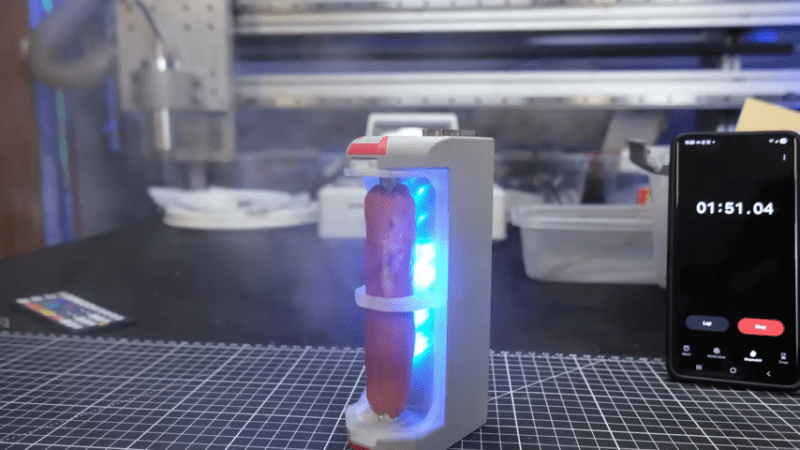
Few of us complain that hot dogs take too long to cook, because we buy them from a stand. Still, if you do have to make your own dog, it can be a frustrating problem. To solve this issue, [Joel Creates] whipped up a solution to cook hot dogs nearly instantaneously. What’s more, it even fits in your pocket!

The idea behind this build is the same as the classic Presto hot dog cooker—pass electricity through a hot dog frank, and it’ll heat up just like any other resistive heating element. To achieve this, [Joel] hooked up a lithium-polymer pack to a 12-volt to 120-volt inverter. The 120-volt output was hooked up to a frank, but it didn’t really cook much. [Joel] then realized the problem—he needed bigger electrodes conducting electricity into the sausage. With 120 volts pumping through a couple of bolts jammed into either end of the frank, he had it cooked in two minutes flat.

All that was left to do was to get this concept working in a compact, portable package. What ensued was testing with a variety of boost converter circuits to take power from the batteries and stepping it up to a high enough voltage to cook with. That, and solving the issue of nasty chemical byproducts produced from passing electricity through the sausages themselves. Eventually, [Joel] comes up with a working prototype which can electrically cook a hot dog to the point of shooting out violent bursts of steam in under two minutes. You’d still have to be pretty brave to eat something that came out of this thing.

The biggest problem with hot dogs remains that the franks are sold in packs of four while buns are sold in packs of six. Nobody’s solved that problem yet, except for those hateful people who inexplicably have eleven friends. If you solve that one, don’t hesitate to notify the tipsline. Don’t forget, either, that the common hot dog can make for an excellent LED tester. Video after the break.

Continue reading “High-Speed Pocket Hot Dog Cooker”

2025 Component Abuse Challenge: Dawg Gone LED Tester

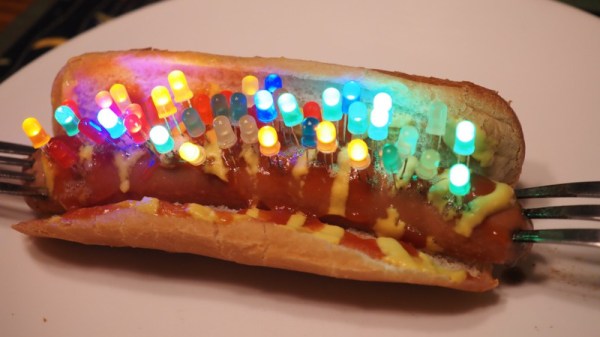
The Hackaday 2025 Component Abuse Challenge is all about abusing electronic components in the service of making them do things they were never intended to. It’s not the 2025 Food Abuse Challenge, so in the case of [Ian Dunn]’s hot dog pressed into service as an LED tester, we’ll take the ‘dawg to be a component in its own right. And by any measure, it’s being abused!

Cooking hot dogs by passing an electric current through them has a long and faintly hazardous history to it — we’re sure we’ve heard of domestic hot dog cooker appliances that are little more than the mains supply on a pin at each end of a hot dog shaped receptacle. This one takes the ‘dawg in a bun with condiments, no less, and sticks an ordinary table fork wired up to the grid in each end. The LED testing is the cherry on the cake, because he simply sticks a pile of LEDs by their pins into the tasty sausage. It forms a crude potential divider, so there’s about enough volts across the gap between pins to light it up nicely.

We like this project on so many levels, though we’re not sure what heavy metals would leach out of those LED pins into the meat. If it’s inspired you to do something similar you still have a few days in which to enter the contest, so break out your convenience food and a pile of parts, and start experimenting!

Ham Almost Cooks ‘Dog

For those of us licensed in other countries it comes as something of a surprise to find that American radio amateurs now have to run RF exposure calculations as part of their licence requirements. [Ham Radio Crash Course] as approached this in a unique fashion, by running around 800 watts of 6-metre power into a vertical antenna festooned with hotdogs. That’s right, this ham is trying to cook some ‘dawgs! Is his station producing dangerous levels of power that might cook passers-by?

Of course, aside from a barely-warmed line along where the ‘dogs were attached to the antenna there’s no heating to be found. But we think he’s trying to make the point in the video below the break about the relative pointlessness of applying RF field limits which are definitely relevant at much higher frequencies, to hams at low frequencies.

It leaves us curious as to how that 800 watts could be efficiently transferred into the sausages and really cook them. Strapping them to a vertical is we think the equivalent of strapping anything resistive to a conductor, they do not form a significant  enough part of the circuit. We think that even six metres could cook a sausage if it could be efficiently coupled into it, so we’d suggest putting a grounded sausage up the middle of a close-wound helix.

If you have any thoughts on the RF exposure calculations, or on the best way to cook a ‘dog with 6m, we’d love to hear the, in the comments. Meanwhile, this isn’t the first piece of ‘dog-based shenanigans we’ve brought you.

Continue reading “Ham Almost Cooks ‘Dog”

Homemade SawStop Attachment Is Just About As Sketchy As It Sounds

TL;DR — when [Colin Furze] is your “safety inspector,” you really should be reconsidering your project goals.

Most of us have probably by now seen the SawStop brand of self-stopping table saw, which detects when something meatier than wood has the bad taste to touch the spinning blade, more or less instantly stopping it and preventing sudden traumatic amputations. It’s an outstanding idea, and we’d love to see the technology built into all table saws. But alas, SawStop saws are priced out of reach for many woodworkers, which left [Ruth Amos] to roll her own DIY version of the system.

It should be stated right off the bat that none of what [Ruth] does here is a good idea, and that everything shown is really just a proof of concept. The basis for her build was a somewhat flimsy-looking contractor-style saw, to which [Ruth] attached an Arduino set up to detect when something conductive touches the blade. She shares no particulars on the sensing method, but our guess is capacitive coupling. She then sets about experimenting with a series of above-table gizmos to arrest the blade, with limited success, plus all the attachments would make the saw essentially useless. But working above the table does make sense in the prototyping phase, and allowed her to figure out what wouldn’t work.

In the end, it was an electromagnetic clutch from an electric lawnmower that seemed to do the trick, albeit at the expense of heavy mods to the saw and a considerable increase in the system’s angular momentum. Nonetheless, the blade stops pretty close to instantly in the old hot dog test. It doesn’t drop the blade below the table, of course, and the hot dog is a little worse for the wear, but it’s still pretty impressive.

We’ve discussed SawStop’s technology before and why it isn’t perhaps as widely available as it should be, if you’re curious.

Continue reading “Homemade SawStop Attachment Is Just About As Sketchy As It Sounds”