Hackaday Links: January 5, 2014

hackaday-links-chain

While we can’t condone the actual use of this device, [Husam]’s portable WiFi jammer is actually pretty cool. It uses a Raspberry Pi and an Aircrack-ng compatible dongle to spam the airwaves with deauth packets. The entire device is packaged in a neat box with an Arduino-controlled LCD and RGB LEDs. Check out an imgur gallery here.

You can pick up a wireless phone charger real cheap from any of the usual internet outlets, but try finding one that’s also a phone stand. [Malcolm] created his own. He used a Qi charger from DealExtreme and attached it to a 3D printed phone stand.

A while back, [John] noticed an old tube radio in an antique store. No, he didn’t replace the guts with a Raspberry Pi and an SD card full of MP3s. He just brought it back to working condition. After fixing the wiring (no ground cord on these old things), repairing the speaker cone, putting some new twine on the tuner and replacing the caps, [John] has himself a new old radio. Here’s a video of the complete refurbishment.

Here’s a Sega Master System (pretty much a Game Gear) running on an STM32 dev board. Also included are some ROMs for some classic games – Sonic the Hedgehog, Castle of Illusion, and The Lion King. If you have this STM Discovery board you can grab the emulator right here.

[Spencer] wanted a longer battery life in his iPhone, so he did what any engineering student would do: he put another battery in parallel.

Breadboarding something with an AVR or MAX232? Print out some of these stickers and make sure you get the pinouts right. Thanks, [Marius].

Google Glass Hack For Apple Fanboys Can Be Had Right Now

google-glass-for-apple-iphone

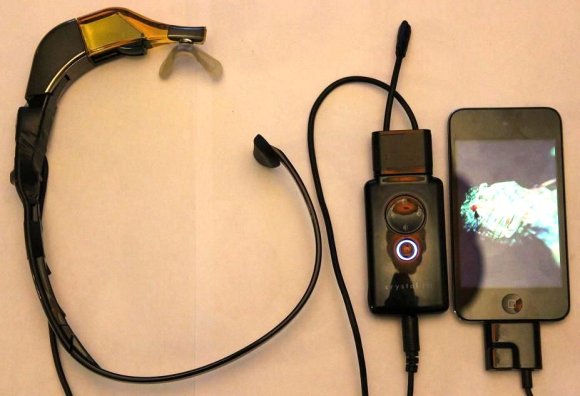
If you’re a follower of Apple hardware the upcoming Google Glass release probably doesn’t interest you much. But the concept is universally cool. If you want to have your own one-eyed voice-activated computer running iOS, then this is the hack for you. [John] calls it the Beady-i, and posted a step-by-step article on how he put it together.

The headpiece is shown on the left. It’s a combination of a pair of glasses with projection screens built-in, and a gaming headset. [John] cut off one of the lenses, and removed the remaining arm of the glasses. That arm was replaced with the frame of a gaming headset, which now wraps around the back of his neck to make sure the lopsided display isn’t going to fall off.

By combining the electronics from both the glasses and the headset, and terminating the connections with a docking plug he’s got what he was after. The lens displays what is shown on the screen, and the gaming headset lets him hear the device’s sound in one ear and register input using the microphone.

Laser Etching An IPhone 5

Laser Etched iPhone 5

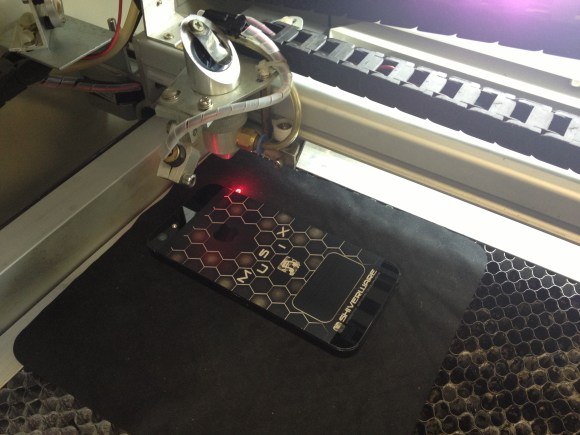
CrashBangLabs in Regina recently got their hands on a laser cutter. The Full Spectrum cutter was donated by a local company, who were upgrading to a larger machine.

With no laser cutting experience, [Brett] decided that his first project would be laser engraving his iPhone 5. This is a bit of an ambitious first project, since the power and speed would have to be set correctly to get a good contrast level, and you only have one try to get it right. Also, using too much power might have turn the phone into a laser etched brick.

[Brett] used an older aluminium iPod for testing. Once the laser speed and power was dialed in, he loaded up the artwork for the real thing. The cutter did a pretty good job at etching the art, but as the etching started it became clear that an alignment error had occurred. Fortunately [Brett] decided to not interrupt the cutter, and ended up with a good looking phone, with a slight alignment issue.

After the break, check out a time lapse of the laser cutter doing its thing.

Continue reading “Laser Etching An IPhone 5”

Pinoccio Web Rover

web-rover

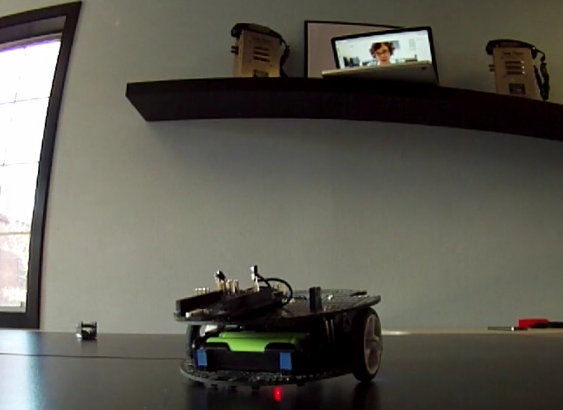
Before assuming that the title should be “web crawler,” just shush your shussins’ and check out the video after the break. The Pinoccio, as previously noted, is a board in development as a sort of web-enabled by default Arduino. This makes it perfect for a project like this one where a little rover is controlled from 10,000 Kilometers away, or around 6000 Miles for those of us that dwell in the US.

This setup uses a cell-phone accelerometer in Brazil to allow control of this robot in Nevada. Although close, the control isn’t quite real time, so that has to be accounted for. Something like this could be easily used for a telepresence ‘bot.

If you want to build your own, the assembly time is estimated at 1 hour. Instructions, as well as source code can be found on their page after the video. Although the Pinoccio board won’t be available until at least this summer, maybe this will give someone inspiration to try something similar in the mean time! Continue reading “Pinoccio Web Rover”

Simple IPhone Telescope Mount

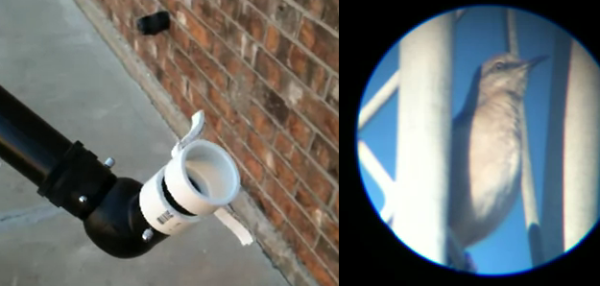
This cheap and easy hack will let you use your old smart phone to take pictures and videos of the view through a telescope. [Xobmo] built the connector for just 55 cents. Apart from our concerns about scratching the lens when inserting the phone in the bracket we love the idea.

He was given the Celestron Powerseeker 70AZ as a gift from his wife last Christmas. He looked around the Internet and saw that there are already some solutions for recording video using an iPhone 3GS. This design on Thingiverse would be perfect, but he doesn’t have access to a 3D printer and ordering it form a service would cost almost $50. But when he got to thinking about it, all he needed was a ring to fit on the telescope and a way to connected the iPhone to it. He headed down to the hardware store and picked up a PVC coupler. After working with a hack saw and drill he ended up with a slot with two wings on it. Just slip the phone in and slide the ring on the eyepiece. You can see some action shots, and get a look at the mount itself, in the clip after the break.

Continue reading “Simple IPhone Telescope Mount”

Bluetooth Control For Your DSLR Or Just About Any Other IR Operated Device

Just the other day we were reading a Reddit thread asking about how to control a television with a smartphone. The conversation started by talking about adding an IR LED to the phone.  Then it was suggested that there should be standalone Bluetooth devices that convert commands to IR, and came around to the ideas that TV’s should ship with native Bluetooth hardware. We couldn’t agree more but we’re also not about to replace our TV just for this option. That’s why we were delighted to find this project waiting on our tip line. It’s a method of controlling a camera shutter from a smartphone using Bluetooth. But the technique will work for any device which uses an infrared remote control.

The video after the break shows two different devices controlling the camera shutter. As you can see in the diagram above, the iPhone is the master controller, connecting to a Bluetooth headset mounted on the camera. That headset was altered to feed the speaker connections into an IR LED pointed at the camera’s receiver. The iPhone plays an encoded audio track matching the IR remote command, resulting in the properly formatted message flashing on the LED. The watch doesn’t have the ability to playback audio, but it can send a message to the phone, which then plays the proper audio track through the headset.

Continue reading “Bluetooth Control For Your DSLR Or Just About Any Other IR Operated Device”

IPhone Hack Isn’t Sold By Adafruit

light-up-iphone

[Becky] wrote in to tell us about her latest hack for Adafruit Industries. This hack will allow you to light up the Apple symbol on the back of your phone, and as she notes, it will definitely void your warranty. From the looks of the video, it requires some extremely good soldering skills, and optionally mid-level tape skills. If you’re up to the challenge, and have the stomach to see your iPhone on the operating table, the results are quite good.

One other challenge of doing this hack is that it uses a kit that Adafruit isn’t going to sell since it uses knock-off Apple parts. They exist somewhere, but where to source them would be a challenge. On the other hand, from a purely experimental/engineering point of view, the video after the break is quite interesting. Many of us would be very hesitant to take apart a several hundred dollar phone, much less solder to a power supply on it!

Continue reading “IPhone Hack Isn’t Sold By Adafruit”