
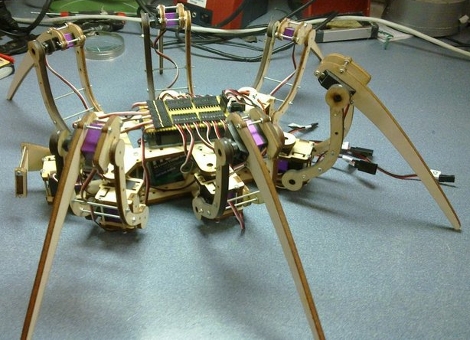
SpiderBot Prompts Laser Envy

[Daniel’s] horrifying hexapod makes us wish we were sitting next to a laser cutter. The parts are cut from 4.9mm plywood and include laser-sculpted sections to allow the twenty servos to properly seat in their mounting spaces. We would suggest that you build it in secret so as not to ruin the surprise when your house mates come home to find this romping around their room.

Sadly, we couldn’t find video of this in action but go look at this other hexapod if the still shots aren’t good enough. Adding two legs to the party, you behold the video after the break of the 8-legged spider milled from ABS.

Continue reading “SpiderBot Prompts Laser Envy”

Phaser-to-laser Mod Puts Out 465mW

Here’s another Star Trek phaser toy with a laser added. [Jay] started with a 1994 Star Trek phaser and added a 12X Blu-Ray diode. The sound effects of the toy still work, a nice touch that you can check out in the video after the break. That video shows him popping balloons with the laser, a feat made possible by the 465 mW that it puts out when the diode is driven at 320 mA of current. He’s made a nice carrying case for the weapon but we didn’t see a spot in there for protective glasses like we’ve seen with other phaser hacks. He did make one safety consideration by adding a safety switch and indicator LED to signal when the laser diode is armed.

Continue reading “Phaser-to-laser Mod Puts Out 465mW”

Laser-cut Puzzle Box

One of our fondest memories from the 1980’s is watching Magnum P.I. on television. Higgins, Magnum’s employer, had a puzzle box that Magnum could never figure out how to open. Now you can laser cut a puzzle box for yourself and recreate some scenes from television’s glory days.

The design for the box pictured above is not new. The plans for the Cubey 2 project have been around for a while but relied on your mad-woodworking-skills to turn out the pieces. Since we’re not great with a chisel we were happy to see vector graphic and encapsulated postscript files to robotically aid in production. Once the puzzle parts have been assembled a facade is adhered onto each side to hide the pieces. This means you can go for Higgins’ traditional puzzle-box look or sport the hellraiser.

Arduino Security With Frickin’ Laser

[over9k] used his Arduino to set up a laser trip wire. The laser is mounted along side the Arduino, reflects off of a mirror, and shines on a photoresistor that interfaces via a voltage divider. The signal from the voltage divider is monitored for a change when the laser beam is broken. [over9k] set things up so that a webcam snaps a picture of the intruder and Twitters the event for easy notification. Video after the break walks through each of these steps.

This build is a bit rough around the edges but unlike other laser trip wires this keeps all the electronics in one place. The laser interface could be a bit more eloquent, and we’re wondering just how much current it is pulling off of the Arduino pins. But if you’re bored and have this stuff on hand it will be fun to play around with it. Continue reading “Arduino Security With Frickin’ Laser”

Laser Harp

[Jared] had a bunch of lasers left over from a previous project that he put to use by producing this laser harp. The look of it reminds us of a very small Koto or perhaps an Autoharp (although the chords can’t be changed on this model).

We’re so glad that [Jared] spent the time to produce such a fine looking body for the instrument. The strings that would traditionally produce the sound on a harp have been replaced with laser diodes shining at Cadmium Sulfide photo resistors. When a beam of light is broken, an Arduino detects the change via the CdS cell and plays a sound through an Altec Lansing speaker inside of the case.

Unfortunately there’s no video available but we’re pretty sure it makes a “pew-pew” sound. There is a link to download the source code but it points to the overview page instead of downloadable code. From the fritzing diagram the CdS cells are part of a voltage divider which provides digital logic to the Arduino. That should be pretty easy to replicate even without seeing [Jared’s] code and we’re sure you can source other Arduino instrument projects for tips on wave shield or midi functionality.

[Thanks The Cheap Vegetable Gardener]

Scan Room, Explore Virtually

[Patrick] directed us to his project for alternate realism. The final goal is to be able to walk around in a space wearing a head mounted display, exploring a virtual representation of that space. This virtual representation could be altered, stylized, augmented and modified in countless ways. It is an exploration in perception, similar to enjoying different styles of painting, we could enjoy different styles of viewing a real space. Currently, it isn’t quite real time. He has to scan a room with a somewhat bulky device, then plug into his display to explore it. Being able to scan quickly and reliably enough shouldn’t be far off. [Patrick] notes that others have done almost real time scans at home already.

Set Phasers To “blind”

enterprise-phaser-pistol

[Directive0] added a 200mW laser to his Enterprise Phase Pistol toy. This joins the ranks of hand-held laser hacks that we’ve seen around here lately. His build makes use of the stun and kill settings of the toy to switch between different modes. The built-in 9 volt battery holder is tapped into for power. When set to stun, the stun LED indicator is illuminated and a trigger pull sends current limited electricity to the laser diode. When the kill (or blind) setting is selected, the appropriate LED is illuminated and the trigger sends the full current from the battery to the laser diode. Power regulation is managed by the driver circuit for the laser.

This build preserves the unmodded look of the toy gun. [Directive0’s] inclusion of protective glass should fend off the warnings we usually see in the comments of these types of hacks.









