Building DIY BlinkM Clones

ghetto_pixels

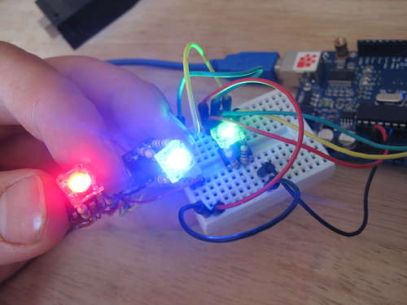
If you are planning on using more than a handful of BlinkMs in a project, you will likely find that their $15 price tag quickly adds up. Instructables user [jimthree] found himself in that position and opted to create his own homebrew version of a BlinkM instead. He calls his creations “Ghetto Pixels”, and while they might not look as professional as the real thing, they get the job done just the same.

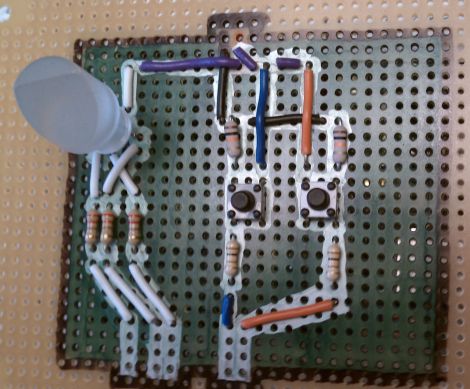
He bought a batch of RGB LEDs online for under a dollar apiece, pairing them with ATTiny45s that he scored for about $1.50 each. [imthree] popped his uCs into a programmer, flashing them with an open-source BlinkM firmware clone called CYZ_RGB. He then prototyped his circuit on some breadboard, adding the appropriate resistors to the mix before testing out the LEDs. When he was confident everything was working correctly, he assembled Ghetto Pixels deadbug-style.

When everything was said and done, they came together in a pretty compact package comparable to that of the BlinkM. As you can see in the video below, they work great too!
Continue reading “Building DIY BlinkM Clones”

Twitter Notifier Lets Us Know How Awesome We Are

twitter_notifier

Let’s admit it, you’re just a little bit vain. Heck, we’re all just a little bit vain when you really think about it. Instructables user [pdxnat] was self-absorbed enough that he constructed an LED “mood light” that alerts him each time someone mentions his user name on Twitter.

The build is pretty simple, with most of the work being done on his PC. His Arduino is wired to a simple RGB LED that calmly cycles through various colors until someone mentions his name on Twitter. At that point, the client software running on his PC passes a message to the Arduino over a serial interface, causing it to wildly pulse the LED. Once it catches his eye, he stops the alert cycle with the press of the reset button, returning the LED to its previous state. As a bonus, he decided to write the Twitter-polling application in both Processing and Python, enabling fans of either language to easily replicate his work.

It’s a pretty cool idea, and it would be great to see someone expand it to include other online services to provide a greater overall feel for how awesome they really are.

Keep reading to see a quick video of the notifier in action.

Continue reading “Twitter Notifier Lets Us Know How Awesome We Are”

Turning Spotlights Into Soft LED Nightlights

led_spotlight_retrofit

[Bob] had a couple of bright, 12V halogen spotlights in his hallway that didn’t get much use. Rather than toss them out or leave them sitting idle, he decided to replace the bright bulbs with dimmer LEDs that he could keep lit through the night.

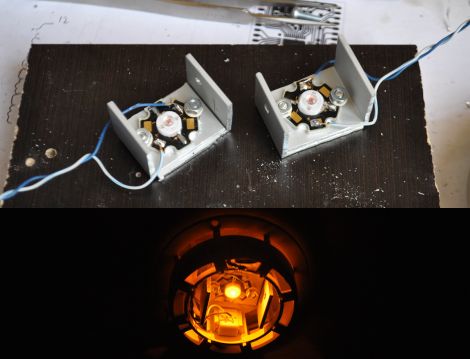
He opened up the spotlights, removing the bulbs and the built in mirrors before fitting them with 350mA LED pucks. The pucks were mounted to a pair of L-shaped aluminum scraps, which serve as both a mounting plate and heatsink. When running, the underdriven LEDs barely heat the aluminum plates, so he is pretty confident that the lights are adequately cooled.

The orange LEDs provide a nice warm glow in his hallway, and he says they are perfect for late night trips to the fridge. They currently stay lit all the time, but [Bob] is considering adding a light sensor to turn them on them automatically, as well as a PIR sensor to increase the brightness as someone passes by.

The Infrared Graduation Cap

It’s graduation time for many high schoolers, and while many students would love to decorate their caps, administration generally looks down upon this practice. [Victor], however, thought of a way around this.

The human eye cannot see infrared light, but camcorders generally can. Putting these two concepts together with a couple of infrared LEDs, [Victor] was able to make a cap that displayed his decoration in everyone’s “digital memory”, but wouldn’t be detected until the video of the offense was displayed. Hopefully by the time the prank is detected, [Victor] will have successfully graduated and presumably gone on to other pursuits.

An ATmega 168 controls this hat to display his message, “Congratulations Class of 2011,” in Morse code. What a creative use of both old and new technology to pull off an awesome graduation prank. Be sure to check out the video after the break to see how everything was put together. Continue reading “The Infrared Graduation Cap”

Disco Isn’t Dead: Diy Dance Floor Spotted At Student Parties

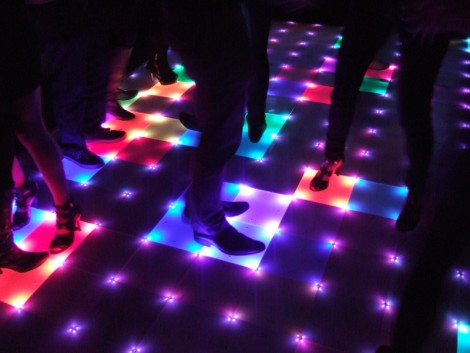
Your party is lame if it doesn’t include interactive blinking lights on the dance floor. [Mario] and [Lukas] didn’t want to have lame parties, so they enlisted some fellow students to build an interactive dance floor (translated). The finished party-piece is 4 meters by 2.5 meters (that’s about 13’x8′ for us yanks) and includes 160 lighted squares. But it’s the electronics that really make this a heavy project.

Milled into the underside of the pressboard base are a series of pockets and channels to hold various components. If you look hard enough, you’re going to find eight AVR microcontrollers which control the LEDs, 8 CPLDs to manage the weight sensors which make the floor interactive, and an FPGA and embedded computer to tie everything together. It’s movable, a hit at parties, and so far it seems to hold up to the occasional spilled beverage.

You can’t share a project like this without some video. See it after the break.

Continue reading “Disco Isn’t Dead: Diy Dance Floor Spotted At Student Parties”

Hackaday Links: Monday June 13

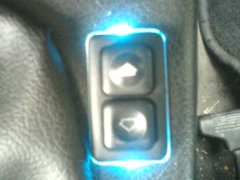
Tim wrote in to tell us about this simple hack where he replaced the stock button lights with some really cool Blue LEDS on an ’87 BMW. He uses some capacitors, to achieve the effect that it takes a bit for the charge to drain out so the lights stay on for a bit after being turned off.  The lights themselves look really nice, so check out the pic.

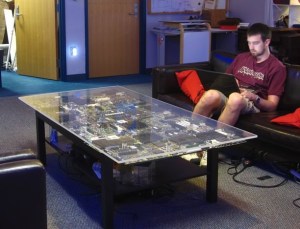
Here’s an awesome coffee Table built using a large electrical board. It definitely would look good in anyone’s den, although it most likely has a low wife approval factor (WAF). This is actually based on a “motherboard wall that HAD covered before, but the “coffee table” form probably looks even better.

Finally, after the break is a video of someone washing an interactive art exhibit. Not sure if it qualifies as a hack, but it looks pretty cool to see lights following someone around when he’s washing the screen/window.

Continue reading “Hackaday Links: Monday June 13”

Hacking Cakes With LEDs, The Sequel!

A few weeks back we ran a piece about the convergence of making and baking in an attempt to create a cake festooned with working LEDs. The moral was that not every creative idea ends in victory, but we applauded the spirit it takes to post one’s goofs for the whole internet to see and to learn from.

[Craig]’s LED matrix proved unreliable…and the underlying cake didn’t fare much better, resembling that charred lump in the toaster oven in Time Bandits. The cakes-with-lights meme might have died right there if not for a fluke of association…

Continue reading “Hacking Cakes With LEDs, The Sequel!”