Intruder Alarm McDonald’s Toy Hacking

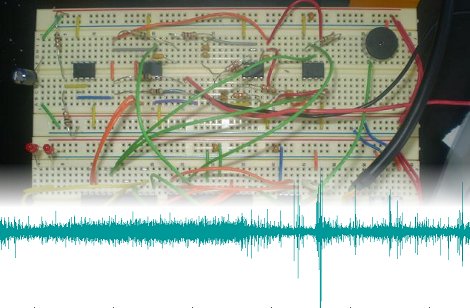
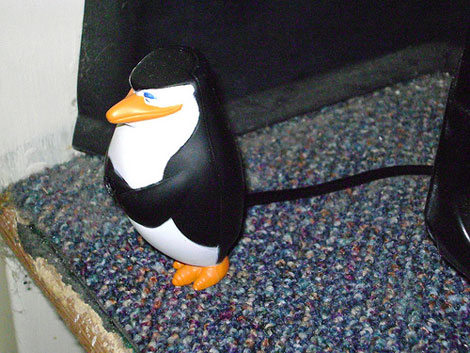
[malikaii] needed to set up some kind of tripwire style alarm system for his office. His bosses kept sneaking in to find him slacking. So, like any loyal hacker, instead of just working harder he built an alarm system. After a failed attempt to recreate an IR alarm circuit he found on the web and built from old appliance parts, he found the Hack a Day article about harvesting McDonald’s toys. The end result was a fully functional IR detecting alarm for the office doorway. This is pretty simple really, the best kind of hack.
Flash Animations On Peggy2.0

[vimeo=http://vimeo.com/10453715]

The LED display toy known as the Peggy2.0 just keeps getting cooler and cooler.  [Leonard] is now sharing with us how we can stream flash animations to one. It requires some Java and an Arduino, but the final effect is quite fluid and responsive. We’ve seen the Peggy grow from basically an electronic litebright to doing video and even being chained together to make larger displays.

[via EMSL]

LED Lighting, A Learning Experience

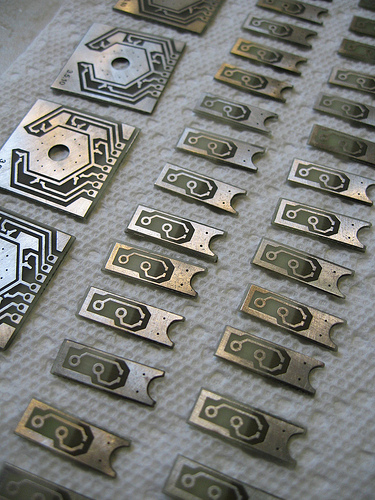
[Joel] has a very specific color temperature of lighting he wants in his home. So specific, he’s decided to build his own LED lighting to get it. Actually, he’s still searching for that perfect shade of white, but doing so has learned a lot.  He initially made some very pretty PCBs, but then found that hand soldering them made quite a mess. What better time to delve into reflowing? He shares his positive initiation to the skillet method in his latest update. The search still continues for that nice warm glow he’s desiring. We’ve actually seen [Joel] before, he likes smoked meat.

Woot How-to: Let There Be Light! (for Your Rovio)

Before we get into the how-to, we felt it would be appropriate to explain a little bit about how this came to be. As many of you may remember, a couple of months ago we attended CES 2010. While there, we also attended the It Won’t Stay in Vegas Blogger party and ended up meeting the guys from Woot. After all of us spent a little bit of time appreciating the open bar, a group of us stood ended up standing around and talking shop for a while. All of a sudden, a member of our group, Jeremy Grosser, proposed the idea that Hackaday and Woot form a partnership. Basically, they would give us a heads up on what they are going to sell and we would write up a how-to on how to do something cool or useful with that product. Then, when the day came for Woot to sell the product, we would post our how-to. What you are reading right now just so happens to be that idea in action, the first official partnership between Hackaday and Woot. In this how-to, we’ll be taking apart the Wowwee Rovio mobile webcam robot, adding some super-bright LEDs for better see-in-the-dark action, and see how some software called RoboRealm can give it a little bit of artificial intelligence.

Continue reading “Woot How-to: Let There Be Light! (for Your Rovio)”

LEDs Invade Coffee Table Crevice

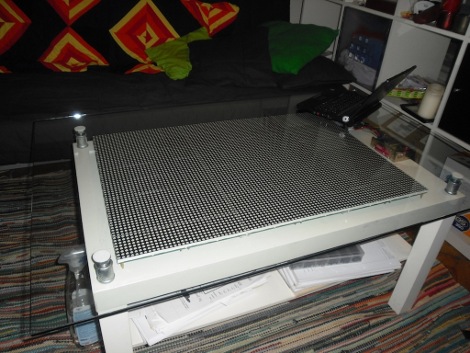
That’s a lot of LEDs, and a little bit of glass cleaner. [Tobias] spiced up his IKEA coffee table by adding 6144 LEDs. This is a larger realization of SparkFun’s LED coffee table which used 64 8×8 modules. [Tobias] sourced three display boards from Sure Electronics for a total of 96 8×8 modules. These boards are addressed through a serial interface; four serial lines for each board but a shared data bus for each of the row select pins and the data/latch/clock pins.  This method uses 19 of the 20 pins on the Arduino that drives the display. After the break you can see a demonstration. If this is more than you need there’s always the 112-LED and 81-LED table projects that can produce a full color range. Continue reading “LEDs Invade Coffee Table Crevice”

Dr. Boardman’s Color Conundrum

We feel like trumpets should be sounding. Someone took the overused project of connecting RGB LEDs to a microcontroller and produced something useful. [Paul] created Dr. Boardman’s Color Conundrum which works much like a simple mechanical coin-op game you might find at a carnival. When switched on, a random color is displayed by the ping-pong ball covered LED on the left. The player then manipulates three knobs to color-match the two lights.

Inside you’ll find a minimalist set of hardware. An ATmega8 polls the three potentiometers and uses them to mix the appropriate user color. Everything is wired-up using prototyping board and draws power from two AA batteries. He’s using a random seed stored in EEPROM and increments it every time the uC boots up. This keeps the input color different for every game.

Fun and simple, it’s not going to make your guests marvel at the complexity but [Paul’s] come up with a unique game that we think has marketing potential.

Lucid Dreaming

When we saw [merkz] use of an Arduino to produce lucid dreaming we were quite shocked. Unlike typical setups that just flash a light through sleep, his system monitors eye movement through electrodes and is able to send the data to a computer for graphing and analyzing.  The only problem being we couldn’t find a circuit diagram or code.

Not ones to be shot down so quickly, a Google revealed this thread on making ‘Dream Goggles’, which was really a Brain-Wave Machine based on the parallel port. Some modifications of an ECG collector’s electrodes using sound cards, and you could have your own lucid dreaming.

[Thanks Phil]