Silicon-Based MEMS Resonators Offer Accuracy In Little Space

Currently quartz crystal-based oscillators are among the most common type of clock source in electronics, providing a reasonably accurate source in a cheap and small package. Unfortunately for high accuracy applications, atomic clocks aren’t quite compact enough to fit into the typical quartz-based temperature-compensated crystal oscillators (TCXOs) and even quartz-based solutions are rather large. The focus therefore has been on developing doped silicon MEMS solutions that can provide a similar low-drift solution as the best compensated quartz crystal oscillators, with the IEEE Spectrum magazine recently covering one such solution.

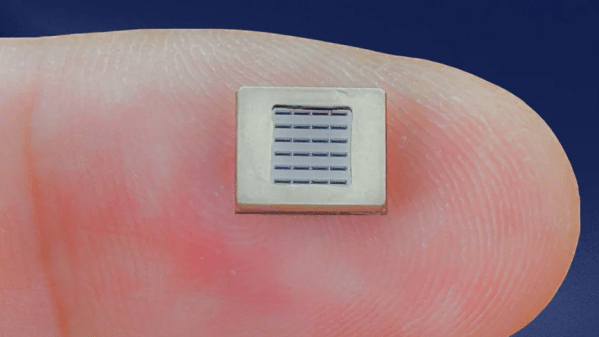
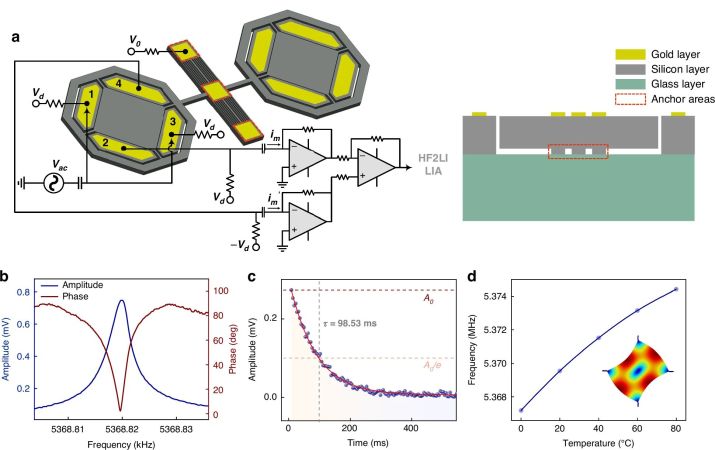
Part of the DARPA H6 program, [Everestus Ezike] et al. developed a solution that was stable to ±25 parts per billion (ppb) over the course of eight hours. This can be contrasted with a commercially available TCXO like the Microchip MX-503, which boasts a frequency stability of ±30 ppb.

Higher accuracy is achievable by swapping the TCXO for an oven-controlled crystal oscillator (OCXO), with the internal temperature of the oscillator not compensated for, but rather controlled with an active heater. There are many existing OCXOs that offer down to sub-1 ppb stability, albeit in quite a big package, such as the OX-171 with a sizable 28×38 mm footprint.

With a MEMS silicon-based oscillator in OXCO configuration [Yutao Xu] et al. were able to achieve a frequency stability of ±14 ppb, which puts it pretty close to the better quartz-based oscillators, yet within a fraction of the space. As these devices mature, we may see them eventually compete with even the traditional OCXO offerings, though the hyperbolic premise of the IEEE Spectrum article of them competing with atomic clocks should be taken with at least a few kilograms of salt.

Thanks to [anfractuosity] for the tip.

Your Noisy Fingerprints Vulnerable To New Side-Channel Attack

Here’s a warning we never thought we’d have to give: when you’re in an audio or video call on your phone, avoid the temptation to doomscroll or use an app that requires a lot of swiping. Doing so just might save you from getting your identity stolen through the most improbable vector imaginable — by listening to the sound your fingerprints make on the phone’s screen (PDF).

Now, we love a good side-channel attack as much as anyone, and we’ve covered a lot of them over the years. But things like exfiltrating data by blinking hard drive lights or turning GPUs into radio transmitters always seemed a little far-fetched to be the basis of a field-practical exploit. But PrintListener, as [Man Zhou] et al dub their experimental system, seems much more feasible, even if it requires a ton of complex math and some AI help. At the heart of the attack are the nearly imperceptible sounds caused by friction between a user’s fingerprints and the glass screen on the phone. These sounds are recorded along with whatever else is going on at the time, such as a video conference or an online gaming session. The recordings are preprocessed to remove background noise and subjected to spectral analysis, which is sensitive enough to detect the whorls, loops, and arches of the unsuspecting user’s finger.

Once fingerprint patterns have been extracted, they’re used to synthesize a set of five similar fingerprints using MasterPrint, a generative adversarial network (GAN). MasterPrint can generate fingerprints that can unlock phones all by itself, but seeding the process with patterns from a specific user increases the odds of success. The researchers claim they can defeat Automatic Fingerprint Identification System (AFIS) readers between 9% and 30% of the time using PrintListener — not fabulous performance, but still pretty scary given how new this is.

Up Close And Personal With A MEMS Microphone

If you’ve ever wondered what lies beneath the barely visible hole in the can of a MEMS microphone, you’re in luck, because [Zach Tong] has a $10 pair of earbuds to sacrifice for the cause and an electron microscope.

For the uninitiated, MEMS stands for microelectromechanical systems, the tiny silicon machines that power some of the more miraculous functions of smartphones and other modern electronics. The most familiar MEMS device might be the accelerometer that gives your phone a sense of where it is in space; [Zach] has a deep dive into MEMS accelerometers that we covered a while back.

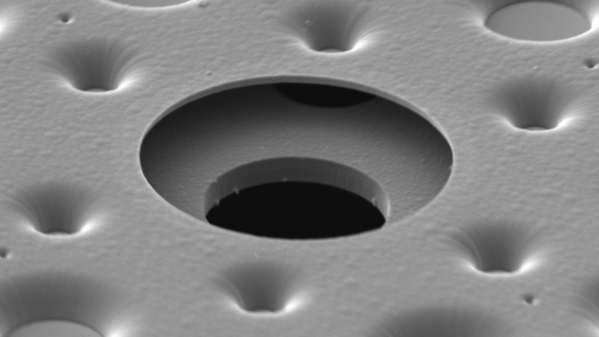
MEMS microphones seem a little bit easier to understand mechanically, since all they have to do is change vibrations in air into an electrical signal. The microphone that [Zach] tore down for this video is ridiculously small; the SMD device is only about 3 mm long, with the MEMS chip under the can a fraction of a millimeter on a side. After some overall views with the optical microscope, [Zach] opened the can and put the guts under his scanning electron microscope. The SEM shots are pretty amazing, revealing a dimpled silicon diaphragm over a second layer with holes etched right through it. The dimples on the diaphragm nest into the holes, forming an air-dielectric capacitor whose capacitance varies as sound waves vibrate the diaphragm.

The most visually interesting feature, though, might be the deep cavity lying behind the two upper surfaces. The cavity, which [Zach] says bears evidence of having been etched by the deep reactive ion etching method, has cool-looking corrugations in its walls. The enormity of the cavity relative to the thin layers covering it suggests it’s a resonating cavity for the sound waves.

Thanks to [Zach] for this in-depth look at a device that’s amazingly complex yet remarkably simple.

Continue reading “Up Close And Personal With A MEMS Microphone”

Tiny Speaker Busts Past Sound Limits With Ultrasound

Conventional speakers work by moving air around to create sound, but tiny speakers that use ultrasonic frequencies to create pressure and generate sound opens some new doors, especially in terms of maximum achievable volume.

A new design boasts being the first 140 dB, full-range MEMS speaker. But that kind of volume potential has less to do with delivering music at an ear-splitting volume and more to do with performing truly effective noise cancellation even in a small device like earbuds. Cancelling out the jackhammers of the world requires parts able to really deliver a punch, especially in low frequencies. That’s something that’s not so easy to do in a tiny form factor. The new device is the Cypress, from MEMS speaker manufacturer xMEMS and samples are aiming to ship in June 2024.

Combining ultrasonic waves to create audible sound is something we’ve seen show up in different ways, like using an array of transducers to focus sound like a laser beam. Another thing ultrasonics can do is cause sensors in complex electronics to become unhinged from reality and report false readings. Neato!

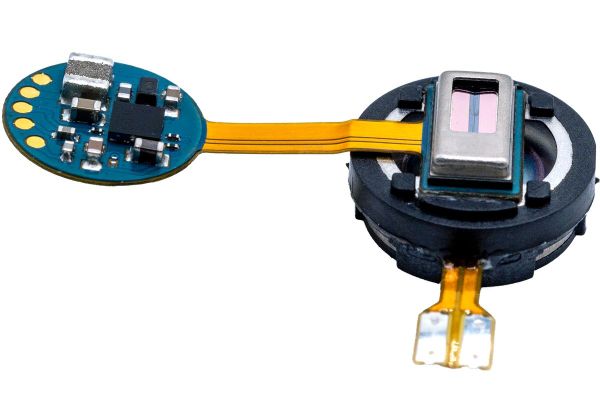
XMems Cowell MEMS-based tweeter on top of dynamic driver. (Credit: xMEMS)

After MEMS Microphones, MEMS Speakers Enter The Market

These days it’s hard to not come across solid-state (micro-electromechanical systems, MEMS) microphones, as they are now displacing electret microphones almost everywhere due to their small size and low cost. Although MEMS speakers are not impossible, creating a miniature speaker that can both displace a lot of air (‘volume’) and accurately reproduce a wide range of frequencies – unlike simple piezo buzzers – is a lot tougher. Here a startup called xMEMS figures that they have at least partially cracked the code with their piezoMEMS speakers, with Creative using the Cowell version in their brand-new Aurvana Ace in-ear monitors. Continue reading “After MEMS Microphones, MEMS Speakers Enter The Market”

MEMS Teardown And Macroscopic Models

There is a bit of a paradox when it comes to miniaturization. When electronics replaced mechanical devices, it was often the case that the electronic version was smaller. When transistors and, later, ICs, came around, things got smaller still. However, as things shrink to microscopic scales, transistors don’t work well, and you often find — full circle — mechanical devices. [Breaking Taps] has an investigation of a MEMS chip. MEMS is short for Micro Electromechanical Systems, which operate in a decidedly mechanical way. You can see the video, which has some gorgeous electron microscopy, below. The best part, though, is the 3D-printed macroscale mechanisms that let you see how the pieces work.

Decapsulating the MPU-6050 was challenging. We usually mill a cavity on the top of an IC and use fuming nitric on a hot plate (under a fume hood) to remove the remaining epoxy. However, the construction of these chips has two pieces of silicon sandwiched together, so you need to fully expose the die to split them apart, so our usual method might not work so well. Splitting them open, though, damaged parts of the chip, so the video shows a composite of several devices.

Continue reading “MEMS Teardown And Macroscopic Models”

A Lab-Grade Measurement Microphone For Not A Lot

The quality of any measurement can only be as good as the instrument used to gather it, and for acoustic measurements, finding a good enough instrument can be surprisingly difficult. Commonly available microphones can be of good quality, but since they are invariably designed for speech or music, they need not have the flat or wide enough response and low noise figure demanded of an instrumentation microphone.

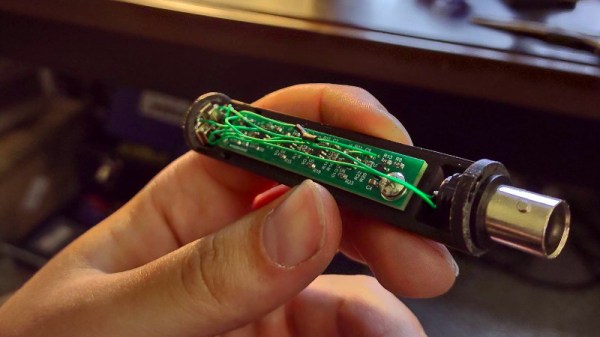
Microphones for measurement purposes can be had for a very large outlay, but here’s [Peter Riccardi] with a unit designed around an array of MEMS capsules that delivers comparable performance for a fraction of the cost.

The result is both an extremely interesting project for those of us with an interest in audio, and a thorough delve into some aspects of its design for those who are merely curious. It uses four capsules in an effort to cancel out induced electrical noise, and boasts some impressive comparative measurements when tested against a commercial measurement microphone. We could almost see ourselves building this project.

Interested in audio technology? Try our Know Audio series.