When a part on a vehicle fails, oftentimes the response is to fit a new one fresh out the box. However, sometimes, whether by necessity or simply for the love of it, it’s possible to handcraft a solution instead. [Samodel] does just that when whipping up a new exhaust for his scooter out of scrap metal.
It’s a great example of classic backyard metalworking techniques. The flange is recreated using a cardboard template rubbed on the exhaust port, with the residual oil leaving a clear impression. Hard work with a grinder and drill get things started, with an insane amount of filing to finish the piece off nicely. A properly tuned pipe is then sketched out on the computer, and a paper template created. These templates are cut out of an old fridge to create the main muffler section.
There’s plenty of other hacks, too – from quick and dirty pipe bends to handy sheet forming techniques. It’s not the first time we’ve seen great metalworking with scrap material, either. Video after the break.
When it comes to YouTube videos, there’s little we like more than some good quality workshop action, watching someone in command of their tools craft a machine from raw materials with an amazing result. It’s something [Workshop From Scratch] delivers with his homemade mini dumper, in which he makes a small dump-truck from scratch with a result that looks as though he’d bought it factory-made from his agricultural supplier.
At its heart is a substantial chassis made from welded together double box section tube, to which he’s bolted a second-hand hydraulic transmission of the type you would find on larger walk-behind groundskeeping machinery. At the back is a front steering axle from a mobility scooter, that pivots on a bearing and wheel hub from a Ford Mondeo to ensure stability on rough ground. There is a platform for the operator to stand on as the little Honda 4-stroke engine moves it around. The bucket is plasma cut and welded, and it’s safe to say that his welding ability exceeds ours.
A little over a year ago, we ran a contest that challenged readers to leave the comfort of their PCBs and breadboards. We wanted to see circuits built in three dimensions, with extra points awarded for creativity and artistic flair. Truth be told there was initially some concern that the “Circuit Sculpture” contest was a bit too abstract for the Hackaday community, but the overwhelming number of absolutely gorgeous entries certainly put those doubts to rest.
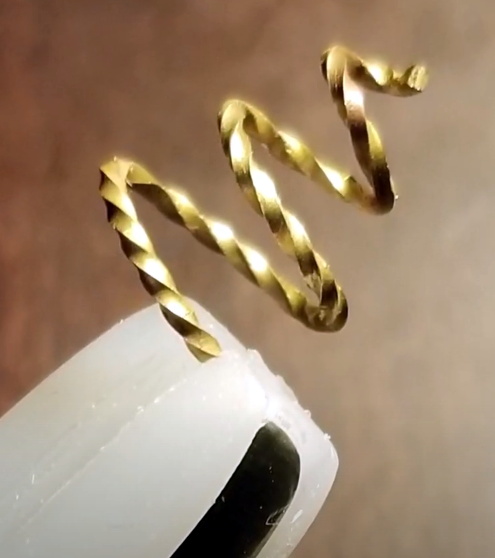
In a recent video, [Michael Aichlmayr] walks viewers through the creation of his mesmerizing entry Wonderlandscape, which ended up taking honorable mention in the Circuit Sculpture contest for Best Metalworks. Though this is much more than just a simple walk-through of a project. Sure you’ll see how brass bar stock was artfully twisted and wrapped to create a metallic winterscape that looks like it could have come from Bob Ross’s hitherto unknown cyberpunk period, but that’s only half the story.
The brass bar was twisted by hand with pliers.
In the video, [Michael] recalls how he discovered the burgeoning electronic sculpture community, and points to a few exceptional examples that got him hooked on finding the beauty that’s usually hidden inside of a plastic enclosure. Eventually he heard about the Circuit Sculpture contest, and decided it was the perfect opportunity to build something of his own. That’s right, Wonderlandscape is his very first attempt at turning electronics into art.
But the best may be yet to come. [Michael] explains that, due to the time constraints of the contest, he had to use metal stock purchased from the crafts store. But his ultimate goal is actually to melt down salvaged brass and bronze components and make his own wire and rods. We can’t wait to see what he’ll be able to accomplish when he starts working with his own custom made metal, and are eagerly awaiting the future video that he says will go over the techniques he’s been working on.
This story is a great reminder of how stepping out of your comfort zone once and awhile can be a good thing. Entering the contest with no previous experience was a risk to be sure, but [Michael] came out the other side more experienced and with a few new friends in the community. So why not enter our latest contest and see where it takes you?
For those who might not have run into one before, a magnetic vise is used when you want to quickly anchor something to a metal surface at an arbitrary position. They’re often used to hold the workpiece down when machining, and can be a real time saver if a lot of repositioning is involved.
[Workshop From Scratch] recently wanted to put together one of these handy pieces of gear, and as we’ve come to expect from his channel, the finished product is an absolute beast. Starting with little more than scraps of metal, the video after the break takes the viewer on a fascinating journey that ends with some demonstrations of the vise in action.
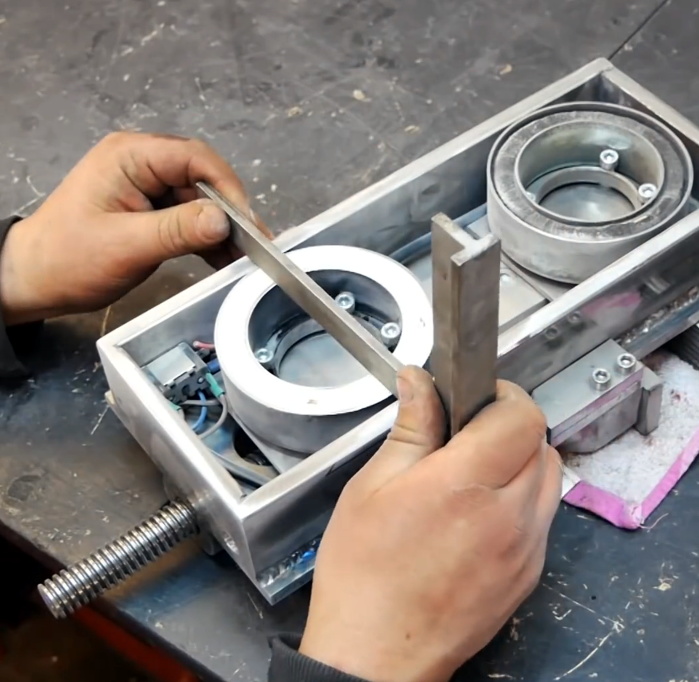
Conceptually, this build is relatively simple. Start with a vise, put a hollow base on it, and fit it with powerful electromagnets that will anchor it down once you flip the switch. Technically you could just build a magnetic base and bolt a commercially available vise onto it, but that’s not how [Workshop From Scratch] does things.
Every element of the build is done by hand, from the pattern cut into the jaws to the t-handle nut driver that gets adapted into a very slick crank. Of particular interest is how much effort is put into grinding down the surface of the electromagnets so they are perfectly flush with the base of the vise. Incidentally, these beefy electromagnets were salvaged from automotive air conditioning compressors, so you might want to add that to your junkyard shopping list.
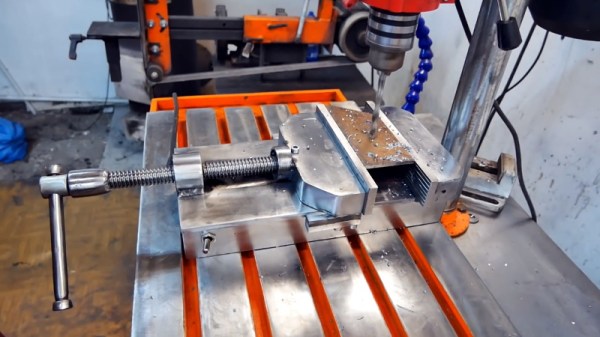
Eagle-eyed readers might recognize the surface [Workshop From Scratch] uses the vise on as the custom drill press table he built a few months ago. These videos are not only reminders of what you can accomplish when you’ve mastered the use of a few common tools, but just how much design and thought goes into the hardware many of us take for granted.
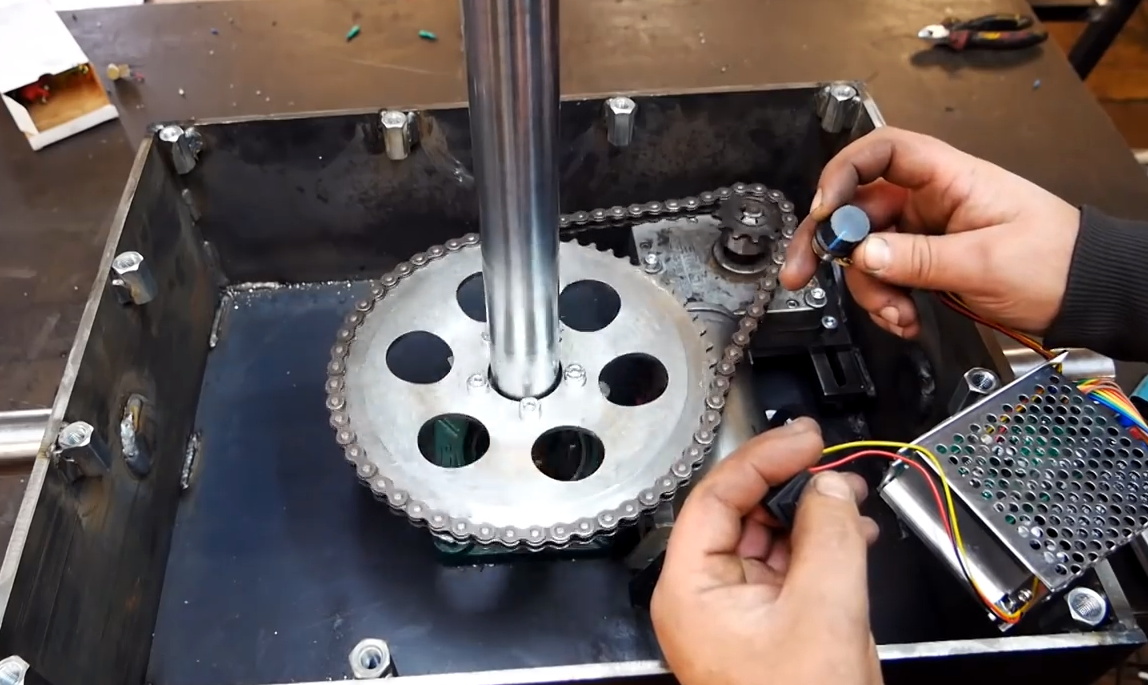
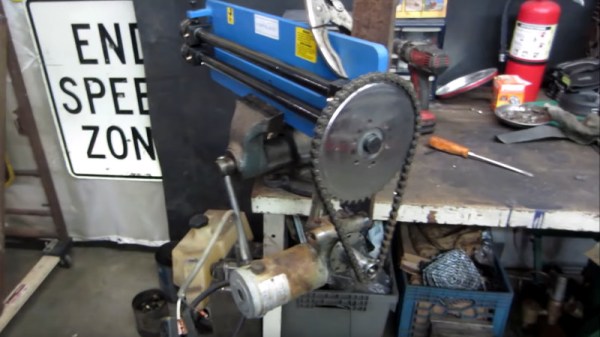
We all have old projects which maybe didn’t quite deliver knocking about, sometimes they gather dust for years. They have a use though, in that when you *really* need that part you can lift it from that forgotten project. That’s what [Mustie1] did with a forgotten electric bicycle project, he took its motor and used it to automate his bead roller.
A bead roller is a tool used in the world of automotive bodywork to press a bead — a continuous depression — into a piece of sheet metal. The inexpensive roller he had fitted in a bench vice, and was operated by means of a handle. Unfortunately the size of the tool meant that it was difficult to operate at the same time as rolling a precise bead, so improvement was required.
He first considered using a cordless drill, but then remembered the electric bicycle project. Its geared motor had come from an electric wheelchair and certainly possessed the right speed, but he needed a suitable sprocket. This was supplied from a scrap engine-assisted bicycle that he’d acquired, and proved to be perfect for the job. The final automated roller used the trigger controller from a cordless drill mounted in a foot switch, and the roller mounted on a stand repurposed from a piece of gym equipment. The result is a useful, and above all controllable, tool that can run a perfect bead in any shape desired on a piece of sheet metal.
Surprisingly this is the first bead roller we’ve featured here, but sheet metal work is a constant in hardware hacker projects. Read our guide to sheet metal bending, for a start.
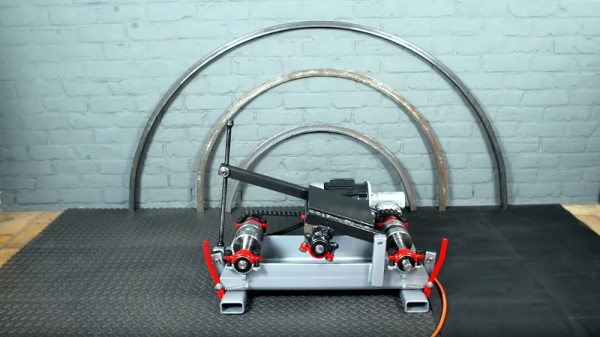
Every serious metal worker will end up getting themself a roller bender at some point, but if you’re as dedicated as [Meanwhile in the Garage], you might just start building the things yourself. His heavy-duty electric roller bender, demonstrated in the video after the break, is perfect for the thicker steel and bigger radii his smaller manual machine can’t handle.
The basic concept is the same in both machines, with two fixed rollers and a third adjustable opposing one between them. Most of the components are pieces of scrap metal, and each shaft runs on bearings mounted in homemade pillow blocks. The two fixed shafts are connected together by a chain drive, and a scrap industrial motor provides the rotating power through a worm gearbox. There are two adjustable bushings on each shaft to keep the work piece aligned. The lead screw from an old car jack is used to adjust the position of the moving roller.
We picked up a few interesting tips from the video, like how to properly align a cylindrical workpiece in a drill press for drilling radial holes. He also used toggle switches as limit switches in a pretty ingenious way, and F-clamps on the work piece to activate them when it reaches the end.
Building your own tools at home is a time-honoured hacking tradition, which we have never seen a shortage of here on Hackaday. Check out this DIY drill press and vertical CNC mill.
Anyone who’s done a bit of metalworking will know how quickly your stockpile will pick up a coating of rust with even just a bit of humidity. While welding requires only a bit of wire brushing at the joint areas, cleaning a large frame for paint is a completely different story. The projects [Make it Extreme] gets himself into tend to involve a lot of steel, so he built his own electrolysis tank for rust removal.
Electrolytic rust removal involves placing the piece of steel to be cleaned into an alkaline electrolyte solution (water and washing soda) with a sacrificial steel anode and connecting a low voltage DC supply over the two pieces. [Make it Extreme] started with an old plastic container, around which he built a very neat trolley frame. He obviously put some thought into how the tank will be cleaned, since it can be removed by unscrewing six bolts and removing the top part of the frame.
The high current, low voltage power supply that is required for the process was built using an old microwave transformer. The secondary coil is removed and replaced with coil of thick insulated wire, to convert it into a step down transformer. After the rewinding the transformer outputs about 13 VAC, which is then run through beefy bridge rectifier modules to get a DC current. A custom machined copper bolt terminal is mounted through the side of the tank to attach the sacrificial anode plate to the positive lead of the power supply, while the negative lead is clamped to the rusty steel to be cleaned.