Horns Across America: The AT&T Long Lines Network

A bewildering amount of engineering was thrown at the various challenges presented to the United States by the end of World War II and the beginning of the Cold War. From the Interstate Highway System to the population shift from cities to suburbs, infrastructure of all types was being constructed at a rapid pace, fueled by reasonable assessments of extant and future threats seasoned with a dash of paranoia, and funded by bulging federal coffers due to post-war prosperity and booming populations. No project seemed too big, and each pushed the bleeding edge of technology at the time.

Some of these critical infrastructure projects have gone the way of the dodo, supplanted by newer technologies that rendered them obsolete. Relics of these projects still dot the American landscape today, and are easy to find if you know where to look. One that always fascinated me was the network of microwave radio relay stations that once stitched the country together. From mountaintop to mountaintop, they stand silent and largely unattended, but they once buzzed with the business of a nation. Here’s how they came to be, and how they eventually made themselves relics.

Continue reading “Horns Across America: The AT&T Long Lines Network”

Using Nanotubes To Strengthen 3D Prints

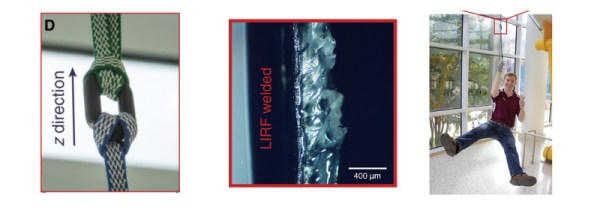
3D printing has brought the production of plastic parts to the desktops and workshops of makers the world over, primarily through the use of FDM technology. The problem this method is that when squirting layers of hot plastic out to create a part, the subsequent vertical layers don’t adhere particularly well to each other, leading to poor strength and delamination problems. However, carbon nanotubes may hold some promise in solving this issue.

A useful property of carbon nanotubes is that they can be heated with microwave energy. Taking advantage of this, researchers coated PLA filament in a polymer film containing carbon nanotubes. As the layers of the print are laid down, the nanotubes are primarily located at the interface between the vertical layers. By using microwaves to heat the nanotubes, this allows the print to be locally heated at the interface between layers, essentially welding the layers together. As far as results are concerned, the team reports an impressive 275% improvement in fracture strength over traditionally printed parts.

The research paper is freely available, which we always like to see. There’s other methods to improve your print strength, too – you could always try annealing your printed parts.

[Thanks ????[d] ???? for the tip]

Unlikely Cascade Of Failures Leads To Microwave’s Demise

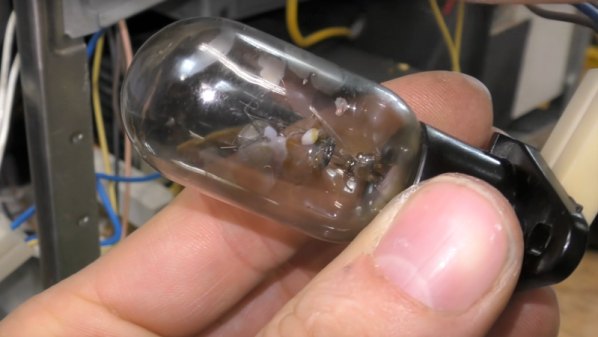
Surely a blown light bulb can’t kill a microwave oven, right? You might not expect it to, but that was indeed the root cause of a problem that [mikeselecticstuff] recently investigated; the cascade of failures is instructive to say the least.

While the microwave that made its way to [mike]’s bench wasn’t exactly engineered to fail, it surely was not designed to succeed. We won’t spoil the surprise, but suffice it to say that his hopes for a quick repair after the owner reported a bang before it died were dashed by an arc across the interior light bulb that put a pulse of mains voltage in places it didn’t belong. That the cascade of failures killed the appliance is a testament to how designing to a price point limits how thoroughly devices can be tested before production runs in the millions are stuffed into containers for trips to overseas markets.

Even though [mike] made his best effort to adhere to the Repair Manifesto, the end result was a scrapped microwave. It wasn’t a total loss given the interesting parts inside, but a disappointment nonetheless unless it forces us to keep in mind edge-case failure modes in our designs.

Continue reading “Unlikely Cascade Of Failures Leads To Microwave’s Demise”

Measuring Gait Speed Passively To Diagnose Diseases

You may not realize it, but how fast a person walks is an important indicator of overall health. We all instinctively know that we lag noticeably when a cold or the flu hits, but monitoring gait speed can help diagnose a plethora of chronic diseases and conditions. Wearables like Fitbit would be one way to monitor gait speed, but the Computer Science and Artificial Intelligence Lab at MIT thinks there’s a better way:  a wireless appliance that measures gait speed passively.

CSAIL’s sensor, dubbed WiTrack (PDF), is a wall-mounted plaque that could be easily concealed as a picture or mirror. It sends out low-power RF signals between about 5- and 7-GHz to perform 3D motion tracking in real time. The WiTrack sensor has a resolution of about 8 cm at those frequencies. With their WiGait algorithms (PDF), the CSAIL team led by [Chen-Yu Hsu] is able to measure not only overall walking speed, but also stride length. That turns out to be critical to predicting the onset of such diseases as Parkinson’s, which has a very characteristic shuffling gait in the early phase of the disease. Mobility impairments from other diseases, like ALS and multiple sclerosis, could also be identified.

WiTrack builds on [Hsu]’s previous work with through-wall RF tracking. It’s nice to see a novel technique coming closer to a useful product, and we’ll be watching to see where this one goes.

Continue reading “Measuring Gait Speed Passively To Diagnose Diseases”

$2700 EBay Bet Pays Off For This 14 GHz Spectrum Analyzer Repair

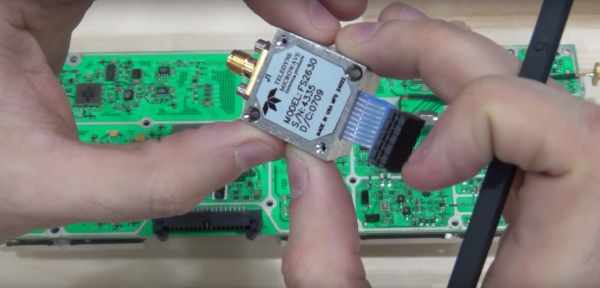
The eBay addiction starts small. One night you’re buying $3 buck-boost converters and cheap Chinese USB power packs. The next thing you know you’re spending thousands on dead instruments with no documentation. You’ve got the skills though, and if your bet that you can diagnose and repair a 14 GHz real-time spectrum analyzer is right, you’ll be putting a snazzy instrument on the bench for a fraction of the original $50,000 it cost.

Make some popcorn and get cozy before settling in to watch [Shahriar]’s video below, because it clocks in at just over an hour. But it’s pretty entertaining, and just seeing how Tektronix built the RSA 6114A spectrum analyzer is worth the time. Things are different when you’re piping microwave signals around the chassis of a beast such a this, the interior of which is densely packed with pluggable modules. Tek factory service would no doubt perform a simple module swap to get this machine running again, but [Shahriar] wasn’t having any of that on his $2,700 eBay find. After isolating the problem to the local-oscillator generator module, [Shahriar] takes us on a tour of where the signals go and what they do. We won’t reveal the eventual culprit, but suffice it to say that after a little SMD rework, [Shahriar] has a very fancy new instrument for the shop.

If this repair gives you the itch to get working on microwave circuits, maybe it’s time to build that backyard synthetic aperture radar set you’ve always wanted.

Continue reading “$2700 EBay Bet Pays Off For This 14 GHz Spectrum Analyzer Repair”

Toshiro Kodera: Electromagnetic Gyrotropes

We’ve learned a lot by watching the talks from the Hackaday Superconferences. Still, it’s a rare occurrence to learn something totally new. Microwave engineer, professor, and mad hacker [Toshiro Kodera] gave a talk on some current research that he’s doing: replacing natural magnetic gyrotropic material with engineered metamaterials in order to make two-way beam steering antennas and more.

If you already fully understood that last sentence, you may not learn as much from [Toshiro]’s talk as we did. If you’re at all interested in strange radio-frequency phenomena, neat material properties, or are just curious, don your physics wizard’s hat and watch his presentation. Just below the video, we’ll attempt to give you the Cliff’s Notes.

Continue reading “Toshiro Kodera: Electromagnetic Gyrotropes”

Get On 10 GHz For 3 Euros

A frequent complaint you will hear about amateur radio is that it is a chequebook pursuit. Of course you can work the incredible DX if you spend $20k on a high-end radio, big antenna, and associated components. The reality is though that because it’s such a multi-faceted world there are many ways into it of which the operator with the shiny rig is taking only one.

On the commonly used HF and VHF bands at the lower end of the radio spectrum you will definitely find chequebook amateurs of the type described in the previous paragraph. But as you ascend into the microwave bands there are no shiny new radios on the market, so even the well-heeled licensee must plow their own furrow and build their own station.

You might think that this would remain a chequebook operation of a different type, as exotic microwave devices are not always cheap. But in fact these bands have a long history of extremely inexpensive construction, in which skilled design and construction as well as clever re-use of components from satellite TV systems and Doppler radar modules play a part. And it is a project following this path that is our subject today, for [Peter Knol, PA1SDB] has repurposed a modern Doppler radar module as a transmitter for the 10GHz or 3cm amateur band (Google Translate version of Dutch original). The best bit about [Peter]’s project is the price: these modules can be had for only three Euros.

Years ago a Doppler module would have used a Gunn diode in a waveguide cavity and small horn, usually with an adjacent mixer diode for receiving. Its modern equivalent uses a transistor oscillator on a PCB, with a dielectric resonator and a set of patch antennas. There is also a simple receiver on board, but since [Peter] is using a converted ten-Euro satellite LNB for that task, it is redundant.

He takes us through the process of adjusting the module’s frequency before showing us how to mount it at the prime focus of a parabolic antenna. FM modulation comes via a very old-fashioned transformer in the power feed. He then looks at fitting an SMA connector and using it for more advanced antenna set-ups, before experimenting with the attenuating properties of different substances. All in all this is a fascinating read if you are interested in simple microwave construction.

The result is not the most accomplished 10 GHz station in the world, but it performs adequately for its extremely low price given that he’s logged a 32 km contact with it.

Though we cover our fair share of amateur radio stories here at Hackaday it’s fair to say we haven’t seen many in the microwave bands. If however you think we’ve been remiss in this area, may we point you to our recent coverage of a microwave radio receiver made from diamond?

Via Southgate ARC.