Nanoaetherphone Is A Special MIDI Controller

MIDI controllers can be simple straightforward keyboards, or wild magical devices that seem to snatch notes from the very aether itself. As you might expect from the name, the Nanoaetherphone II is one of the latter.

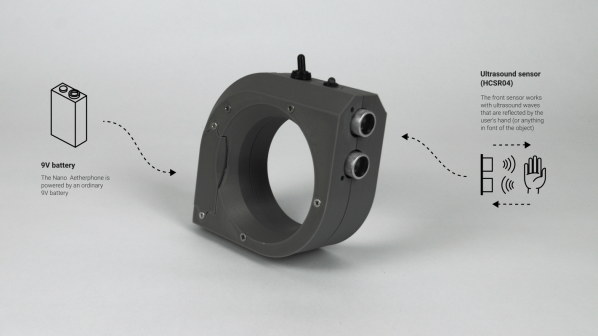
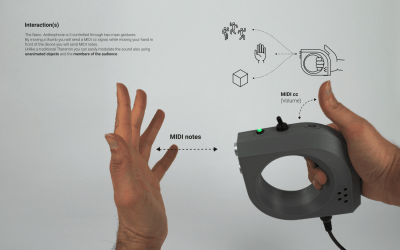
The device is inspired by the Theremin, and was built to celebrate its 100th anniversary. The Nanoaetherphone II is all about using sensors to capture data from wireless hand-wavey interactions, and turn it into MIDI messages. To this end, it has an LDR sensor for detecting light levels, which determines volume levels. This is actuated by the user’s thumb, blocking the sensor or allowing ambient light to reach it. At the front of the handheld unit, there is also an ultrasonic range sensor. Depending on how close the sensor is to the user’s hand or other object determines the exact note sent by the device. As a MIDI controller, it is intended to be hooked up to an external synthesizer to actually generate sound.
The overall concept isn’t too complicated, and the design makes it easy to pickup and play. We imagine it could even be foolproofed by programming it only to play notes from a given scale or mode, allowing for easy soloing without too many of those ill-tempered blue notes. Jazz enthusiasts might prefer it to just spit out any and all notes, of course.

We love a good MIDI controller around these parts, and we’ve seen everything from knitted models to those made out of old phones. Video after the break.

Continue reading “Nanoaetherphone Is A Special MIDI Controller”

PDP-8 Plays Period Popcorn Piece

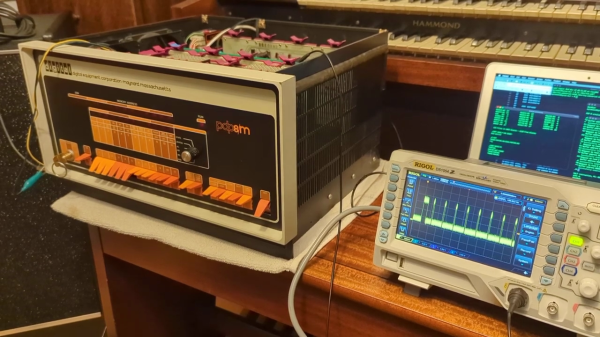
[Kyle Owen], collector of antique tech, decided to try his hand at music arrangement — for the PDP-8 computer, that is (listen to the video below the break). He’s using a program submitted by Richard Wilson to the Digital Equipment Corporation Users Society (DECUS) in 1976, appropriately named MUSIC. It runs on OS/8 and is written in the PDP-8 assembly language PAL8. Using the syntax of MUSIC, [Kyle] arranged Gershon Kingsley’s famous Moog synthesizer hit “Popcorn” (the Hot Butter version from 1972).

You might notice the lack of a disk or tape drive in his setup. That’s because [Kyle] is using an RK05 disk emulator he wrote back in 2014. It’s running on a Raspberry Pi and connects over serial, which he says is slower than an RK05 but faster than a tape drive. He has connected up a Cordovox amplifier cabinet for this demonstration, but the original means of listening to the MUSIC output was an AM radio held near the computer (hear the second video below the break). This worked by executing the PDP-8 CAF instruction at a desired frequency, say 440 Hz.

Thus, when this instruction is executed, logic all over the computer goes “zap”, clearing out various registers. Now, if a radio is held close to the computer, it will pick up some of this energy, and at 440 times a second, will deliver a pulse to the speaker. The result is that you will hear a tone from the radio — as a matter of fact, you will hear an A.

Continue reading “PDP-8 Plays Period Popcorn Piece”

I’ve Got Two Turntables And A Laser Engraver

Digital media provides us with a lot of advantages. For something like recording and playing back music, digital copies don’t degrade, they can have arbitrarily high quality, and they can be played in a number of different ways including through digital streaming services. That being said, a number of people don’t feel like the digital experience is as faithful to the original sound as it could be and opt for analog methods instead. Creating analog copies of music is a much tougher matter though, as [Marco] demonstrates by using a laser engraver to produce vinyl records.

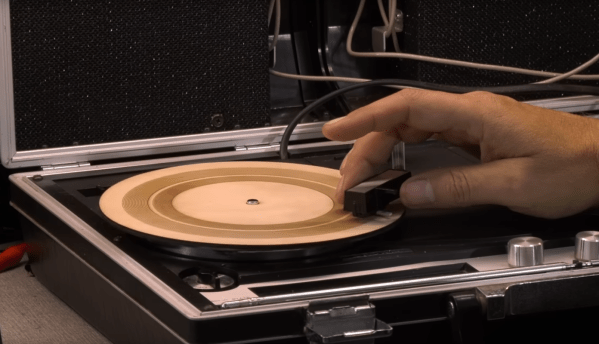
[Marco] started this month-long project by assembling and calibrating the laser engraver. It has fine enough resolution to encode analog data onto a piece of vinyl, but he had to create the software. The first step was to generate the audio sample, then process it through a filter to remove some of the unwanted frequencies. From there, the waveform gets made into a spiral, accounting for the changing speed of the needle on the record as it moves to the center. Then the data is finally ready to be sent to the laser engraver.

[Marco] did practice a few times using wood with excellent success before moving on to vinyl, and after some calibration of the laser engraver he has a nearly flawless 45 rpm record ready to hit the turntable. It’s an excellent watch if not for anything than seeing a working wood record. We’ve actually seen a similar project before (without the wood prototyping), and one to play records from an image, but it’s been quite a while.

Thanks to [ZioTibia81] for the tip!

Continue reading “I’ve Got Two Turntables And A Laser Engraver”

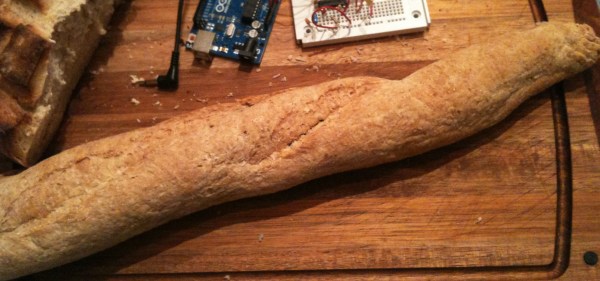
A baguette sits diagonally across a wooden cutting board. Above it sits an Arduino and an electronics breadboard.

Theremin Baguette Brings New Meaning To Breadboarding

Theremins are a bit of an odd instrument to begin with, but [AphexHenry] decided to put one where no theremin has gone before: into a baguette.

The “baguetophone” is a theremin and piezo-percussion instrument inside a hollowed-out baguette. Starting with a DIY theremin tutorial from Academy of Media Arts Cologne, [AphexHenry] added some spice with a piezo pickup inside the baguette to function as a percussion instrument. One noted downside of squeezing the instrument into such an unusual enclosure is that the antenna doesn’t respond as well as it might with a more conventional arrangement. Outputs from the piezo and antenna are run through Max/MSP on a computer to turn the bread into a MIDI controller. Like many DIY theremins, it appears that this build neglects the volume antenna, but there’s no reason you couldn’t add one. Maybe disguised as a piece of cheese?

Outside smuggling an instrument into a French café for a flash mob performance, this could also prove handy if you’re someone who gets hungry while playing music. We don’t recommend snacking on the Arduino even if it is ROHS compliant though.

If you want to learn more about how theremins work, check out Theremin in Detail. After that, you might want to browse all of our theremin articles or look at this project where they used a 555 instead.

Continue reading “Theremin Baguette Brings New Meaning To Breadboarding”

Arduino Lo-Fi Orchestra closeup thumbnail

Lo-Fi Orchestra Learns Tubular Bells

Hardware projects often fall into three categories: Those that flash lights, those that make sounds and those that move. This virtuoso performance by [Kevin]’s “Lo-Fi Orchestra” manages all three, whilst doing an excellent job of reproducing the 1973 musical classic Tubular Bells by Mike Oldfield.

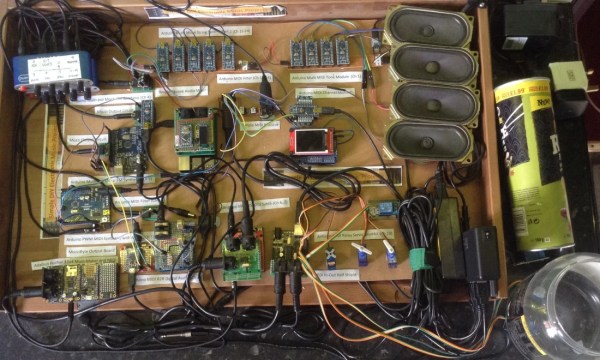
Producing decent polyphonic sounds of different timbres simultaneously is a challenge for simple microcontroller boards like Arduinos, so [Kevin] has embraced the “More is more” philosophy and split up the job of sound generation in much the same way as a traditional orchestra might. Altogether, 11 Arduino Nanos, 6 Arduino Unos, an Arduino Pro Mini, an Adafruit Feather 32u4, and a Raspberry Pi running MT32-Pi make up this electronic ensemble.

Arduino servo drumkit
Arduino Servo & Relay Drumkit

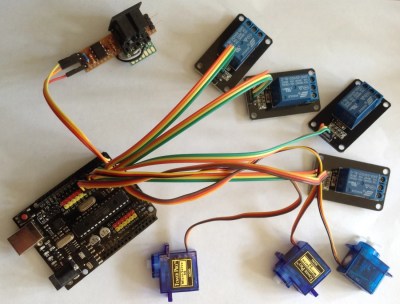
The servo & relay drumkit is a particular highlight, providing some physical sounds to go along with the otherwise solid-state generation.

The whole project is “conducted” over MIDI and the flashing sequencer in the middle gives a visual indication of the music that is almost hypnotic. The performance is split into two videos (after the break), and will be familiar to fans of 70’s music and classic horror movies alike. We’re astonished how accurately [Kevin] has captured the mood of the original recording.

If this all looks slightly familiar, it may be because we have covered the Lo-Fi Orchestra before, when it entertained us with a rousing rendition of Gustav Holst’s Planets Suite. If you’re more interested in real Tubular Bells than synthesized ones, then check out this MIDI-controlled set from 2013. Continue reading “Lo-Fi Orchestra Learns Tubular Bells

Building An Old Guitar From A New One

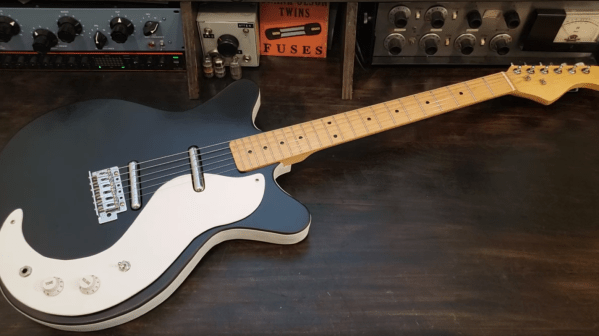
Anyone who’s ever played guitar to at least the skill level required to form a terrible garage band knows the names of the most legendary guitars. The driving sound of the Gibson Les Paul played by Jimmy Page, the upside-down and smooth Fender Stratocaster from Jimi Hendrix, or the twangy Rickenbacker made famous by George Harrison are all lusted-after models. The guitar that [Frank] really wanted was a Danelectro DC59 and since they’ve been steadily creeping up in price, he decided to build his own.

The body of the clone guitar is hollow and made from effectively scrap wood, in this case plywood. As the original guitars were in fact famous for using the least expensive materials possible, this makes it a great choice for a clone. [Frank] made the guitar using almost exclusively hand tools and glued everything together, but did use a few donor parts from a modern Stratocaster-type guitar. With most of the rough shape of the guitar finished, it was time to add the parts that make the guitar sound the way that a real Danelectro should: the lipstick-style pickups. He purchased these completely separately as they are the most important part to get right to emulate the tone and feel of the original.

With everything finally soldered and assembled, [Frank] got right to work recording a sample audio track which is included at the end of the video. It certainly sounds like the original to our untrained ears, and for around $100 it’s not a bad value either. If you’d like to see a guitar built from the ground up without using another as a clone, take a look at this build which brings a completely original guitar into existence, entirely from scratch.

Continue reading “Building An Old Guitar From A New One”

Making A Tape Echo The Traditional Way

[Juan Nicola] has taken inspiration from the musician hackers of old and re-purposed a reel-to-reel tape recorder into a tape-echo for his guitar with a built-in valve amplifier (video in Spanish).

The principle is to record the sound of the guitar onto a piece of moving magnetic tape, then to read it back again a short time later.  This signal is mixed with the live input and re-recorded back onto the tape further back.  The effect is heard as an echo, and this approach was very popular before digital effects became readily available.

[Juan] installed a new read-head onto his Grundig TK40 and managed to find a suitable mechanical arrangement to keep it all in place.  He has since updated the project by moving to a tape loop, allowing an infinite play-time by re-using the same piece of tape over and over.

Turning tape machines into echo effects is not a new idea, and we’ve shown a few of them over the years, but every one is slightly different!

Both versions are shown after the break.  YouTube closed-caption auto-translate might come in handy here for non-Spanish speakers.

Continue reading “Making A Tape Echo The Traditional Way”