Radiohead Makes Entire Video With Friggin’ Lasers


[Radiohead], being no strangers to out of the box delivery ideas, are preparing to release a new video that was created without the use of cameras. The entire video for the song House of Cards was “filmed” using lasers.

The system, known as Geometric Informatics and Velodyne Lidar, scanned the entire environment 900 times a minute to capture an entire party in real time.

The video was originally set to be released in mid July, but appears to have been moved back.
Dancing Wall-E And Rhythmic Synth


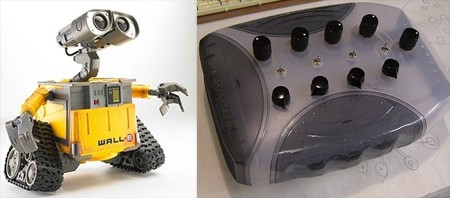
Whether you loved, hated, or didn’t see Wall-E, it’s hard not to fall in love with the iDance Wall-E toy. Connect him to an audio source and Wall-E will dance around like an epileptic Billy Bass.

[Gian Pablo Villamil] at NYC Resistor wondered whether it would work with his custom made Rhythmic Synth, and to his and our delight, it does! The Rhythmic Synth is an older project of his; it is a simple rhythm generator with 4 pitch knobs, 4 modulation knobs, and 4 phase switches. The case was taken from an old external Iomega CD-ROM drive.

Getting the Wall-E to dance isn’t much of a feat, but something about the dancing combined with a synth with embedded lights just screams robot dance party, and that can never be wrong. We’d love to see the Wall-E dancing to a cleaner, more complete synth: maybe this one. Check out Wall-E busting a move after the break.

Continue reading “Dancing Wall-E And Rhythmic Synth”

Optical DJ Controller


[Adrian] sent in this sweet little optical DJ controller. The ‘turntable’ was made from a CD and an encoder wheel created with a laser printed transparent overhead sheet. You can score some optical gear from a spare mouse, or just buy the parts. A PIC18F452 encodes everything into a midi signal. You can find a good photo of the schematics here. And you can hit the demo video after the break.

Continue reading “Optical DJ Controller”

Aurora Open Source Hardware Mixer


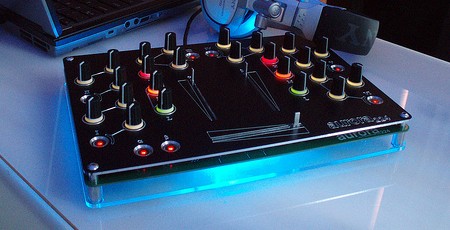
We’ve seen some fairly impressive mixer projects this year, and the Aurora mixer is no exception. It is a dual channel USB-powered mixer with two linear faders, one crossfader, eight backlit buttons and 24 potentiometers, all built around a PIC 18LF4525 microcontroller. That’s all pretty typical for a mixer, but this one is very visually attractive, featuring a clean and stylish form factor and controllable lighting both under the board and in the LEDs backlighting the buttons and knobs.

Whether you want to buy one now or build one yourself, the Aurora team has made both possible. You can contact them for pricing if you are ready to buy. If you prefer to build, this is an open source project with full assembly instructions, schematics, drivers, patches and all other source code and information you should need available here. See more photos of the Aurora mixer here, or see it in action after the break.

Continue reading “Aurora Open Source Hardware Mixer”

Monome Keyboard


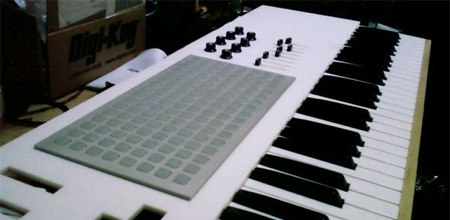
If you asked [David Phipps] whether he prefers Monomes or traditional keyboards, he might ask you “why not have both?” We don’t presume to speak for him, but that’s what we think he’d say based on his Monome-keyboard combination, which puts a Monome right in the keyboard’s console, giving the user the best of both worlds.

[Phipps] calls his device The Peaceblaster (also the name of his album), and it is constructed from a 5-octave Fatar keybed, MKE electronic components, and a Doepfer PKE for the faders and knobs. Everything is available via USB and MIDI out. The project is as yet unfinished, and he hopes to fit a mac mini into the works. If he succeeds, this will be one of the most elegant, powerful and fun keyboards we’ve seen in quite some time.

Easiest Rock Band To MIDI Setup Yet

[youtube=http://www.youtube.com/watch?v=S6bQaHuFvLw&hl=en&rel=0&color1=0x3a3a3a&color2=0x999999]
We have news for those of you dismissing the new Wii Version of Rock Band. Sure, the lack of DLC is a huge factor, but if you’re looking to use the instruments with MIDI software, [Jordan Balagot] has found what may be the easiest way. Since the Wii instruments are connected via USB, they are easy to connect to a computer. [Balagot] used a program called junXion that is a data routing app for OS X. JunXion can take any USB human interface device and remap the buttons, making it easy to set up the drums as a MIDI input device in an intuitive way. Install junXion, plug in the drums, map the pads, and rock out.

[via Create Digital Music]