When one thinks of the Jet Propulsion Lab, the NASA lab responsible for such amazing feats of engineering as Mars rovers and galaxy-exploring spacecraft like Voyager, one does not necessarily think of it as a hotbed of medical innovation. But when the COVID-19 pandemic started its march around the globe, JPL engineers decided to turn their skills from exploring other worlds to helping keep people alive in this one. Fittingly, the challenge they tackled was perhaps the most technically challenging: to build a ventilator that’s simple enough to be built in large numbers, enough to make a difference to the predicted shortfall, but that does the non-trivial job of keeping people breathing as safely as possible.
The result was VITAL, or Ventilator Intervention Technology Accessible Locally. It was designed, prototyped, and tested on an incredibly ambitious timetable: 37 days total. That number alone would be shocking enough, but when one adds in the disruptions and disconnection forced on the team of JPL engineers by the sudden need to self-isolate and work remotely that came up in the middle of the design process, it’s a wonder the team was able to get anywhere. But they worked through the technical and managerial issues and delivered a design that has now been licensed out to eight manufacturers under a no-fee license.
What does it take to bring something as complex as a ventilator to market in so short a time? To delve into that question, Supply Frame’s Erika Earl, who was part of the VITAL team, will stop by the Hack Chat. We’ll talk to her about being on the JPL team, what the design and prototyping process was like, and how the lessons learned here can apply to any team-based rapid-prototyping effort. You may not be building a ventilator in 37 days, but chances are good you can learn something useful from those who did.
Click that speech bubble to the right, and you’ll be taken directly to the Hack Chat group on Hackaday.io. You don’t have to wait until Wednesday; join whenever you want and you can see what the community is talking about. Continue reading “Rapid Prototyping Hack Chat”→
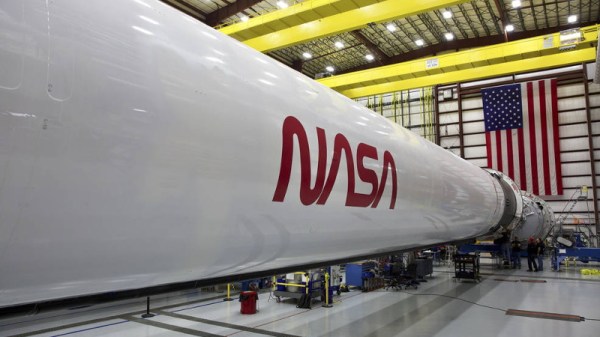
With the launch of the SpaceX Demo-2 mission, the United States has achieved something it hasn’t done in nearly a decade: put a human into low Earth orbit with a domestic booster and vehicle. It was a lapse in capability that stretched on far longer than anyone inside or outside of NASA could have imagined. Through a series of delays and program cancellations, the same agency that put boot prints on the Moon and built the iconic Space Shuttle had been forced to rely on Russia to carry its astronauts into space since 2011.
But America’s slow return to human spaceflight can’t be blamed on the CST-100, or even Boeing, for that matter. Since the retirement of the Space Shuttle, NASA has been hindered by politics and indecisiveness. With a constantly evolving mandate from the White House, the agency’s human spaceflight program has struggled to make significant progress towards any one goal.
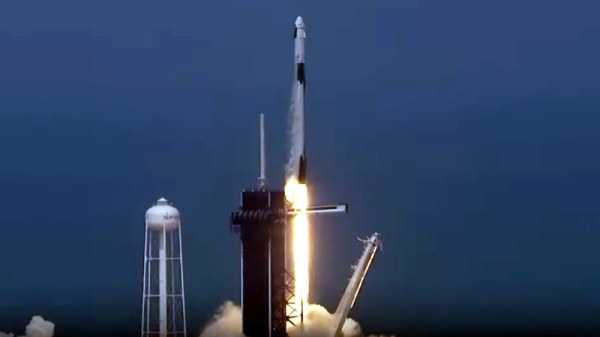
So after a false start due to bad weather, the first crewed launch of a SpaceX Crew Dragon capsule with two astronauts on board has gone ahead. After playing catch-up with the ISS for around 27 hours they’re now safely aboard. At times it seems that space launches have become everyday occurrences, but they are still heroes who have risked their lives in the furtherment of mankind’s exploration of space. Their achievement, and that of all the scientists, engineers, and other staff who stand behind them, is immense.
I watched the drama unfold via the live video feed. Having heaved a huge sigh of relief once they were safely in orbit, the feed cut to the studio, and then moved on to interview the NASA administrator Jim Bridenstine. He was naturally elated at a successful launch, and enthused about the agency’s achievement. You can watch the full interview embedded below, but what caught my attention was his parting sentence:
And if this can inspire a young child to become the next Elon Musk, or the next Jeff Bezos, or the next Sir Richard Branson, then that’s what this is all about
I was slightly shocked and saddened to hear this from the NASA administrator, because to my mind the careers of Musk, Bezos, or Branson should not be the ones first brought to mind by a space launch. This isn’t a comment on those three in themselves; although they have many critics it is undeniable that they have each through their respective space companies brought much to the world of space flight. Instead it’s a comment on what a NASA administrator should be trying to inspire in kids.
Ask yourself how many billionaire masters-of-the-universe it takes for a successful space race compared to the number of scientists, engineers, mathematicians, technicians, physicists, et al. From the anecdote of the NASA administrator it takes about three, but if he is to make good on his goal of returning to the Moon in 2024 and then eventually taking humanity to Mars it will take a generation packed full of those other roles. To understand that we’ll have to take a trip back to the Apollo era, and how that generation of kids were inspired by the spacecraft on their screens.
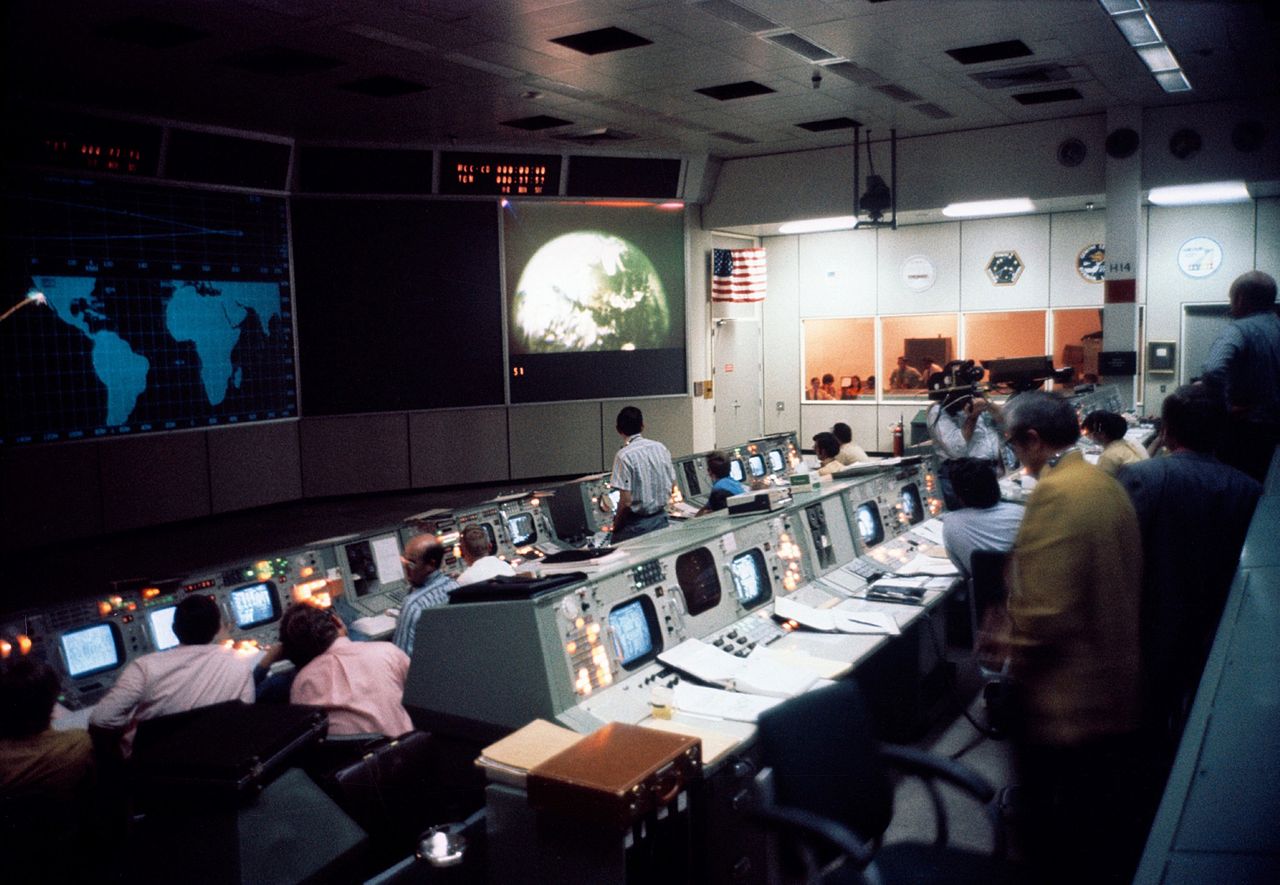
Inspiration from probably the coolest room in the world at the time, the Apollo mission control in Houston. NASA on The Commons / No restrictions
Fifty years ago, we were very much on the brink of becoming a spacefaring planet. American astronauts were taking their first steps on the Moon, and Soviet cosmonauts were occupying real space stations that would soon be capable of housing them for months at a time. Planetary probes were returning colour TV pictures from other worlds, and it was certain that in the immediate aftermath of the Apollo programme we’d be sending astronauts and probably cosmonauts too further afield. A Mars base in the 1980s perhaps, and following our fictional Star Trek heroes further afield thereafter.
We now know it didn’t quite work out that way, but a whole generation of tech-inclined kids grew up wanting nothing more than to be involved in space flight. The vast majority of us never made it, but with that inspiration we took our soldering irons and 8-bit home computers and ran with them. Those NASA folks were the coolest of role-models, and no doubt their Soviet equivalents were too for kids on the other side of the Iron Curtain.
With the best will in the world, the chances of any kid becoming the next Jeff Bezos is about as high as that of their becoming the next Neil Armstrong. Compared to the number of kids in the world, the number of billionaires and the number of astronauts both pale into statistical insignificance. But the chances of a kid becoming an engineer or a scientist is much higher, and in those careers their chances of having some of their work be involved with the space effort becomes not entirely unlikely.
I understand what the NASA administrator was trying to say, but can’t shake the feeling that if those are the people he rolls out to inspire kids watching a space launch, he’s missed an opportunity. Those are the names we all recognize, but shouldn’t we also elevate the people making the scientific breakthroughs so their names are equally recognized? Like Margaret Hamilton, Gene Kranz, and Sergei Korolev and many others before them, we should be making names like Tom Mueller and Margarita Marinova prominent examples of where a career in the sciences can take you. But to be honest, the real problem is we just don’t hear much about all the people doing this fascinating engineering and that’s a sad state of affairs.
Looks like it’s time for Hackaday to pursue a biography series based on the many great minds who are the ones delivering on the promise and vision of today’s (and tomorrow’s) space race. Get us started by talking about your favorite behind the scenes science folks in the comments below.
We keep finding more great space stories than we can cover, so here’s a speed-run through the broader picture of the moment as it applies to space flight.
The big news this week was the first launch of a manned SpaceX Crew Dragon capsule to the ISS. I was excited because the pass en route to the space station was scheduled to be visible from the UK at dusk, and on Wednesday evening I perched atop a nearby hill staring intently at the horizon. Except it had been cancelled due to bad weather. The next launch window is planned for today and you can watch it live.
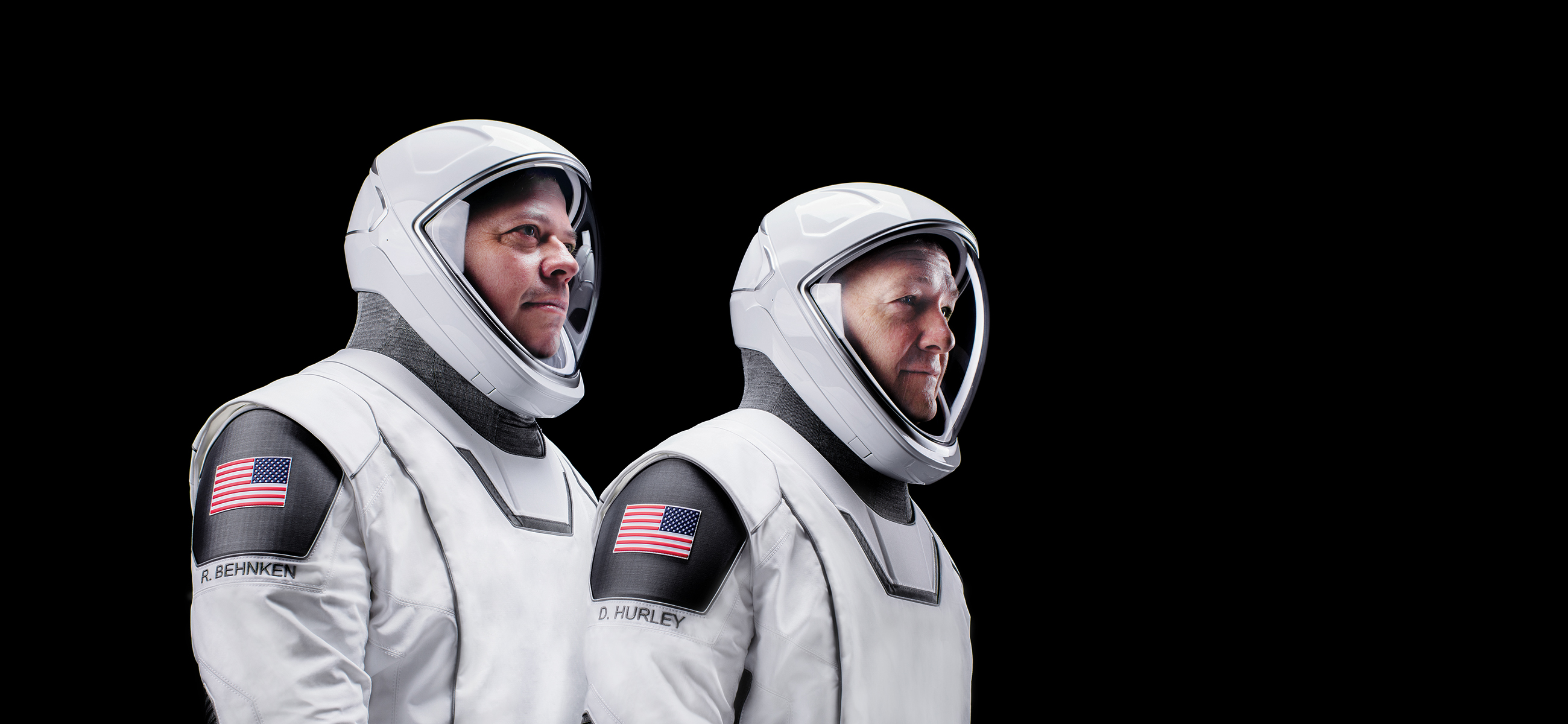
Meanwhile, fashion is the other piece of this manned-launch’s appeal. Their sharply-designed spacesuits have attracted a lot of attention, moving on from the bulky functional Michelin Man aesthetic of previous NASA and Roscosmos garments for a positively futuristic look that wouldn’t be out of place in Star Trek. Never mind that the two astronauts are more seasoned space dog than catwalk model, they still look pretty cool to us. Against the backdrop of a political upheaval at the top of NASA, this first crewed orbital mission from American soil since the retirement of the Shuttle has assumed an importance much greater than might be expected from a run-of-the-mill spaceflight.
While we’re on the subject of the ISS, it’s worth noting that we’re approaching twenty years since the first crew took up residence there, and it has been continuously crewed ever since as an off-planet outpost. This is an astounding achievement for all the engineers, scientists, and crews involved, and though space launches perhaps don’t have the magic they had five decades ago it’s still an awe-inspiring sight to see a man-made object big enough to discern its shape pass over in the night sky. We understand that current plans are to retain the station until at least 2030, so it’s a sight that should remain with us for a while longer.
Closer to Earth are a couple of tests for relative newcomers to the skies. When Richard Branson’s Virgin group isn’t trying to boot millionaires off the planet through its Virgin Galactic operation, it’s aiming to cheaply fling small satellites into orbit from a rocket-toting airborne Boeing 747 with its Virgin Orbit subsidiary. Their first test launch sadly didn’t make it to space, once the rocket had flawlessly launched from the airliner it suffered a fault and the mission had to be aborted. Getting into space is hard.
The second test was never intended to make it into space, but is no less noteworthy. The British company Skyrora have performed a successful ground test of their Skylark L rocket, aiming for a first launch next year and for offering low-earth orbit services by 2023. This is significant because it will be the first British launch since the ill-fated Black Arrow launch in 1971, and with their Scottish launch site the first ever from British soil. If you’ve seen Skyrora mentioned here before, it is because they were behind the retrieval of the Black Arrow wreckage from the Aussie outback that we mentioned when we wrote about that programme.
Looking forward to the coming week, especially today’s rescheduled SpaceX launch. This time however, I’ll check the weather conditions before climbing any hills.
Because of the architecture used for the Apollo missions, extended stays on the surface of the Moon weren’t possible. The spartan Lunar Module simply wasn’t large enough to support excursions of more than a few days in length, and even that would be pushing the edge of the envelope. But then the Apollo program was never intended to be anything more than a proof of concept, to demonstrate that humans could make a controlled landing on the Moon and return to Earth safely. It was always assumed that more detailed explorations would happen on later missions with more advanced equipment and spacecraft.
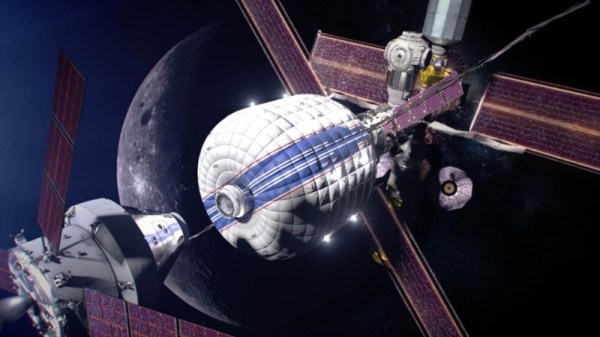
Now NASA hopes that’s finally going to happen in the 2020s as part of its Artemis program. These missions won’t just be sightseeing trips, the agency says they’re returning with the goal of building a sustainable infrastructure on and around our nearest celestial neighbor. With a space station in lunar orbit and a permanent outpost on the surface, personnel could be regularly shuttled between the Earth and Moon similar to how crew rotations are currently handled on the International Space Station.
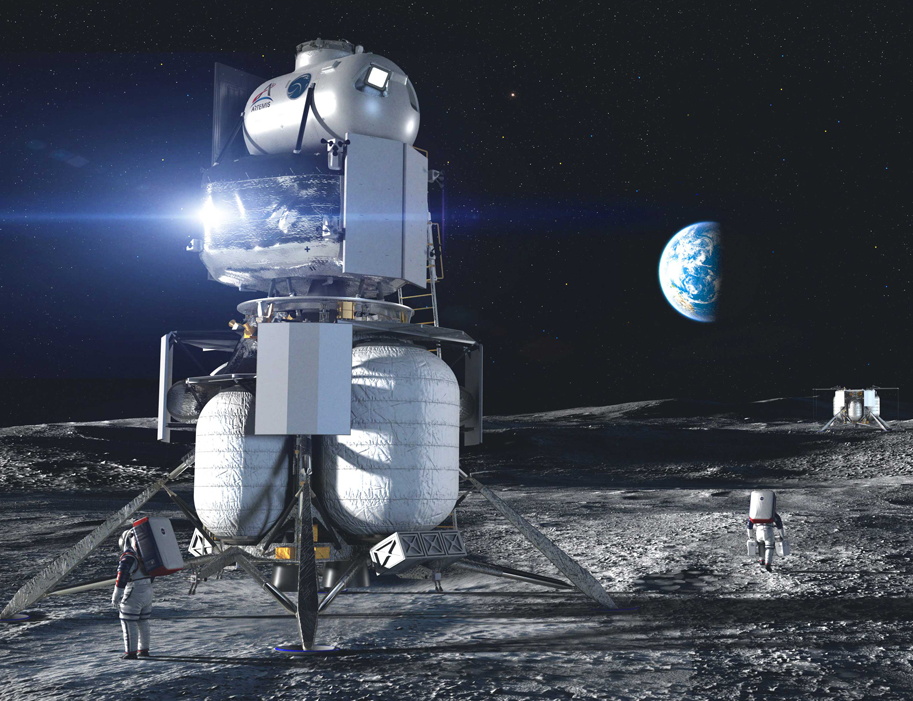
Artemis lander concept
Naturally, there are quite a few technical challenges that need to be addressed before that can happen. A major one is finding ways to safely and accurately deliver multiple payloads to the lunar surface. Building a Moon outpost will be a lot harder if all of its principle modules land several kilometers away from each other, so NASA is partnering with commercial companies to develop crew and cargo vehicles that are capable of high precision landings.
But bringing them down accurately is only half the problem. The Apollo Lunar Module is by far the largest and heaviest object that humanity has ever landed on another celestial body, but it’s absolutely dwarfed by some of the vehicles and components that NASA is considering for the Artemis program. There’s a very real concern that the powerful rocket engines required to gracefully lower these massive craft to the lunar surface might kick up a dangerous cloud of high-velocity dust and debris. In extreme cases, the lander could even find itself touching down at the bottom of a freshly dug crater.
Of course, the logical solution is to build hardened landing pads around the Artemis Base Camp that can support these heavyweight vehicles. But that leads to something of a “Chicken and Egg” problem: how do you build a suitable landing pad if you can’t transport large amounts of material to the surface in the first place? There are a few different approaches being considered to solve this problem, but certainly one of the most interesting among them is the idea proposed by Masten Space Systems. Their experimental technique would allow a rocket engine to literally build its own landing pad by spraying molten aluminum as it approaches the lunar surface.
The Apollo program proved that humans could land on the Moon and do useful work, but due to logistical and technical limitations, individual missions were kept short. For the $28 billion ($283 billion adjusted) spent on the entire program, astronauts only clocked in around 16 days total on the lunar surface. For comparison, the International Space Station has cost an estimated $150 billion to build, and has remained continuously occupied since November 2000. Apollo was an incredible technical achievement, but not a particularly cost-effective way to explore our nearest celestial neighbor.
Leveraging lessons learned from the Apollo program, modern technology, and cooperation with international and commercial partners, NASA has recently published their plans to establish a sustained presence on the Moon within the next decade. The Artemis program, named for the twin sister of Apollo, won’t just be a series of one-off missions. Fully realized, it would consist not only of a permanent outpost where astronauts will work and live on the surface of the Moon for months at a time, but a space station in lunar orbit that provides logistical support and offers a proving ground for the deep-space technologies that will eventually be required for a human mission to Mars.
It’s an ambitious program on a short timeline, but NASA believes it reflects the incredible technological strides that have been made since humans last left the relative safety of low Earth orbit. Operating the International Space Station for 20 years has given the countries involved practical experience in assembling and maintaining a large orbital complex, and decades of robotic missions have honed the technology required for precision powered landings. By combining all of the knowledge gained since the end of Apollo, the Artemis program hopes to finally establish a continuous human presence on and around the Moon.
Yesterday NASA’s Jet Propulsion Laboratory announced that their ventilator design has received Emergency Use Authorization from the US Food and Drug Administration. This paves the way for the design to be manufactured for use in the treatment of COVID-19 patients.
JPL, which is tightly partnered with the California Institute of Technology, designed the ventilator for rapid manufacturing to meet the current need for respiratory tools made scarce by the pandemic. The design process took only 37 days and was submitted for FDA approval around April 23rd. They call it VITAL — Ventilator Intervention Technology Accessible Locally — a nod to NASA’s proclivity for acronyms.


 Our Hack Chats are live community events in the Hackaday.io Hack Chat group messaging. This week we’ll be sitting down on Wednesday, June 10 at 12:00 PM Pacific time. If time zones have you down, we have a handy time zone converter.