NASA Making Big Upgrades To Their Big Dish DSS43

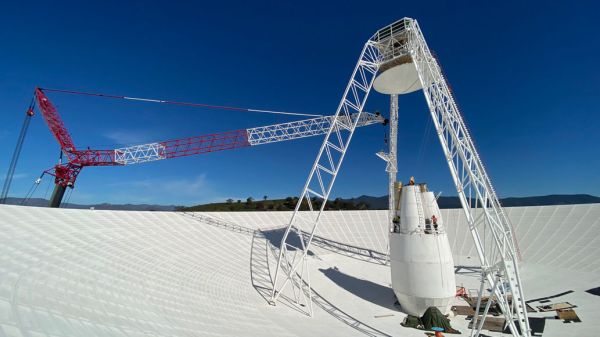
When it comes to antenna projects, we usually cover little ones here. From copper traces on a circuit board to hand-made units for ham radio. But every once in a while it’s fun to look at the opposite end of the spectrum, and anyone who craves such change of pace should check out DSS43’s upgrade currently underway.

Part of NASA’s Deep Space Network (DSN) built to communicate with spacecraft that venture far beyond Earth, Deep Space Station 43 is a large dish antenna with a diameter of 70 meters and largest of the Canberra, Australia DSN complex. However, the raw reflective surface area is only as good as the radio equipment at its center, which are now outdated and thus focus of this round of upgrades.

The NASA page linked above offers a few pieces of fun trivia about DSS43 and its capabilities. If that whets an appetite for more, head over to Twitter for a huge treasure trove. Whoever is in charge of Canberra DSN’s Twitter account has an endless fountain of facts and very eager to share them in response to questions, usually tagged with #DSS43. Example: the weight of DSS43 is roughly 8.5 million kilograms, 4 million of which is moving structure. They also shared time lapse video clips of work in progress, one of which is embedded after the break.

Taking the uniquely capable DSS43 offline for upgrades does have some consequences, one of which is losing our ability to send commands to distant interplanetary probe Voyager 2. (Apparently smaller DSN dishes can be arrayed to receive data, but only DSS43 can send commands.) Such sacrifices are necessary as an investment for the future, with upgrade completion scheduled for January 2021. Just in time to help support Perseverance (formerly “Mars 2020”) rover‘s arrival in February and many more missions for years to come.

Continue reading “NASA Making Big Upgrades To Their Big Dish DSS43”

Spacing Out: OneWeb Rescue, Starlink Base Stations, And Rocket Tests

Another couple of weeks, and a fresh crop of space news to run through as a quick briefing of the latest in the skies above us.

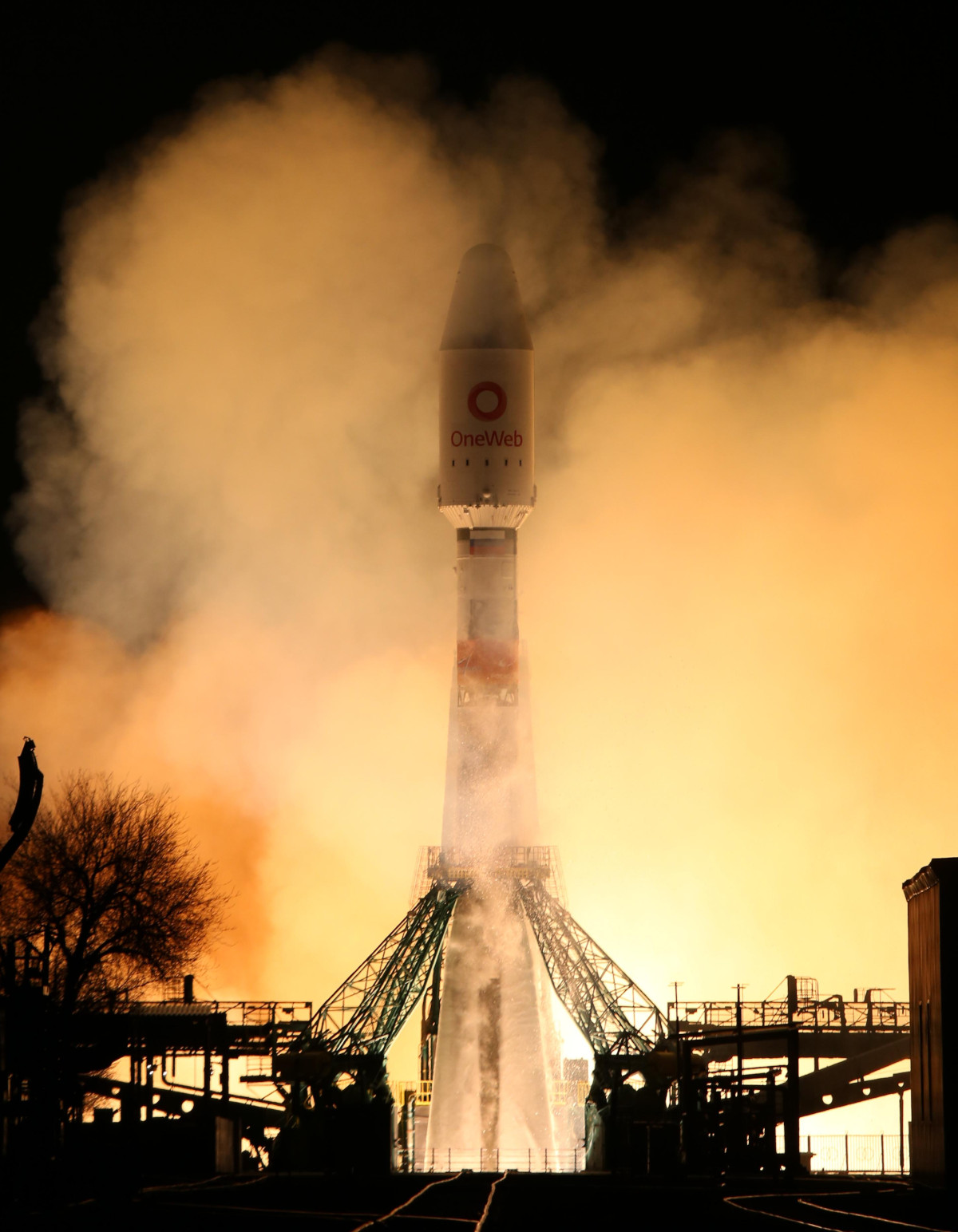
OneWeb's most recent launch, from Baikonur on the 21st of March 2020.
OneWeb’s most recent launch, from Baikonur on the 21st of March 2020. (OneWeb)

The global positioning orbits are getting pretty crowded, with GPS, Russia’s GLONASS, the EU’s Galileo, Japan’s QZSS, and now with the launch of the final satellite in their constellation, China’s BeiDou. As if five were not enough the chance that they might be joined by a sixth constellation from the United Kingdom resurfaced this week, as the UK government is expressing interest in supporting a rescue package for the troubled satellite broadband provider OneWeb. The idea of an independent GPS competitor from a post-Brexit UK has been bouncing around for a couple of years now, and on the face of it until this opportune chance to purchase an “oven ready” satellite constellation might deliver a route to incorporating a positioning payload into their design. The Guardian has its doubts, lining up a bevvy of scientists to point out the rather obvious fact that a low-earth-orbit satellite broadband platform is a very different prospect to a much-higher-orbiting global positioning platform. Despite the country possessing the expertise through its work on Galileo then it remains to be seen whether a OneWeb purchase would be a stroke of genius or a white elephant. Readers with long memories will know that British government investment in space has had its upsets before.

Happily for Brits, not all space endeavours from their islands end in ignominious retreat. Skyrora have scored another milestone, launching the first ever rocket skywards from the Shetland Islands. The Skylark Nano is a relatively tiny craft at only 2m high, and gathered research data during its flight to an altitude of 6km. We’ve followed their work before, including their testing in May of a Skylark L rocket on the Scottish mainland with a view to achieving launch capability in 2023.

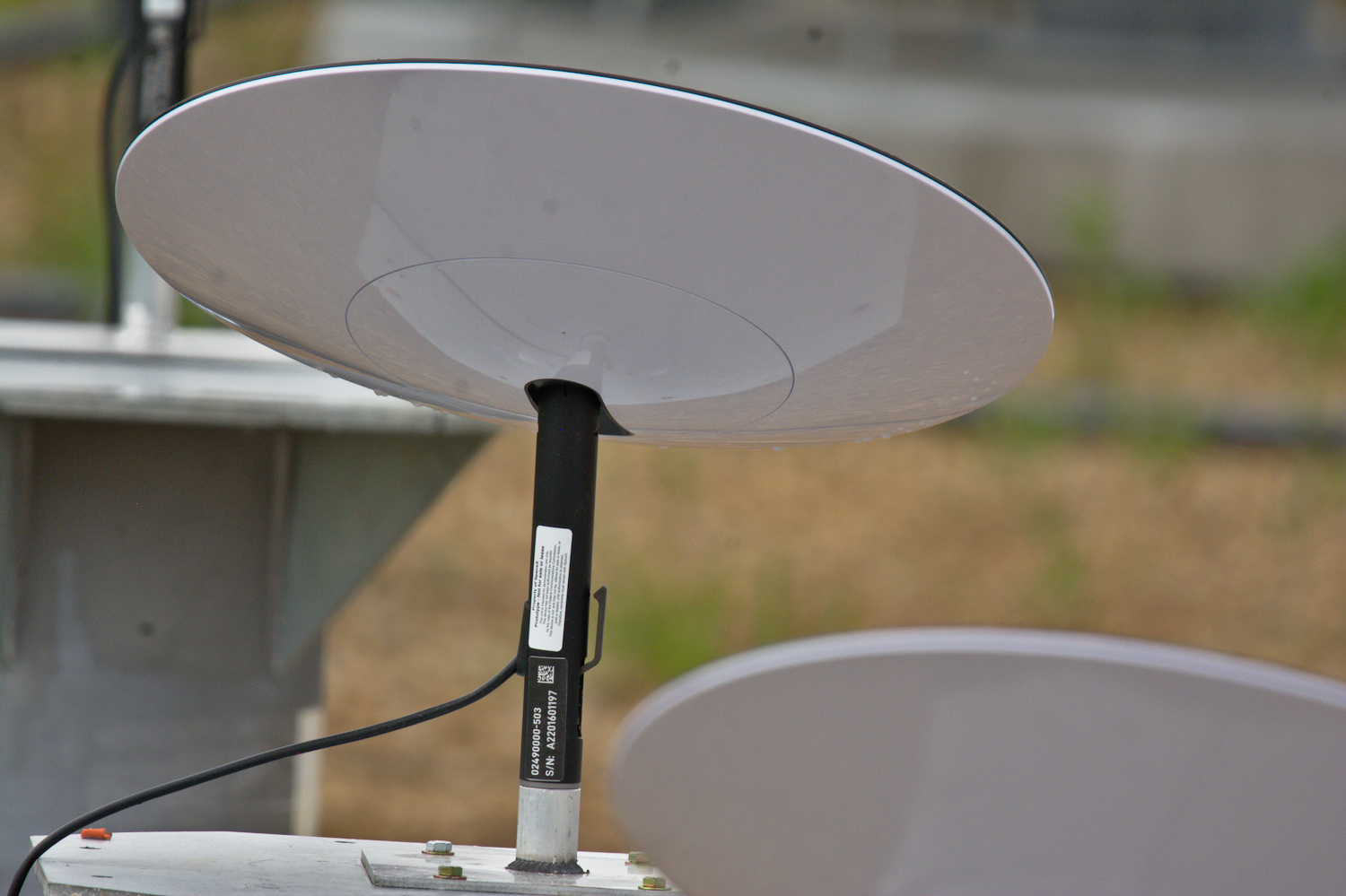
A Starlink phased array end user antenna, spotted in Winsconsin. (darkpenguin22)

SpaceX’s Starlink is never far away from the news, with a fresh set of launches delayed for extra pre-launch tests, and the prospect of signing up to be considered for the space broadband firm’s beta test. Of more interest for Hackaday readers though are a few shots of prototype Starlink ground stations and user terminals that have made it online, on the roof of a Tesla Gigafactory and at a SpaceX facility in Wisconsin. What can be seen are roughly 1.5m radomes for the ground stations and much smaller dinner-plate-sized enclosed arrays for the user terminals. The latter are particularly fascinating as they conceal computer-controlled phased arrays for tracking the constellation as it passes overhead. This is a technology more at home in billion-dollar military radars than consumer devices, so getting it to work on a budget that can put it on a roof anywhere in the world must be a challenge for the Starlink engineers. We can’t wait to see the inevitable eventual teardown when it comes.

Elsewhere, the Virgin Galactic SpaceShip Two completed its second glide test over its Mojave Spaceport home since being grounded in 2019 for extensive refitting, and is now said to be ready for powered tests leading to eventual commercial service giving the extremely well-heeled the chance to float in the zero gravity of suborbital spaceflight. And finally, comes the news that NASA are naming their Washington DC headquarters building for Mary W. Jackson, their first African American female engineer, whose story some of you may be familiar with from the book and film Hidden Figures. The previously unnamed building sits on a section of street named Hidden Figures Way.

Hackaday Links Column Banner

Hackaday Links: June 28, 2020

You can imagine how stressful life is for high-power CEOs of billion-dollar companies in these trying times; one is tempted to shed a tear for them as they jet around the world and plan their next big move. But now someone has gone and upset the applecart by coming up with a way to track executive private jets as they travel across North America. This may sound trivial, but then you realize that hedge fund managers pay big money for the exact same data in order to get an idea of who is meeting with whom and possibly get an idea of upcoming mergers and acquisitions. It’s also not easy, as the elites go to great lengths to guard their privacy. Luckily, the OpenSky Network lists all ADS-B traffic its web of ground stations receives, unlike other flight monitoring sites which weed out “sensitive” traffic. Python programs scrape the OpenSky API and cross-reference plane registrations with the FAA database to see which company jets are doing what. There are plenty of trips to Aspen and Jackson Hole to filter out, but with everyone and his little brother fancying themselves a day trader lately, it’s another tool in the toolbox.

We got a nice note from Michelle Thompson this week thanking us for mentioning the GNU Radio Conference in last week’s Links article, and in particular for mentioning the virtual CTF challenge that they’re planning. It turns out that Michelle is deeply involved in designing the virtual CTF challenge, after having worked on the IRL challenges at previous conferences. She shared a few details of how the conference team made the decision to go forward with the virtual challenge, inspired in part by the success of the Hack-A-Sat qualifying rounds, which were also held remotely. It sounds like the GNU Radio CTF challenge will be pretty amazing, with IQ files being distributed to participants in lieu of actually setting up receivers. We wish Michelle and the other challenge coordinators the best of luck with the virtual con, and we really hope a Hackaday reader wins.

Amateur radio is often derided as a hobby, earning the epithet “Discord for Boomers” according to my son. There’s more than a grain of truth to that, but there are actually plenty of examples where a ham radio operator has been able to make a big difference in an emergency. Case in point is this story from the Western Massachusetts ARRL. Alden Jones (KC1JWR) was hiking along a section of the Appalachian Trail in southern Vermont last week when he suddenly got light-headed and collapsed. A passing hiker who happened to be an emergency medical technician rendered aid and attempt to contact 911 on his cell phone, but coverage was spotty and the dispatcher couldn’t hear him. So Alden, by this point feeling a little better, pulled out his handy talkie and made an emergency call to the local repeater. Luckily the Western Massachusetts Traffic Net was just about to start, so they went into emergency mode and coordinated the response. One of the hams even went to the rescue staging area and rigged up a quick antenna to improve the signal so that rescuers could finally get a helicopter to give Alden a ride to the hospital. He’s fine now, and hats off to everyone who pitched in on the eight-hour rescue effort.

And finally, there are obviously a lot of details to be worked out before anyone is going to set foot on the Moon again. We’ve got Top People™ working on all the big questions, of course, but apparently NASA needs a little help figuring out how and where the next men and first women on the Moon are going to do their business. The Lunar Loo Challenge seeks innovative designs for toilets that can be used in both microgravity and on the lunar surface. There is $35,000 in prize money for entrants in the Technical division; NASA is also accepting entries in a Junior division, which could prove to be highly entertaining.

Lonnie Johnson, Prolific Engineer And Hero To Millions Of Kids (Even If They Don’t Know It)

The current generation Super Soaker XP30. (Hasbro)

To be a child in the 1970s and 1980s was to be of the first generations to benefit from electronic technologies in your toys. As those lucky kids battled blocky 8-bit digital foes, the adults used to fret that it would rot their brains. Kids didn’t play outside nearly as much as generations past, because modern toys were seducing them to the small screen. Truth be told, when you could battle aliens with a virtual weapon that was in your imagination HUGE, how do you compete with that.

How those ’80s kids must have envied their younger siblings then when in 1990 one of the best toys ever was launched, a stored-pressure water gun which we know as the Super Soaker. Made of plastic, and not requiring batteries, it far outperformed all squirt guns that had come before it, rapidly becoming the hit toy of every sweltering summer day. The Super Soaker line of water pistols and guns redefined how much fun kids could have while getting each other drenched. No longer were the best water pistols the electric models which cost a fortune in batteries that your parents would surely refuse to replace — these did it better.

You likely know all about the Super Soaker, but you might not know it was invented by an aerospace engineer named Lonnie Johnson whose career included working on stealth technology and numerous projects with NASA.

Continue reading “Lonnie Johnson, Prolific Engineer And Hero To Millions Of Kids (Even If They Don’t Know It)”

Rapid Prototyping Hack Chat

Join us on Wednesday, June 10 at noon Pacific for the Rapid Prototyping Hack Chat with Erika Earl!

When one thinks of the Jet Propulsion Lab, the NASA lab responsible for such amazing feats of engineering as Mars rovers and galaxy-exploring spacecraft like Voyager, one does not necessarily think of it as a hotbed of medical innovation. But when the COVID-19 pandemic started its march around the globe, JPL engineers decided to turn their skills from exploring other worlds to helping keep people alive in this one. Fittingly, the challenge they tackled was perhaps the most technically challenging: to build a ventilator that’s simple enough to be built in large numbers, enough to make a difference to the predicted shortfall, but that does the non-trivial job of keeping people breathing as safely as possible.

The result was VITAL, or Ventilator Intervention Technology Accessible Locally. It was designed, prototyped, and tested on an incredibly ambitious timetable: 37 days total. That number alone would be shocking enough, but when one adds in the disruptions and disconnection forced on the team of JPL engineers by the sudden need to self-isolate and work remotely that came up in the middle of the design process, it’s a wonder the team was able to get anywhere. But they worked through the technical and managerial issues and delivered a design that has now been licensed out to eight manufacturers under a no-fee license.

What does it take to bring something as complex as a ventilator to market in so short a time? To delve into that question, Supply Frame’s Erika Earl, who was part of the VITAL team, will stop by the Hack Chat. We’ll talk to her about being on the JPL team, what the design and prototyping process was like, and how the lessons learned here can apply to any team-based rapid-prototyping effort. You may not be building a ventilator in 37 days, but chances are good you can learn something useful from those who did.

join-hack-chatOur Hack Chats are live community events in the Hackaday.io Hack Chat group messaging. This week we’ll be sitting down on Wednesday, June 10 at 12:00 PM Pacific time. If time zones have you down, we have a handy time zone converter.

Click that speech bubble to the right, and you’ll be taken directly to the Hack Chat group on Hackaday.io. You don’t have to wait until Wednesday; join whenever you want and you can see what the community is talking about.
Continue reading “Rapid Prototyping Hack Chat”

NASA’s Long-Delayed Return To Human Spaceflight

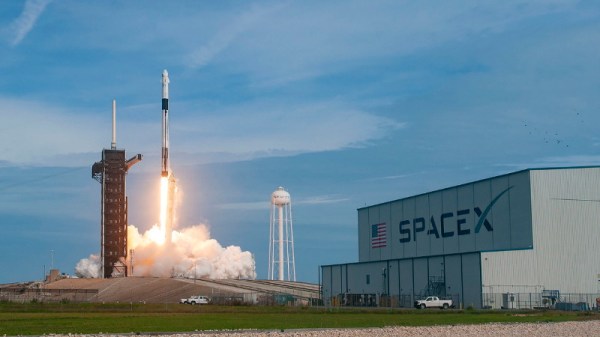
With the launch of the SpaceX Demo-2 mission, the United States has achieved something it hasn’t done in nearly a decade: put a human into low Earth orbit with a domestic booster and vehicle. It was a lapse in capability that stretched on far longer than anyone inside or outside of NASA could have imagined. Through a series of delays and program cancellations, the same agency that put boot prints on the Moon and built the iconic Space Shuttle had been forced to rely on Russia to carry its astronauts into space since 2011.

NASA would still be waiting to launch its own astronauts had they relied on America’s traditional aerospace giants to get the job done. The inaugural flight of the Boeing CST-100 “Starliner” to the International Space Station in December was an embarrassing failure that came perilously close to losing the unmanned capsule. A later investigation found that sloppy software development and inconsistent testing had caused at least two major failures during the mission, which ultimately had to be cut short as the vehicle couldn’t even reach the altitude of the ISS, to say nothing of making a docking attempt. NASA and Boeing have since agreed to attempt another test of the CST-100 sometime before the end of the year, though a delay into 2021 seems almost inevitable due to the global pandemic.

But America’s slow return to human spaceflight can’t be blamed on the CST-100, or even Boeing, for that matter. Since the retirement of the Space Shuttle, NASA has been hindered by politics and indecisiveness. With a constantly evolving mandate from the White House, the agency’s human spaceflight program has struggled to make significant progress towards any one goal.

Continue reading “NASA’s Long-Delayed Return To Human Spaceflight”

If This Is Your Inspiration From Space, You’re Doing It Wrong

So after a false start due to bad weather, the first crewed launch of a SpaceX Crew Dragon capsule with two astronauts on board has gone ahead. After playing catch-up with the ISS for around 27 hours they’re now safely aboard. At times it seems that space launches have become everyday occurrences, but they are still heroes who have risked their lives in the furtherment of mankind’s exploration of space. Their achievement, and that of all the scientists, engineers, and other staff who stand behind them, is immense.

I watched the drama unfold via the live video feed. Having heaved a huge sigh of relief once they were safely in orbit, the feed cut to the studio, and then moved on to interview the NASA administrator Jim Bridenstine. He was naturally elated at a successful launch, and enthused about the agency’s achievement. You can watch the full interview embedded below, but what caught my attention was his parting sentence:

And if this can inspire a young child to become the next Elon Musk, or the next Jeff Bezos, or the next Sir Richard Branson, then that’s what this is all about

I was slightly shocked and saddened to hear this from the NASA administrator, because to my mind the careers of Musk, Bezos, or Branson should not be the ones first brought to mind by a space launch. This isn’t a comment on those three in themselves; although they have many critics it is undeniable that they have each through their respective space companies brought much to the world of space flight. Instead it’s a comment on what a NASA administrator should be trying to inspire in kids.

Ask yourself how many billionaire masters-of-the-universe it takes for a successful space race compared to the number of scientists, engineers, mathematicians, technicians, physicists, et al. From the anecdote of the NASA administrator it takes about three, but if he is to make good on his goal of returning to the Moon in 2024 and then eventually taking humanity to Mars it will take a generation packed full of those other roles. To understand that we’ll have to take a trip back to the Apollo era, and how that generation of kids were inspired by the spacecraft on their screens.

Inspiration from probably the coolest room in the world at the time, the Apollo mission control in Houston.
Inspiration from probably the coolest room in the world at the time, the Apollo mission control in Houston. NASA on The Commons / No restrictions

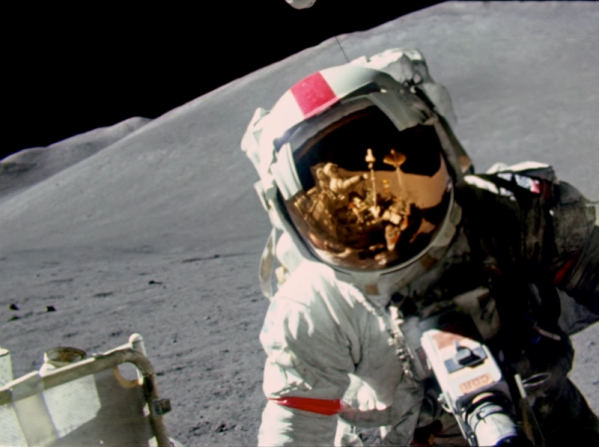
Fifty years ago, we were very much on the brink of becoming a spacefaring planet. American astronauts were taking their first steps on the Moon, and Soviet cosmonauts were occupying real space stations that would soon be capable of housing them for months at a time. Planetary probes were returning colour TV pictures from other worlds, and it was certain that in the immediate aftermath of the Apollo programme we’d be sending astronauts and probably cosmonauts too further afield. A Mars base in the 1980s perhaps, and following our fictional Star Trek heroes further afield thereafter.

We now know it didn’t quite work out that way, but a whole generation of tech-inclined kids grew up wanting nothing more than to be involved in space flight. The vast majority of us never made it, but with that inspiration we took our soldering irons and 8-bit home computers and ran with them. Those NASA folks were the coolest of role-models, and no doubt their Soviet equivalents were too for kids on the other side of the Iron Curtain.

With the best will in the world, the chances of any kid becoming the next Jeff Bezos is about as high as that of their becoming the next Neil Armstrong. Compared to the number of kids in the world, the number of billionaires and the number of astronauts both pale into statistical insignificance. But the chances of a kid becoming an engineer or a scientist is much higher, and in those careers their chances of having some of their work be involved with the space effort becomes not entirely unlikely.

I understand what the NASA administrator was trying to say, but can’t shake the feeling that if those are the people he rolls out to inspire kids watching a space launch, he’s missed an opportunity. Those are the names we all recognize, but shouldn’t we also elevate the people making the scientific breakthroughs so their names are equally recognized? Like Margaret Hamilton, Gene Kranz, and Sergei Korolev and many others before them, we should be making names like Tom Mueller and Margarita Marinova prominent examples of where a career in the sciences can take you. But to be honest, the real problem is we just don’t hear much about all the people doing this fascinating engineering and that’s a sad state of affairs.

Looks like it’s time for Hackaday to pursue a biography series based on the many great minds who are the ones delivering on the promise and vision of today’s (and tomorrow’s) space race. Get us started by talking about your favorite behind the scenes science folks in the comments below.

Continue reading “If This Is Your Inspiration From Space, You’re Doing It Wrong”