Game Boy Video Out Adapter

[youtube=http://www.youtube.com/watch?v=JRKB5FT3Feg]

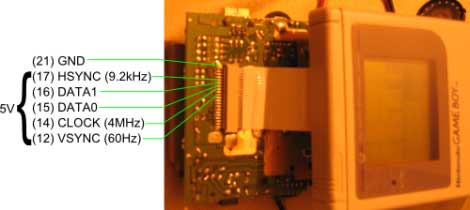
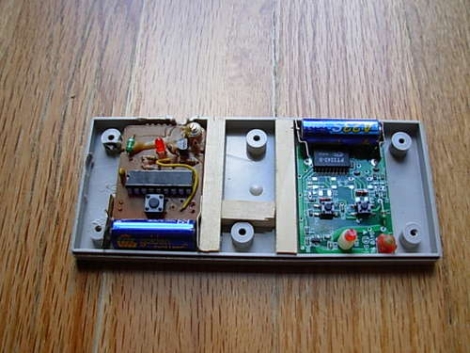
A bit light on the details, but we enjoyed seeing this video out device for the Nintendo Game Boy. A parallel cable connects to a modified Game Boy and transmits signals to the adapter which is housed in an old VHS cassette. We gather that some Super Game Boy hardware does the signal processing but from there your guess is probably better than ours.

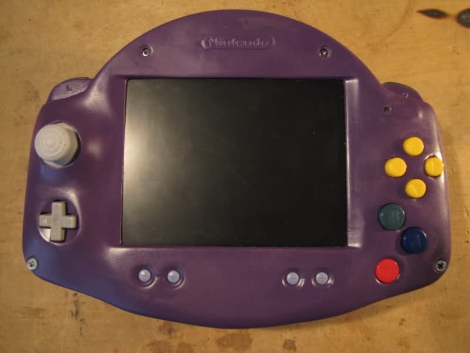
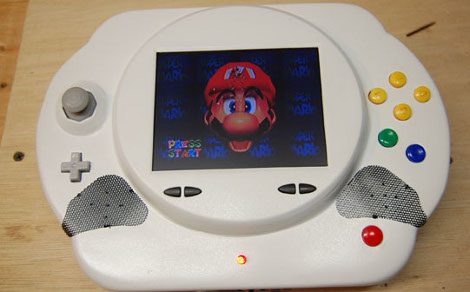
[NeX] mentions that he originally wanted a screen to be included in the cassette. We’ve seen custom portables with small screens before, but he’s also developed a bare bones hand-held without a screen so that’s where the inclusion in the cassette would have been handy. We also wonder how the images will look on a big TV of the 50+ inch size. [NeX] has been pretty busy with the hacking lately, don’t miss the wire porn of his homemade Game Boy project.

[Thanks Jose]

Force Feedback For The Nintendo DS

[youtube=http://www.youtube.com/watch?v=TBH6vQhKaiY]

This cool mod brings force feedback to the Nintendo DS. There’s a motor with an offset weight mounted inside the DS for vibration and some nice SMD LEDs plopped in there for good measure. The force feedback is being controlled via a picaxe mocrocontroller and triggered from the analog audio signal. While using the analog audio may not be the most precise method, he says that the results are pretty decent.

[Thanks Dan, via HacknMod]

Arduino To Nintendo DS Interface

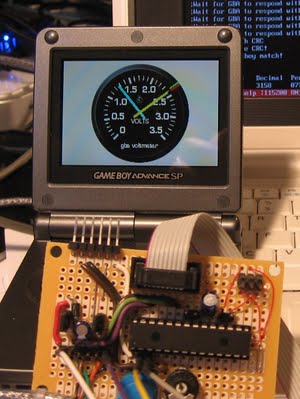
[Hounjini] was poking around at the Game Boy Advanced bus of his Nintendo DS lite and figured out how to use it to connect an Arduino to the DS. For testing he’s soldered an IDC plug to the cartridge cover pin interface but this only requires four connections. The Arduino can both send and receive data from the DS lite as shown in the example videos after the break. The data access is made possible by making the Arduino look like a controller that the DS is happy to talk to.

Continue reading “Arduino To Nintendo DS Interface”

Repair Or Improve Your NES

There’s a warm place in our hearts for the original Nintendo Entertainment System. It’s too bad we don’t have that hardware sitting around anymore. But if you do there’s a chance it needs some TLC and there’s always room for a blue LED mod. [Raph] has a wonderful collection of NES hardware repairs and hacks that you should take a look at. These include replacing the power supply, fixing the cartridge connector, monkeying with the CIC chip, adding a reset button on the controller, converting the audio from mono to stereo, and yes, swapping in a blue LED. Oh, and as a side note, [Raph] gets a bit of extra hacker ‘cred for including “coded manually using VIM” at the bottom of his page. Classic.

NES Console To Cartridge Security In Depth

[Segher] has reverse engineered the hardware and command set for the NES CIC chips. These chips make up the security hardware that validates a cartridge to make sure it has been licensed by Nintendo. Only after authentication will the console’s CIC chip stop reseting the hardware at 1 Hz. The was no hardware information available for these chips (go figure) so [Segher] had to do some sleuthing with the tools at hand which include some rom dumps from the chip pairs. He was nice enough to share his findings with us. We’re betting they’re not of much use to you but we found it an interesting read.

[Thank ppcasm]

[Photo credit: Breaking Eggs and Making Omelets]

NES RAM Replacement

[Spatula Tzar] Turned on her NES one day to find it no longer working. Off went the case and out came the oscilloscope. After probing around for a bit, she found that one of the RAM chips was very hot. She hot aired off the bad chip implementing an “Impenetrable Aluminum Heat Shield of Science” to protect the rest of the components. In the chip’s place she soldered a wide DIP socket for which the NES engineers had thoughtfully left a place. Then, using a 128Mbit SRAM SOIC, she soldered it to 0.100″ headers to fit in the socket. As the original chip was only 16Mbit, unused address lines are tied high or low. The console is now fully functional again. Also checkout the comments on Oldschool NES ‘repair’ how-to.

LEDboy Super Pixel Brothers

[youtube=http://www.youtube.com/watch?v=cB6vSHDDdhI]

We really love this version of super mario brothers that [Brad] is putting together. It is played on an 8×8 RGB LED screen, powered by a pic microprocessor. There aren’t many details on the construction or code yet, but we expect he’ll publish it soon. We’re guessing it is very similar to his other 8×8 game system. If you really want to get a jump start, he has published some great tutorials on working with pic microprocessors.

[via instructables]