Update: 50MHz To 100Mhz Scope Conversion

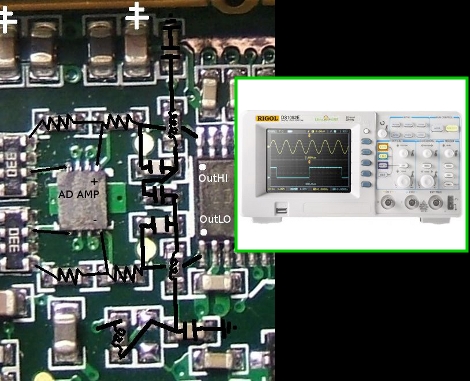
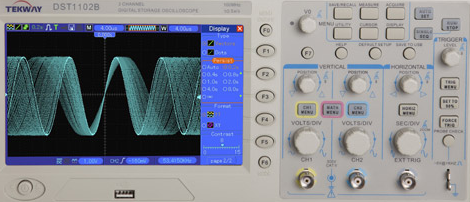
Changing this 50MHz Rigol oscilloscope into its larger, more expensive brother just became quite a bit easier. When we originally looked at this hack it required pulling some capacitors off of the board. Now all it takes is three commands over a serial terminal connection.

Take a look at the walk through video after the break. You’ll see that there’s one chip that needs to be setup differently to change the functionality. Removing capacitors was actually changing the commands sent to initialize that chip at power-up. Now you can just change the model number and one letter of the serial number via a terminal and the firmware will recognize this as the more expensive DS1102E.

Continue reading “Update: 50MHz To 100Mhz Scope Conversion”

50MHz To 100Mhz Scope Conversion

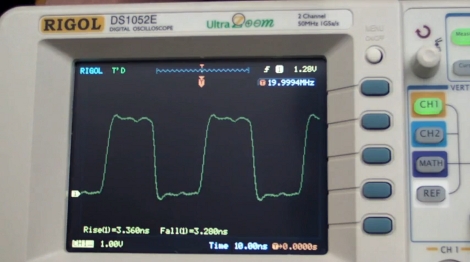
[Ross] is the proud owner of a 50 MHz Rigol DS1052E oscilloscope. He’d like to have the 100 MHz version but the $400 difference in price puts it out of his reach. After some extensive poking around on the PCB and pouring over datasheets, he managed to reverse engineer the design and upgrade to a 100 MHz version. This is as easy as desoldering one capacitor to deactivate a high-pass filter present in the lesser model of scope, unlocking the faster potential of its bigger brother.

USB Oscilloscope

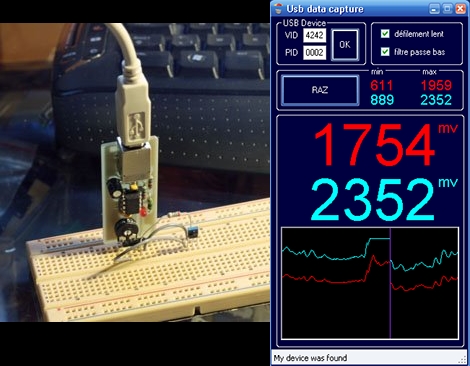
Here’s a USB oscilloscope project from a few years back. It’s easy to build on a single-sided PCB and very cheap because it uses just a handful of parts. At the center, an ATtiny45 microcontroller uses its ADC capabilities for the two traces and also handles the USB connectivity. The internal oscillator is used and trimmed up for accuracy by referencing the USB clock. On the PC side of things, a program written in C# displays the data coming over the serial bus. Quick, small, and useful; a schematic, board layout, firmware, and PC software sources are all available for download.

[Thanks Shri]

Oscilloscope Doubles As A Serial Terminal

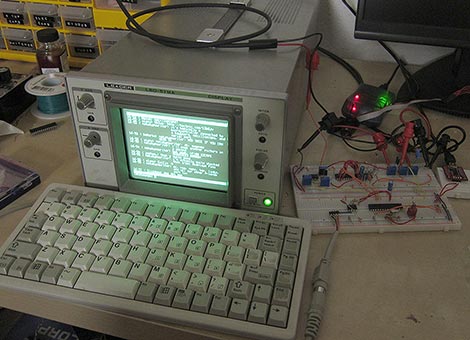
PC-based USB oscilloscopes are fast becoming all the rage. [Matt Sarnoff’s] Terminalscope takes the reverse approach, adapting an oscilloscope into a full serial terminal. You may have seen something similar before in the Dutchtronix/SparkFun O-Clock, but [Matt’s] project goes one further by adding a PS/2 keyboard port for full bidirectional serial communication, and with much sharper display resolution to boot.

The mostly VT-100 compatible Terminalscope is built around two AVR microcontrollers: an ATmega328P runs full-tilt to generate the video signal and handle serial I/O, while an ATtiny45 handles keyboard input to avoid interrupting the ’328’s duties. Rather than vector trace each character, a raster-scanning approach is used: the beam follows a fixed X/Y path (like a television), while modulating the Z input (beam intensity) to form an image. The device can be connected to a PC via serial port or USB-to-TTY adapter, or directly to another microcontroller to debug serial output.

We recently showed an oscilloscope being used as a multichannel digital logic display. The Terminalscope provides yet another use for this essential bench tool and could nicely round out a “poor man’s” testing setup. The schematic and full source code are available for download.

Use An Analog Oscilloscope To Display Digital Logic

[Mike Bradley] wanted to use his oscilloscope to display 8 channels of digital signals. Alas, the analog unit didn’t have this capability. Not to worry, he threw together an adapter module that does the trick. Using a PIC 18F26K20 microcontroller he inputs four or eight channel digital logic (at 5V) and filters the output to an analog signal that the oscilloscope can interpret. What you see in the photo above is the result.

DSO Nano Oscilloscope Reviewed

dsonano

We’ve been eyeing Seeed Studio’s DSO nano digital storage oscilloscope with a mix of intrigue and skepticism. A pocket-sized $89 storage ’scope? This is a joke, right? Hack a Day reader [Blair Thomson] has written a thorough review based on his experience with one of the beta test units, and it might be a winner after all.

[Blair] feels the unit compares favorably to buying a similarly-priced secondhand analog oscilloscope. The DSO nano wins major points for ease of use, a good range of functionality, and of course the whole portability thing (the enclosure is a repurposed portable media player). Can’t say we’re entirely convinced though. As a single-trace ’scope with 1 MHz bandwidth, the DSO nano may be extremely limiting for anything but basic hobbyist use…which, to be fair, is exactly how they’re marketing it. We can see a place for this the same way there’s a place for $10 multimeters — an inexpensive, toss-in-the-toolbag second ’scope to quickly test for vital signs, something that might complement but not replace a good bench unit.

Text On An Oscilloscope

[youtube=http://www.youtube.com/watch?v=zLpfq4tHZxE]

This is an interesting little toy. A tiny board that can display text on an oscilloscope. The components, or rather just component, is a PIC16F628A. Aside from a power supply, that’s it. It can display 10 characters at a time and, as you can see above, scroll them as well. We don’t really know of a practical use for this, but it would make a nice practical joke tool. If you want some more complicated oscilloscope effects, check out Tennis for Two.

[via HackedGadgets]