One of the major choices a newcomer to the RC flying hobby must make is on the RC link protocol. To add the list of choices (or confusion) there is now a new open-source, low latency, and long-range protocol named ExpressLRS.
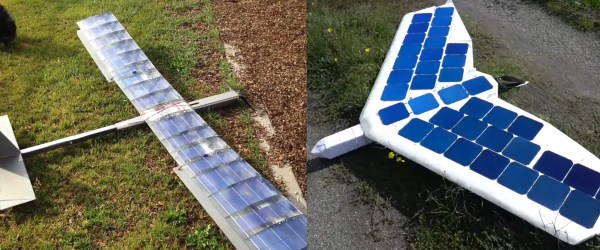
ExpressLRS’s claim to fame is high packet rates of up to 500 Hz, with plans for 1000 Hz, and latency as low as 5 ms. Long-range testing has pushed it out to 30 km with a flying wing (video below), but this is not unheard of for other protocols. Most modern RC protocols run either in the 2.4 GHz or 915/868 MHz bands, with the latter having a definite advantage in terms of range.
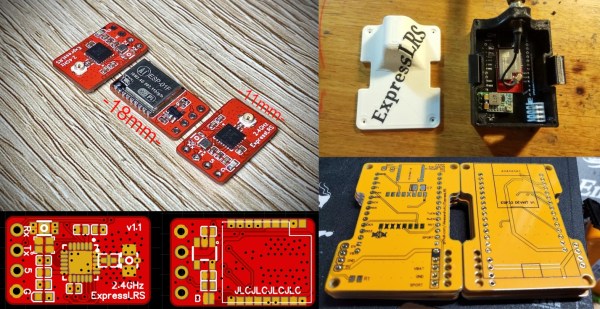
ExpressLRS has options to run on either band, using Semtech SX127x (915/868 MHz) or SX1280 (2.4 GHz) LoRa transceivers, connected to STM32, ESP32, or ESP8285 microcontrollers. The ESP microcontrollers also allow software updates over Wi-Fi.
We’re excited to see an open-source competitor to the proprietary protocols currently dominating the market, but several open-source protocols have come and gone over the years. Hardware availability and compatibility is a deciding factor for a new protocol’s success, and ExpressLRS already has an advantage in this regard. Existing Frsky R9 transmitters and receivers, and Immersion RC Ghost receivers are compatible with the firmware. There are also DIY options available, and the GitHub page claims that several manufacturers are working on official ExpressLRS hardware.
If you’re already into the RC hobby, and you have compatible hardware lying around, be sure to give it a try and give some feedback to the developers! One scenario we would like to see tested is high interference and congested band conditions, like at RC flying events.
All the source code and hardware designs are available on GitHub, and there are active community discussions on Discord. Continue reading “ExpressLRS: Open Source, Low Latency, Long Range RC Protocol”



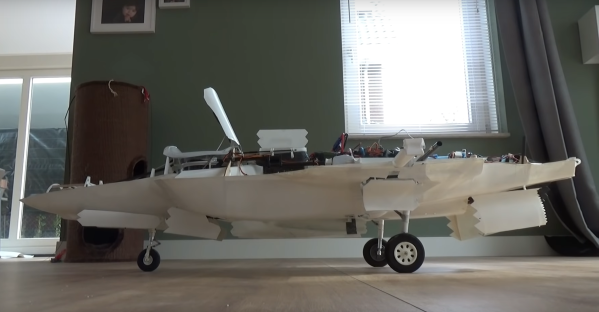
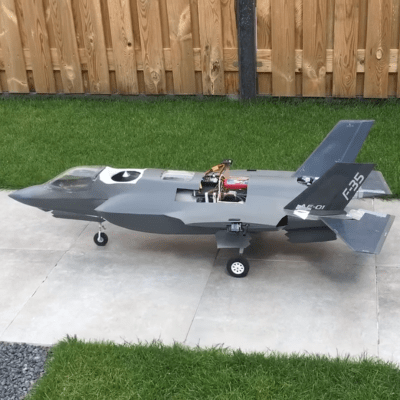 [Joel] wants his model to be as close as possible to the real thing, and has integrated all these features into his build. Thrust is provided by two EDF motors, the pivoting nozzle is 3D printed and actuated by three set of small DC motors, and all 5 doors for VTOL are actuated by a single servo in the nose via a series of linkages. For tilt control, air from the main fan is channeled to the wing-tips and controlled by servo-actuated valves. A flight controller intended for use on a multi-rotor is used to help keep the plane stable while hovering. One iteration of this plane bit the dust during development, but [Joel] has done successful test flights for both hover and conventional horizontal flight. The really tricky part will be transitioning between flight modes, and [Joel] hopes to achieve that in the near future.