Weed Eater String Made From Plastic Bottles

For those who don’t mind constantly adding tiny but measurable amounts of microplastics to their landscaping, string trimmers are an excellent way of maintaining edging around garden beds, trimming weeds, or maintaining ground covers on a steep hill. One problem with them, though, is that not only is the string consumable but it can be expensive. Plus, if you have a trimmer with a proprietary spool you need to hope the company never goes out of business. Or, you can simply refill your string spool with this handy tool.

The build uses plastic bottles to create the string from what would likely become garbage anyway. First, a sharp roller-style knife slices the plastic into a long thin strip. Once cut, it is fed through a heater similar to a hot end on a 3D printer which allows the plastic to be deformed or forged into a cylinder. From there the plastic is added onto a spool, which also has the motor in it that drives the entire mechanism. In this case it is using an old variable-speed drill.

From the comments on the video, there is some discussion about the economics of using this string in a weed eater. It’s likely the plastic won’t last as long as specialty string trimmer string, and the time and expense of making the plastic may never save much money. But we have to give credit to the ingenuity nonetheless. And, if you’re really into recycling plastic just for the sake of keeping it out of the landfill, there are plenty of other ways to go about accomplishing that goal.
I will NEVER buy weed whip line again! from landscaping

2022 Hackaday Prize: Reuse, Recycle, Revamp Finalists

The 2022 Hackaday Prize is focused on taking care of the planet. The theme of our second challenge round, “Reduce, Recycle, Revamp” is all about tailoring your projects to make use of existing resources and keeping material out of the landfill rather than contributing to it. Our judges have scrutinized the entries and handed me the sealed envelope. All of these ten projects will receive $500 right now and are eligible for the Grand Prize of $50,000, to be announced in November.

We were looking for two broad types of recycling projects in this round, either projects that incorporate a significant recycled component in their build, or projects that facilitate recycling themselves, and frankly we got a good mix of both!
Continue reading “2022 Hackaday Prize: Reuse, Recycle, Revamp Finalists”

PVC Pipe Transformed Into Handy Tool Box

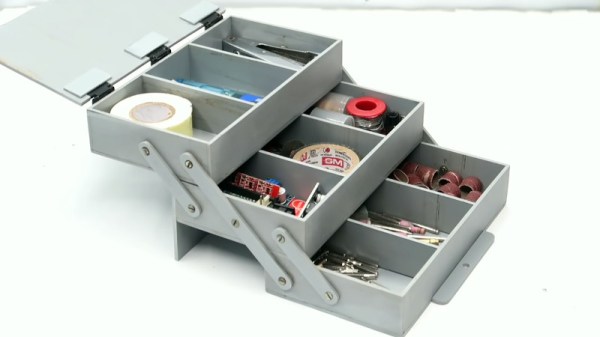
Would you believe the multi-tiered toolbox pictured here started its life as a piece of bog standard PVC pipe? It certainly wouldn’t be our first choice of building material, but as shown in the video after the break, it only takes a heat source and something suitably flat to convert a piece of PVC pipe into a versatile sheet material.

Flattening the heated PVC.

Unrolling the PVC pipe and getting it flat is covered in the first minute of the video, while the rest of the run time is dedicated to building the tool box. Each and every piece you see here, except for the screws and lid hinges, is carefully cut from the PVC sheet. Though we suspect a few more chunks of pipe went into this build than the video would have you believe.

Would we build such an elaborate box if we had to cut each piece of the thing out by hand? Probably not. But then, we can’t deny the final results here are pretty impressive. Incidentally, if you thought those hinges on the top looked a lot like links removed from a watch band…you’d be correct.

Admittedly we’re a bit late covering this one, and under normal circumstances we might have let it slip by given the several million views it’s amassed over the last year. But the central theme of reusing a common material to build something unexpected is solid Hackaday territory, and aligns closely with this year’s Hackaday Prize challenges.

Continue reading “PVC Pipe Transformed Into Handy Tool Box”

A fridge magnet with a display showing recycling reminders

Hackaday Prize 2022: BinPal Is A Convenient Recycling Reminder

While curbside pickup of recyclables is convenient, it does require you to keep track of which type of waste is picked up when: miss the biweekly paper pickup and you’ll soon find yourself stockpiling four weeks’ worth of boxes and newspapers. When [Dominic Buchstaller]’s stack of cardboard began to reach his ceiling, he decided to take action by building himself BinPal: a fridge magnet that helps you remember when to take out which bin.

At heart of the simple but effective BinPal is an ESP32 board that connects to Google Apps Script and retrieves the pickup schedule from Google Calendar. If one of four categories of waste is due for pickup, its icon is highlighted on an LCD screen. The user can press a touch-sensitive button to confirm the bin has been brought out for pickup; if that hasn’t been done by 8 pm, the display’s backlight starts flashing as an additional reminder.

The outer shell of the device is made from laser-cut plywood, with a few strong magnets glued inside to ensure the BinPal stays firmly attached to the fridge. In the true spirit of recycling, [Dominic] used only components that he had in his parts bin to make the BinPal. However, these parts are all easily available online, and with the full schematics and code available on the project’s Hackaday.io page it should be easy to adapt the design to different hardware platforms as well.

[Dominic]’s design was inspired by a flashing LED chore reminder we featured a few years ago. You can also make household task reminders by reusing a Kindle for its ePaper display.

2022 Hackaday Prize: Reuse, Recycle, And Revamp All The Things

Where has the year gone? It’s already summer in the Northern Hemisphere, and the second Challenge of the 2022 Hackaday Prize ends this weekend, along with your chance at one of ten $500 prizes. If you thrive on last-minute challenges, consider the eleventh hour upon you. But don’t panic; there’s still a decent amount of time left to start a new project over on Hackaday.io and get it entered into the contest.

The second Challenge focuses on creating new ways of recycling materials. What does this look like? That’s a pretty broad topic, but it could be anything from a better method of chip harvesting to an inexpensive and/or low-energy process for shredding used plastic and forming it into millable blocks.

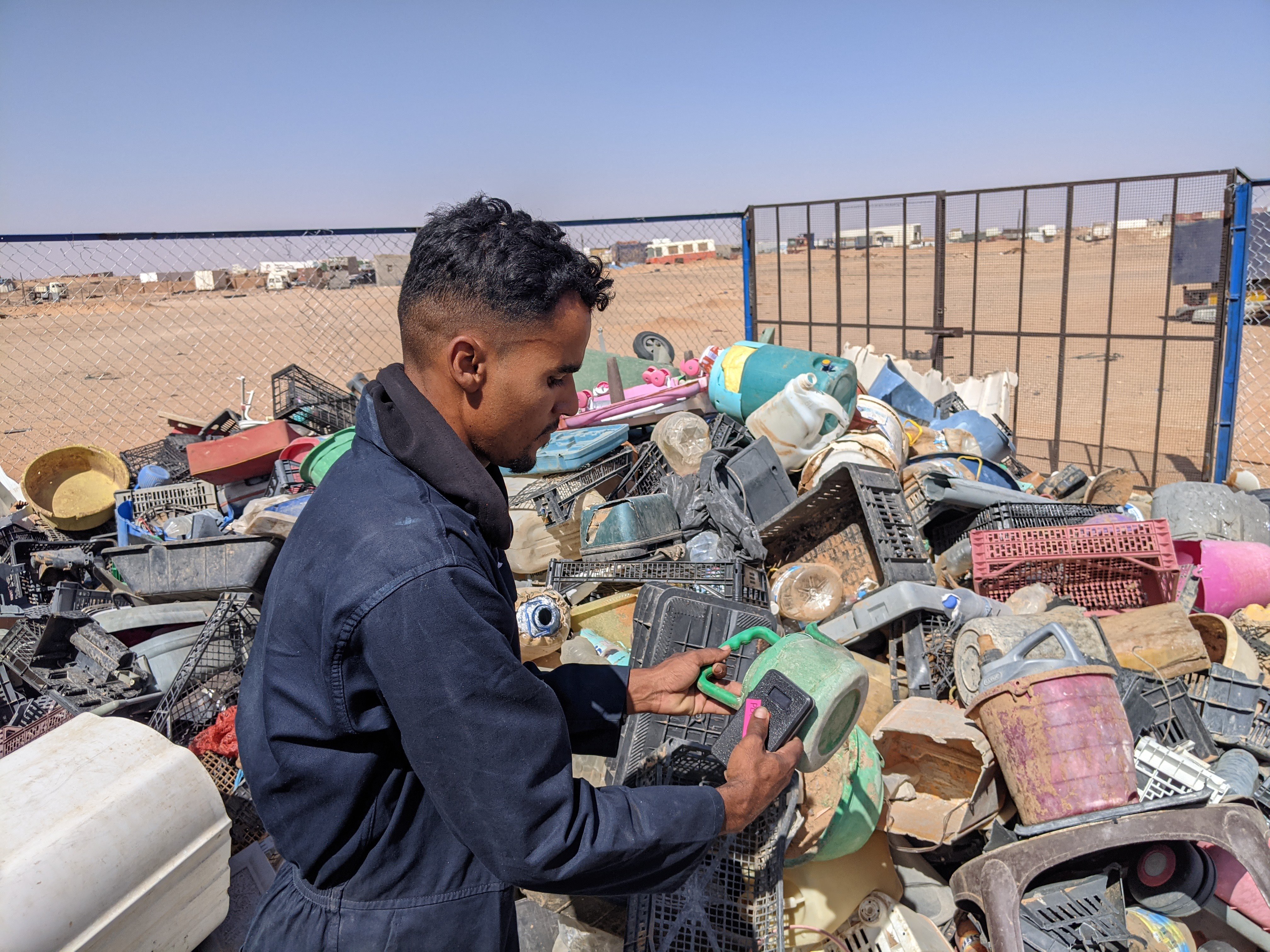
Don’t just think big on a commercial scale — imagine what people can do at home with the stuff in their recycle bin or their neighbor’s trash. If everyone had access to one of [Jerzeek]’s plastic scanners for identifying the type of plastic that mystery bucket or old watering can was made of, just think what could be done. As long as your project focuses on reusing, recycling, or revamping, we want to see it!

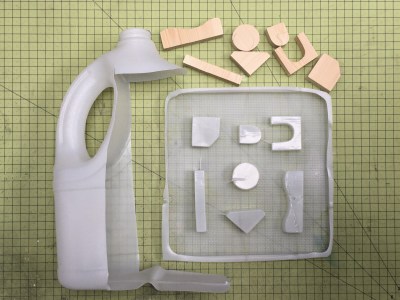
So far, we’ve seen a bunch of excellent projects, many of which are focused on recycling plastic. There’s the Pullstruder, which creates PET filament from plastic bottles, and a method for vacuum-forming HDPE plastic directly from milk jugs. There has to be more than one way to upcycle acrylic scraps into new sheets and jewelry, but the best one definitely involves a panini press and a car jack.

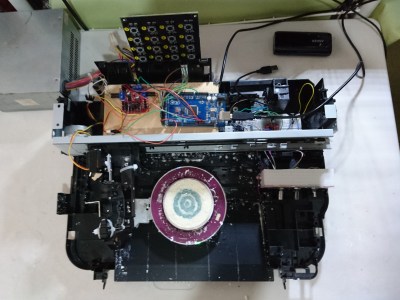
Recycling plastic is totally fantastic, but it’s not the only material available at the dump. You’ll probably have no trouble finding tires from which to make footstools and tables, and if you’re lucky, there’ll be an old phone that could be turned into an IoT assistant. If you want to take the circularity thing literally, dig up a printer and and old CD player and turn them into a mini pottery machine that uses cornstarch.

So basically, we have a bunch of awesome entries right now, but we don’t have yours! Remember: it doesn’t have to be a new project, just a new project page. Did you revolutionize recycling during lockdown? Make a new project and tell us about it! Just don’t forget to actually enter the thing by using the drop-down on the left before 7AM PDT on Sunday, June 12th. Need a time converting countdown thingy? We’ve got you.

After the recycle bin is empty, we’ll be moving on immediately to the Hack It Back challenge. This time, we’ll be asking you to teach old tech new tricks, or to bring a piece of gear back from the dead. Turn a blender into a Dremel-like tool, or give an old ‘scope a screen upgrade. You know what to do!

Hackaday Prize 2022: Recycled Tire Table Is Where The Rubber Meets The Road

The problem with good inventions is that we usually end up with way too many of that particular widget lying around, which can cause all kinds of problems. Take the car tire, for instance. They were a great invention that helped spell the end of buggy whips and broken wagon wheels. But there are so many used-up tires about today that some people end up burning them in large piles, of all possible things.

Not [Vaibhav], who prefers to turn trash into utilitarian treasures. With little more than an old tire, some jute rope, and four plastic drink bottles, they made a sturdy, low-slung piece of furniture that could be used as a coffee table, a foot stool, or whatever life calls for.

Construction was fairly simple and involved stabilizing the hollow core with a round piece of cardboard glued to either side of the tire. Then came the jute rope and glue artistry, which hides any trace of the foundational materials. Finally, [Vaibhav] glued four plastic bottles to the bottom to act as legs. We think that steel cans would last longer and support more weight, but if plastic bottles are the only option, you could always fill them with dirt or sand.

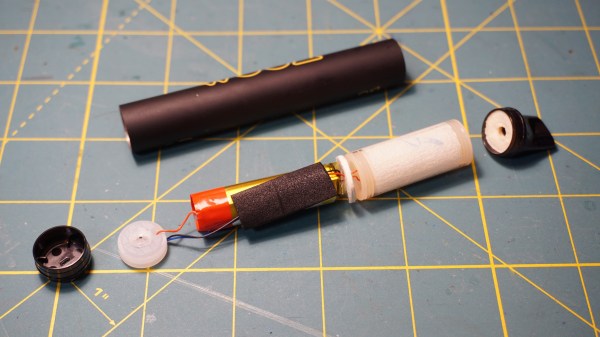
A vape pen, broken into parts, all laid out on a cutting mat

2022 Hackaday Prize: Disposable Vape Pens Turned Project Parts

Disposable vape pens, a sub-genre of electronic cigarettes, have been a fad for a few years now – they’re small self-contained devices with a rechargeable battery and some vape liquid inside. As the battery discharges and the liquid runs out, the entire vape pen is typically thrown out. [Dimitar] wants to change that, however, and teaches us how to reuse as much of the vape pen as possible — as yet another underappreciated source for parts we can use in our projects.

In an extensive worklog, he breaks down and documents a vape pen’s inner workings, coupled with a video we’ve placed below the break showing ways to disassemble them. In these, he shows how we can reuse the casing and the plastic parts, should any of us be interested in a project that happens to fit the e-cig form factor. Attention is paid to the sensor that triggers the evaporation — it may look like a microphone, but is actually a purpose-built pressure-sensor with a high-side switch! He tears into one of these in a separate video, showing how to reuse it as a capacitive touch controller. He also aiming to assemble a small database of related resources on GitHub, currently, hosting the files for the protection circuit he developed as part of his recommendations for safely reusing vape pen Li-ion batteries.

[Dimitar]’s journey is ongoing, and we can’t wait to see some fun uses for these components that he will certainly stumble upon on his way! For instance, here’s a hacker using an e-cig battery to power a pair of RGB LED-adorned sunglasses, replacing the AAAA battery they originally came with. We’ve seen hackers make guides on reusing each and every part of microwave ovens, printers and laptops, and we ourselves have talked about reusing ATX power supplies and computer mice.

Continue reading “2022 Hackaday Prize: Disposable Vape Pens Turned Project Parts”