Reverse Engineering Radio Controlled Outlets

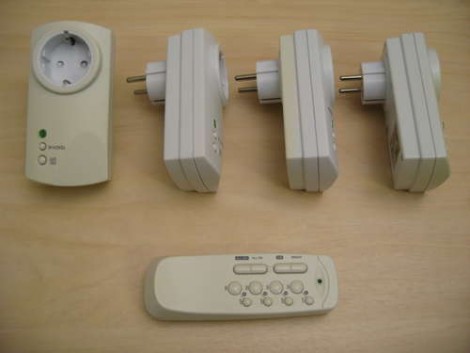
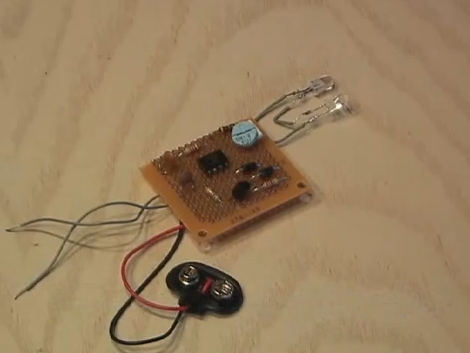
[Chr] picked up a pack of remote control outlets in order to reverse engineer them and build control into his own projects. These can be plugged into outlets around your house and a relay inside each module will switch whatever device is plugged into it after receiving a command from the remote. Once he cracked open the control housing it was easy to find the data line for the RF module which was on its own board. He used a logic analyzer to capture data from various button presses and then spent some time deciphering the communication protocol. He used what he learned to roll the module and code into an interface box where an ATmega8 connects via USB and passes commands from a computer to the RF board. Now he’s added home automation via a computer quite inexpensively. After the break you can watch a clip of the outlets switched using a smartphone.

So why not just patch into the buttons on the remote? Well, this same project was attempted at our local hackerspace earlier this month and the buttons don’t just pull a pin to ground. They use tri-state logic and are arranged into a matrix that is a lot harder to mimic (if not impossible) with a microcontroller. Analyzing the communications going into the RF module is definitely the less labor-intensive of the two approaches.

Continue reading “Reverse Engineering Radio Controlled Outlets”

Adding Pan And Tilt To A Webcam

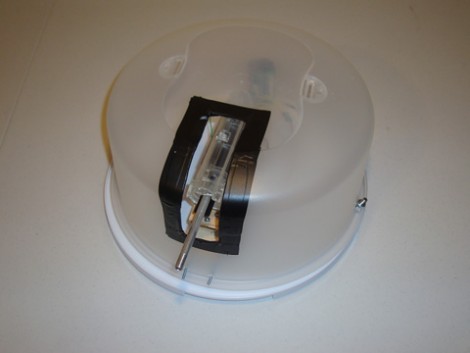
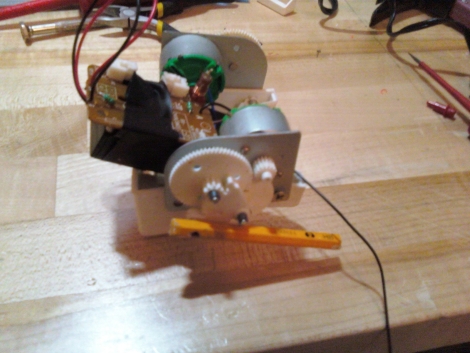
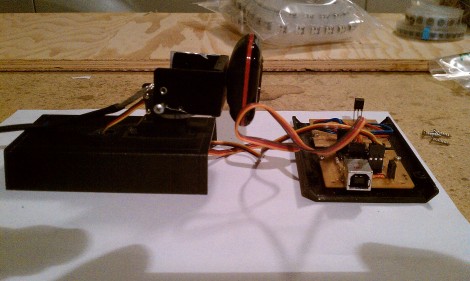
[Brent] and his wife wanted a way to provide more family time for Grandparents that lived far away. They tried a webcam, but their daughter just didn’t oblige by staying in the frame. Instead of chasing her around the room with with the camera he added pan and tilt features to the device. He settled on IR control using a common television remote, similar to our USB remote control receiver tutorial except that it drives servo motors instead of forwarding signals over the serial connection. [Brent] used a Picaxe 08M, connecting two servos together as a base on top of the project box. If you try this yourself there’s a lot of room to grow. Once you’ve assembled the hardware it wouldn’t be too hard to make this web enabled so that Grandpa can click on a web interface to look around the room.

Home Automation Without Pulling Wires

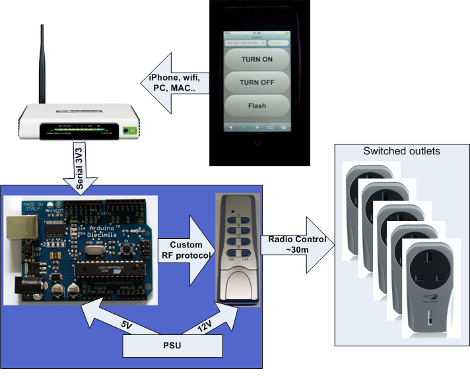
Here’s a bit of simple home automation using hacks with which we’re become pretty familiar. [Mrx23] combined OpenWRT, a microcontroller, and a set of RF controlled outlet switches to add automation to his plug-in devices. An RF remote that controls the switched outlets has been connected to an Arduino. The router communicates with the Arduino via a serial connection. And the router is controlled by a web interface which means you can use a smartphone or other web device to control the outlets.

The best thing about this system is the power that the router wields. Since it has an underlying Linux kernel you have the option of setting CRON jobs to turn lighting on and off, and group settings can be established to set up a room’s lighting level for watching movies, hosting guests, etc. Combine this with the fact that OpenWRT can use port forwarding for Internet control and the possibilities really start to open up.

[Thanks Arpad]

Building A Remote Control

Here’s a homebrew remote control that [Jad Berro] is developing. He’s using a tank robot to test it out but eventually he plans to use it to control an RC plane thanks the 434 MHz wireless module inside. There’s no shortage of input, with two analog sticks from a PlayStation controller, several momentary push buttons, and some toggle switches. Although it’s not shown in the picture above there is also a 16×2 character display that serves as part of the interface. With a navigable menu the only limit to what you can do is the programming space available on the ATmega168 that inhabits the homemade Arduino board at the heart of the system. It certainly would give the robot remote from Friday a run for its money.

All-terrain Camera

One part remote control car, one part camera, and two parts flash make up this all-terrain camera. The folks at Burrard-Lucas photography put together this guerrilla device to capture images of some of the world’s more dangerous wildlife like elephants and tigers (oh my!). This project furthers our opinion that great photographers need to be great hackers to get the shots they want.

[Thanks UC]

Infrared Transmission Decoding

Alright class, quiet down and open your books to the chapter on Manchester Encoding. [Brian J Hoskins] did just that when building this RC5 decoder. This protocol is commonly used in television remote controls. You use them on a daily basis, don’t you think it’s time you understood what’s going on? Check out his writeup and learn the dark art of invisible light communication. Or just skip the learning and follow our how-to.

[Thanks Tim]

AeroQuad – Build Your Own Quadcopter

It hurts us to look at this quadcopter, agonizingly so when we watch the video after the break. That’s because we feel the unstoppable compulsion to build one. This four-rotor helicopter has a lot to be proud of; it features Gyro stabilization, Xbee remote control for very long distance operation, and computer interface for data graphing and calibration.

We like the quadcopter that we came across at CES but building one of our own is more fun than buying it ready-made. The pain we’re feeling is mostly in our pocketbook. To help ease the agony we scoured the parts list and the assembly instructions in order to get an estimate of what this might cost. We’re looking at around $415 plus shipping, not including transmitter and receiver for controlling it.  Yep, that’s a sharp stabbing pain but we’re not sure we can just let it go.

Continue reading “AeroQuad – Build Your Own Quadcopter”