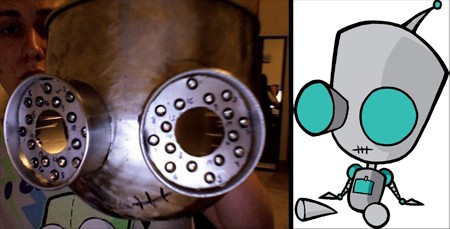
DefconBots Sentry Gun Competition


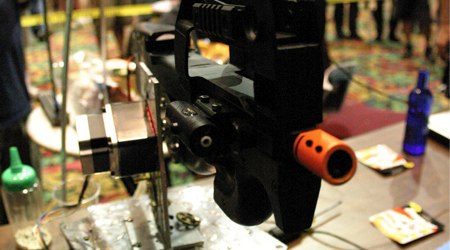
DefconBots is returning again this year with their shooting gallery robot competition for Defcon 16. They’ve decided to leave the rules unchanged from last year. It’s a head to head competition between fully autonomous guns. The first gun to shoot all the targets on their side of the board wins. The rules aren’t very strict on design; as long as you use nonlethal nonmessy amunition and include a safety switch you’re pretty much good to go. The DefconBots site has a reference design to put you on the fast track to competing. Defcon 16 is August 8-10, 2008 in Las Vegas.

Related: [Aaron Rasmussen]’s sentry gun we covered back in 2005

[photo: Bre Pettis]

Air Hockey Robot


Don’t be ashamed, we suck at air hockey too. Luckily for us, we now have a robot opponent to blame or losing streak on. Engineers at Nuvation didn’t build this air hockey playing robot, they simply adapted a standard industrial robot arm for the task. It is controlled jointly by a ColdFire processor and a 9S08 microcontroller. An array of high power LEDs and a camera are positioned over the air hockey table, which captures the position of the puck. The robot reportedly wins 90% of its games, even against solid opponents. While this is more of project to show the power of ColdFire processors, we can’t help but think it will lead to a rash of unbeatable robot opponents. We’ve already been robo-owned at foosball; what’s next?

Robot Clarinet


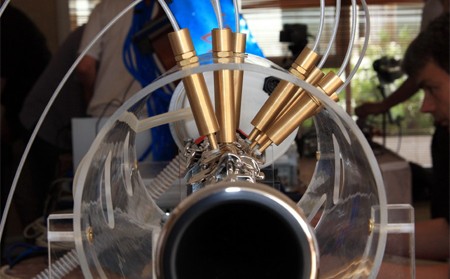
Australian research group NICTA in association with the University of New South Wales won the 2008 Artemis Orchestra Competition with their robot clarinet player. The competition challenges participants to design embedded systems that can play unmodified instruments. NICTA took first prize with their roboclarinet, due mainly to the complexity of the robot’s “mouth.” It uses two servo motors to act as a surrogate tongue and lips, vibrating the reed of the clarinet in a way consistent with human playing. The keys of the clarinet are pushed by a series of brass plungers. All of the robot’s functions are controlled by a computer running Linux. If great sound or novel technology are not enough for you, then the project is at least worth a look for the robot’s attractive, slightly steampunk-esque look. Watch it in action after the break.

Continue reading “Robot Clarinet”

Water Runner Robot


Researchers at Carnegie Mellon University’s NanoRobotics Lab have developed a robot that is capable of running on the surface of a pool of water. Like their wall climbing Waalbot, the Water Runner was inspired by the abilities of a lizard, in this case, the basilisk. The team studied the motions of the basilisk and found morphological features and aspects of the lizard’s stride that make running on water possible. Both the lizard and the robot run on water by slapping the surface to create an air cavity like the one above, then push against the water for the necessary lift and thrust. Several prototypes have been built, and there are variants with 2 or 4 legs and with on and off-board power sources. You can see a slow motion video of the robot’s movement below.

The purpose of their research is to create robots that can traverse any surface on earth and waste less energy to viscous drag than a swimming robot would. Though another of the team’s goals is to further legged robot research, the Water Runner is not without potential practical applications. It could be used to collect water samples, monitor waterways with a camera, or even deliver small packages. Download the full abstract in PDF format for more information.

Continue reading “Water Runner Robot”

Magnetically Actuated Microbots


The Carnegie Mellon NanoRobotics Lab uses external magnetic fields to precisely control their nanosoccer players. The micro robots are just 300×300 micron specs of neodymium-iron-boron permanent magnets that have been laser machined. The working volume is surrounded by five electromagnetic coils. Four coils are used for position while the fifth provides clamping force to the work surface. The bot can be operated almost anywhere as long as the surface isn’t magnetically active. Machine vision is used to watch the bot and provide feedback control. Embedded below is the robot moving across a glass slide next to a dime. It can travel at speeds up to 60 body lengths per second.

Continue reading “Magnetically Actuated Microbots”