RoboGames 2008 This Weekend


The fifth annual RoboGames is happening this weekend in San Francisco. RoboGames is a broad reaching competition designed to bring together specialists in all areas of robotics. Last year’s event had 800 entries in 62 different events. The biggest audience draw is definitely the combat robots shown in the video above, but there are other skill and task based competitions. If you’re in the area, this is definitely worth your time. Check out ROBOT magazine’s coverage from last year to get an idea of what you’ll see (or in our case miss).

[thanks io9]

Portrait Robot


[bre] passed along this portrait drawing robot from the same people that brought you the chief cook robot. Like the previous project, the portrait drawing bot emphasizes man machine interaction. The subject sits down and is asked for the quill. The robot captures the subject’s image and runs it through several processing steps. One set is to determine the contours and another is to determine the fill. The robot then draws the the contours and fills returning to the ink pot each time it reaches a trajectory threshold. Quill drawing can be quite hard for novice illustrators, but the robot’s smooth trajectory calculations prevent drips and stains.

Robofish > Real Fish


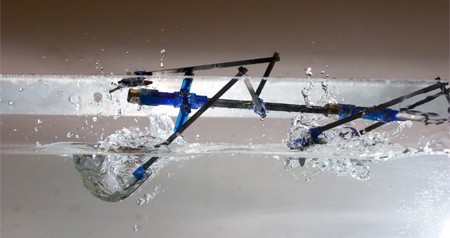
This is the kind of engineering that gets us excited, and not just because we like machines modeled on living things. Science Daily reports that Associate professor [Kristi Morgansen] from The University of Washington has developed these robofish for underwater data collection. Her technology is notable for two major reasons: the small robots use fins for locomotion instead of propellers, which reduces drag and creates greater maneuverability. The second and more important reason is that the robofish can communicate with each other via sonar, largely obviating the need for the robofish to surface for more instructions. Both design concepts were inspired by the shape and behavior of real fish. Currently the robots are only programmed to swim with or away from each other, but these are still prototypes and the technology looks promising. For more tech specs on these “Fin Actuated Autonomous Underwater Vehicles” (see why Robofish is better?), you can have a look at Morgansen’s notes.

Nanobot Nanosoccer


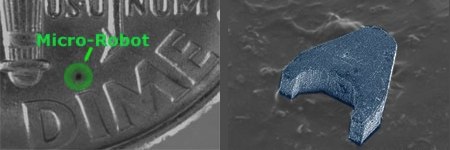
Medgadget recently published a post about a soccer competition for nanobots at RoboCup. The nanobots compete on a field that measures 1500 by 2500 micrometers with goals on the long sides jutting 500 micrometers out. Like normal soccer athletes, the nanobot teams attempt to push the ball – in this case, a silicon dioxide disc with a 50 micrometer diameter – into the goal. The nanobot competitors are monitored by an optical microscope and are remotely controlled by magnetic signals sent across the arena.

The National Institute of Standards and Technology (NIST) and RoboCup have already held two nanobot competitions in the last year. Nanobots made by different teams from various universities compete to test various abilities that will be critical for their practical applications in medicine, manufacturing, and other industries.

Though it is referred to as nanosoccer, the competition is actually a triathlon. The bots must sprint to the goal with the ball in one event, then maneuver the ball around stationary “defenders” and into the goal in the next event, and finally score as many goals as possible within 3 minutes. NIST and RoboCup hope to show the practical potential of nanobots with this competition and have a little fun in the process.

[via Medgadget]

Simple Linux Robot With IR Camera


Here’s something else we found while writing up our duplicate Ikea Linux Cluster post. [Janne] also built this simple linux robot. The robot uses the Qwerk robot controller, a webcam with the IR filter removed (something like this one), a usb WiFi card, an IR spotlight, and a set of repurposed model airplane wheels. The WiFi adapter and webcam attach directly to the Qwerk via its on-board usb ports; the servo motors are also connected via built-in ports. Although [Janne] doesn’t post specific instructions, the Qwerk platform seems fairly easy to work with. Have a look at the Qwerk overview for more information.

PIC Controlled Spray Paint


Most people make LEDs light up for their first microcontroller project. [Alex] built a “large scale dot matrix printer.” This beast is a PIC controlled ground graffiti machine. As it rolls across the ground it deposits strategically located bits of spray paint. Rather than use actual spray paint, he opted for a set of solenoid controlled nozzles that shoot the paint downward.