It’s NICER In Orbit

Given the sheer volume of science going on as the International Space Station circles above our heads every 90 minutes or so, it would be hard for any one experiment to stand out. ISS expeditions conduct experiments on everything from space medicine to astrophysics and beyond, and the instruments needed to do the science have been slowly accreting over the years. There’s so much stuff up there that almost everywhere you turn there’s a box or pallet stuck down with hook-and-loop fasteners or bolted to some bulkhead, each one of them doing something interesting.

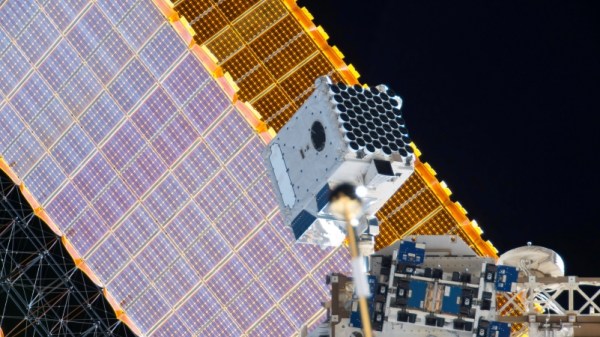
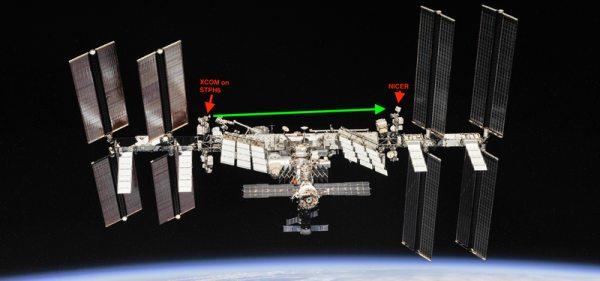
The science on the ISS isn’t contained completely within the hull, of course. The outside of the station fairly bristles with science, with packages nestled in among the solar panels and other infrastructure needed to run the spacecraft. Peering off into space and swiveling around to track targets is an instrument with the friendly name NICER, for “Neutron Star Interior Composition Explorer.” What it does and how it does it is interesting stuff, and what it’s learning about the mysteries of neutron stars could end up having practical uses as humanity pushes out into the solar system and beyond.

Continue reading “It’s NICER In Orbit”

Mary Sherman Morgan, Rocket Fuel Mixologist

In the fall of 1957, it seemed as though the United States’ space program would never get off the ground. The USSR had launched Sputnik in October, and this cemented their place in history as the first nation in space. If that weren’t bad enough, they put Sputnik 2 into orbit a month later.

By Christmas, things looked even worse. The US had twice tried to launch Navy-designed Vanguard rockets, and both were spectacular failures. It was time to use their ace in the hole: the Redstone rocket, a direct descendant of the V-2s designed during WWII. The only problem was the propellant. It would never get the payload into orbit as-is.

The US Army awarded a contract to North American Aviation (NAA) to find a propellant that would do the job. But there was a catch: it was too late to make any changes to the engine’s design, so they had to work with big limitations. Oh, and the Army needed it two days before yesterday.

The Army sent a Colonel to NAA to deliver the contract, and to personally insist that they put their very best man on the job. And they did. What the Army didn’t count on was that NAA’s best man was actually a woman with no college degree.

Continue reading “Mary Sherman Morgan, Rocket Fuel Mixologist”

See Starlink’s “Space Train” Before It Leaves The Station

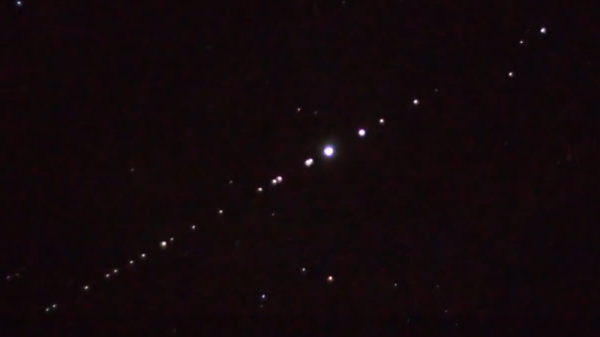
Have you looked up into the night sky recently and seen a bizarre line of luminous dots? Have you noticed an uptick in the number of UFO reports mentioned in the news and social media? If so, you may have already been touched by what many have come to affectionately call Elon Musk’s “Space Train”: a line of tightly grouped Starlink satellites that are making their way around the globe.

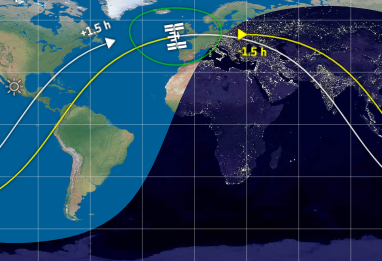
Some have wondered what’s so unique about the Starlink satellites that allows them to be visible from the ground by the naked eye, but that’s actually nothing new. It’s all about being in the right place at the right time, for both the observer and the spacecraft in question. The trick is having the object in space catch the light from the Sun when it has, from the observer’s point of view, already set. It’s essentially the same reason the Moon shines at night, but on a far smaller scale.

The ISS as it travels through Earth’s night and day

The phenomena is known as “satellite flare”, and chasing them is a favorite pastime of avid sky watchers. If you know when and where to look on a clear night, you can easily spot the International Space Station as it zips across the sky thanks to this principle. NASA even offers a service which uses email or SMS to tell you when the ISS should be visible from your location.

What makes the Starlink satellites unique isn’t that we can see them from the ground, but that there’s so many of them flying in a straight line. The initial launch released 60 satellites in a far tighter formation than we’ve ever seen before; Elon even warned that collisions between the individual Starlink satellites wasn’t out of the realm of possibility. The cumulative effect of these close proximity satellite flares is a bit startling, and understandably has people concerned about what the night sky might look like when all 12,000 Starlink satellites are in orbit.

The good news is, the effect is only temporary. As the satellites spread out and begin individual maneuvers, that long line in the sky will fade away. But before Elon’s “Space Train” departs for good, let’s look at how it was created, and how you can still catch a glimpse of this unique phenomena.

Continue reading “See Starlink’s “Space Train” Before It Leaves The Station”

X-Rays Are The Next Frontier In Space Communications

Hundreds of years from now, the story of humanity’s inevitable spread across the solar system will be a collection of engineering problems solved, some probably in heroic fashion. We’ve already tackled a lot of these problems in our first furtive steps into the wider galaxy. Our engineering solutions have taken humans to the Moon and back, but that’s as far as we’ve been able to send our fragile and precious selves.

While we figure out how to solve the problems keeping us trapped in the Earth-Moon system, we’ve sent fleets of robotic emissaries to do our exploration by proxy, to make the observations we need to frame the next set of engineering problems to be solved. But as we reach further out into the solar system and beyond, our exploration capabilities are increasingly suffering from communications bottlenecks that restrict how much data we can ship back to Earth.

We need to find a way to send vast amounts of data back as quickly as possible using as few resources as possible on both ends of the communications link. Doing so may mean turning away from traditional radio communications and going way, way up the dial and developing practical means for communicating with X-rays.

Continue reading “X-Rays Are The Next Frontier In Space Communications”

Full Earth Disc Images From GOES-17 Harvested By SDR

We’ve seen lots of hacks about capturing weather images from the satellites whizzing over our heads, but this nicely written how-to from [Eric Sorensen] takes a different approach. Rather than capturing images from polar satellites that pass overhead a few times a day, this article looks at capturing images from GOES-17, a geostationary satellite that looks down on the Pacific Ocean. The fact that it is a geostationary satellite means that it captures the same view all the time, so you can capture awesome time-lapse videos of the weather.  Continue reading “Full Earth Disc Images From GOES-17 Harvested By SDR”

How 5G Is Likely To Put Weather Forecasting At Risk

If the great Samuel Clemens were alive today, he might modify the famous meteorological quip often attributed to him to read, “Everyone complains about weather forecasts, but I can’t for the life of me see why!” In his day, weather forecasting was as much guesswork as anything else, reading the clouds and the winds to see what was likely to happen in the next few hours, and being wrong as often as right. Telegraphy and better instrumentation made forecasting more scientific and improved accuracy steadily over the decades, to the point where we now enjoy 10-day forecasts that are at least good for planning purposes and three-day outlooks that are right about 90% of the time.

What made this increase in accuracy possible is supercomputers running sophisticated weather modeling software. But models are only as good as the raw data that they use as input, and increasingly that data comes from on high. A constellation of satellites with extremely sensitive sensors watches the planet, detecting changes in winds and water vapor in near real-time. But if the people tasked with running these systems are to be believed, the quality of that data faces a mortal threat from an unlikely foe: the rollout of 5G cellular networks.

Continue reading “How 5G Is Likely To Put Weather Forecasting At Risk”

Humanity Creates A Cloud Of Space Garbage, Again

With the destruction of the Microsat-R reconnaissance satellite on March 27th, India became the fourth country in history to successfully hit an orbiting satellite with a surface-launched weapon. While Microsat-R was indeed a military satellite, there was no hostile intent; the spacecraft was one of India’s own, launched earlier in the year. This follows the examples of previous anti-satellite (ASAT) weapons tests performed by the United States, Russia, and China, all of which targeted domestic spacecraft.

Yet despite the long history of ASAT weapon development among space-fairing nations, India’s recent test has come under considerable scrutiny. Historically, the peak of such testing was during the 1970’s as part of the Cold War rivalry between the United States and then Soviet Union. Humanity’s utilization of space in that era was limited, and the clouds of debris created by the destruction of the target spacecraft were of limited consequence. But today, with a permanently manned outpost in low Earth orbit and rapid commercial launches, space is simply too congested to risk similar experiments. The international community has strongly condemned the recent test as irresponsible.

For their part, India believes they have the right to develop their own defensive capabilities as other nations have before them, especially in light of their increasingly active space program. Prime Minister Narendra Modi released a statement reiterating that the test was not meant to be a provocative act:

Today’s anti-satellite missile will give a new strength to the country in terms of India’s security and a vision of developed journey. I want to assure the world today that it was not directed against anybody.

India has always been against arms race in space and there has been no change in this policy. This test of today does not violate any kind of international law or treaty agreements. We want to use modern technology for the protection and welfare of 130 million [1.3 Billion] citizens of the country.

Further, the Indian Space Research Organisation (ISRO) rejects claims that the test caused any serious danger to other spacecraft. They maintain that the test was carefully orchestrated so that any debris created would renter the Earth’s atmosphere within a matter of months; an assertion that’s been met with criticism by NASA.

So was the Indian ASAT test, known as Mission Shakti, really a danger to international space interests? How does it differ from the earlier tests carried out by other countries? Perhaps most importantly, why do we seem so fascinated with blowing stuff up in space?

Continue reading “Humanity Creates A Cloud Of Space Garbage, Again”