Hackaday Links Column Banner

Hackaday Links: February 1, 2026

For many readers, more snow is the last thing they want to see right now…but what if it comes in the form of an online simulator in the style of an old DOS game? Created by [Potch], it works like one of those “falling sand” simulators, with sliders that let you control various elements of the wintry action. For more a immersive experience, open the window and let some cold air in while you play.

If those old school graphics have you yearning for a simpler time, then you’ll love Places to Telnet, a page on the very slick CRT-themed telnet.org that lists servers you can connect to. The list is made up primarily of games, but there’s also systems you can call up to do things like show the weather or browse Wikipedia. They even take submissions, so if you know any interesting destinations that aren’t on the list, make sure to share with the class.

Our ability to make and use tools is one of the things that separates us from the rest of the animal kingdom, and is an ability not often seen outside of primates. But a recent paper in Current Biology describes how one cow, Veronika, has been observed using a long-handled brush to scratch herself. Apparently the clever heifer will even flip the brush around and use the handle side when she wants to really dig in there. The paper says the findings “invite a reassessment of livestock cognition”, and points out that little serious research has been done on bovine intelligence in the 10,000 or so years since humans first domesticated them. We’re just happy this paper came out when it did — that way it will be a distant memory by the time we fire up the grill in the summer.

Continue reading “Hackaday Links: February 1, 2026”

Hackaday Links Column Banner

Hackaday Links: January 25, 2026

If predictions hold steady, nearly half of the United States will be covered in snow by the time this post goes live, with the Northeast potentially getting buried under more than 18 inches. According to the National Weather Service, the “unusually expansive and long-duration winter storm will bring heavy snow from the central U.S. across the Midwest, Ohio Valley, and through the northeastern U.S. for the remainder of the weekend into Monday.” If that sounds like a fun snow day, they go on to clarify that “crippling to locally catastrophic impacts can be expected”, so keep that in mind. Hopefully you didn’t have any travel plans, as CNBC reported that more than 13,000 flights were canceled as of Friday night. If you’re looking to keep up with the latest developments, we recently came across StormWatch (GitHub repo), a slick open source weather dashboard that’s written entirely in HTML. Stay safe out there, hackers.

Speaking of travel, did you hear about Sebastian Heyneman’s Bogus Journey to Davos? The entrepreneur (or “Tech Bro” to use the parlance of our times) was in town to woo investors attending the World Economic Forum, but ended up spending the night in a Swiss jail cell because the authorities thought he might be a spy. Apparently he had brought along a prototype for the anti-fraud device he was hawking, and mistakenly left it laying on a table while he was rubbing shoulders. It was picked up by security guards and found to contain a very spooky ESP32 development board, so naturally he was whisked off for interrogation. A search of his hotel room uncovered more suspicious equipment, including an electric screwdriver and a soldering iron. Imagine if a child had gotten their hands on them?

Continue reading “Hackaday Links: January 25, 2026”

Backyard Rope Tow From Spare Parts

A few years ago, [Jeremy Makes Things] built a rope tow in his back yard so his son could ski after school. Since the lifts at the local hill closed shortly after schools let out, this was the only practical way for his son to get a few laps in during the week. It’s cobbled together from things that [Jeremy] had around the house, and since the original build it’s sat outside for a few years without much use. There’s been a lot more snow where he lives this year though, so it’s time for a rebuild.

The power source for the rope tow is an old gas-powered snowblower motor, with a set of rollers and pulleys for the rope made out of the back end of a razor scooter. Some polyurethane was poured around the old wheel hub so that the rope would have something to grip onto. The motor needed some sprucing up as well, from carburetor adjustment, fuel tank repairs, and some other pieces of maintenance before it could run again. With that out of the way it could be hoisted back up a tree at the top of the hill and connected to the long rope.

This isn’t the first time [Jeremy] has had to perform major maintenance on this machine either. Three years ago it needed plenty of work especially around the polyurethane wheel where [Jeremy] also had to machine a new wheel bearing in addition to all the other work that had to go into repairing it that time. From the looks of things though it’s a big hit with his son who zips right back up the hill after each ski run. Getting to the tops of ski runs with minimal effort has been a challenge of skiers and snowboarders alike for as long as the sport has been around, and we’ve seen all kinds of unique solutions to that problem over the years.

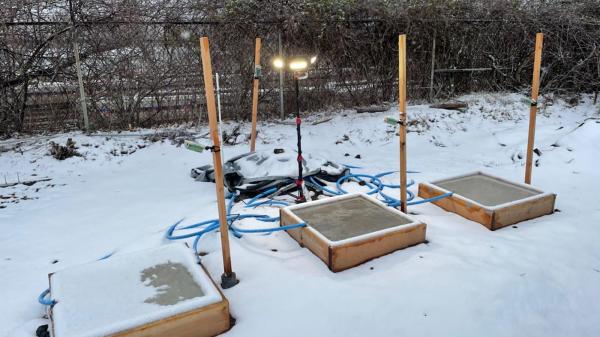
Concrete Clears Its Own Snow

Humans are not creatures well suited to cold environments. Without a large amount of effort to provide clothing, homes, and food to areas with substantial winters, very few of us would survive. The same is true of a lot of our infrastructure since things like ice, frost heave, and large temperature swings can all negatively impact buildings, roadways, and other structures. A team at Drexel University in Pennsylvania has created a type of concrete they hope might solve some issues with the material in cold climates.

Specifically when it comes to sidewalks and roadways, traditional methods of snow and ice removal such as plowing and salting are generally damaging to the surface material, with salting additionally being damaging to vehicles. Freeze-thaw cycles aren’t kind to these surfaces either. This concrete, on the other hand, contains a low-temperature liquid paraffin which releases heat when it has a phase change, from a liquid to a solid. By incorporating the material into the concrete, it can warm itself as temperatures drop, maintaining a temperature above freezing to melt ice and snow. The warming effect isn’t indefinite, but lasts a significant amount of time during testing.

Continue reading “Concrete Clears Its Own Snow”

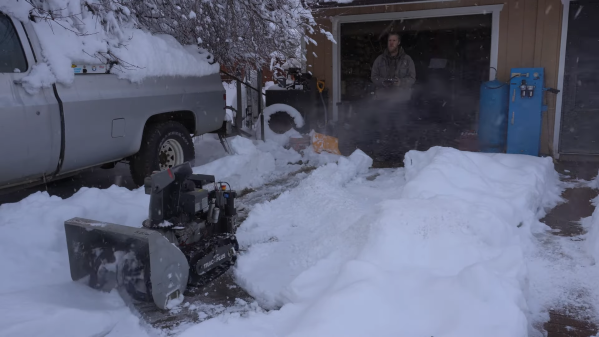
Fail Of The Week: The Little Remote-Controlled Snowblower That Couldn’t

[Punxatawny Phil]’s prognostications aside, winter isn’t over up here in the Northern Hemisphere, and the snow keeps falling. If you’re sick of shoveling the driveway and the walk and you don’t have a kid handy to rope into the job, relax —  this rapidly assembled junkyard RC snowblower will do just as crappy a job while you stay nice and warm inside.

This build seemed to have a lot of potential at the start, based as it was on a second-hand track-drive snowblower, something that was presumably purpose-built for the job at hand. [Lucas] quickly got to work on it; he left the original gasoline engine to power the auger but took most of the transmission off so that each track could be driven separately with a wheelchair motor.  That seemed like a solid idea as far as steering goes, but the fact that he chose to drive the 24 volt motors with a single 12 volt deep-cycle battery worked against him out in the snow.

With a battery upgrade for better traction, the snowblower actually got around in the snow pretty well. [Lucas] also added some nice features, like a linear actuator to remotely engage the auger — a nice safety touch when kids and pets are around — and a motor to control the direction of the chute. Even these improvements weren’t enough, though; it worked insofar as it moved snow from where it was to where it wasn’t, but didn’t really move it very far. To the casual observer, it seems like there’s just not enough weight to the machine, allowing it to ride up over the snow rather than scraping the driveway clean. Check out the video below and see what you think.

Now, we’re not picking on [Lucas] here. Far from it — we enjoyed this build as much as some of his other stuff, like his scratch-built CO2 laser tube and his potty-mouthed approach to Kaizen tool organization. We still think this one has a lot of potential, and we’re glad he vowed to continue working on it for next winter.

Continue reading “Fail Of The Week: The Little Remote-Controlled Snowblower That Couldn’t”

The Giant LEGO You Always Wanted To Play With

The interlocking LEGO bricks are probably one of the most versatile toys to come out of the 20th century, but aside from the Duplo larger-sized version for smaller kids, they don’t come in what you might term grown-up sizes. This has not deterred [Veranda Vikings] though, who have come up with the fantastic idea of giant LEGO bricks made from snow.

Making them is simplicity itself given enough depth of the white stuff, simply press the lid of one of those plastic LEGO storage bins into some fresh snowfall hard enough to compact  your brick, and then lift clear a perfect icy 2 by 2 brick. Most of the post is devoted to the building escapades of some very happy kids, and we can’t help envying them the opportunity. It appears that like the LEGO fries in the cafe at Legoland in Bilund, these bricks don’t quite interlock. We think that it would be possible to press the LEGO storage lid into the bottom of them though, perhaps some readers would like to experiment.

Either way, this is a hack to warm the hearts of readers worldwide, whether they live in a country with snow or not. We’re surprised Lego themselves haven’t caught on to the idea, and sold giant snow-brick moulds.

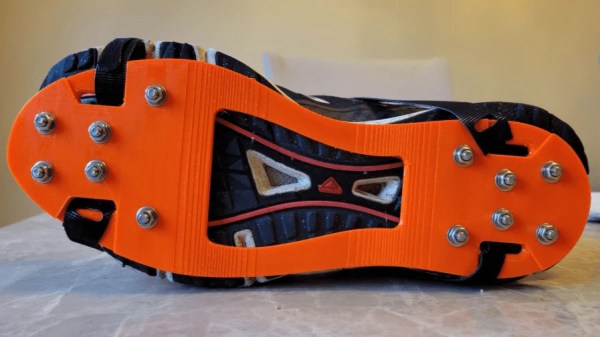
DIY Cleats Give You Traction In Ice And Snow

It’s getting into the cold and snowy season for much of the world, and that means it can be slippy when you go walking outside. If you need more traction, but your shoes don’t have spikes, fear not. You can build yourself a set of these nifty strap-on cleats designed by [Zero To Infinity].

The cleats are a 3D printed design, which [Zero To Infinity] modeled in Fusion 360 to match their own shoes. Obviously, everybody’s shoes differ, so they’ve provided simple instructions on how to design your own similar cleats to suit your personal footwear. They’re then printed in a stiff TPU to give them the right amount of flex for bending to conform to the shoe. The cleats themselves are simply M4 bolts, nuts, and washers screwed through the cleats, pointy-side down. They can then be strapped to a shoe, and you’re done!

We’d love to see a set of snow shoes that are fully printed and ready to accept cleats. Indeed, we’ve seen some neat printed sneaker designs before. They haven’t really caught on yet, but there’s nothing to stop you printing the hottest kicks of 2024 right in your own home. When you do, don’t hesitate to hit up the tipsline!