Snow Plowing By Bicycle

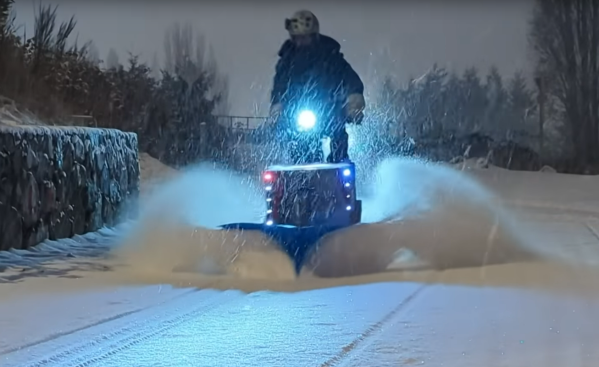
There are few challenges more difficult or dangerous than trying to get around the majority of North American cities by bicycle. Not only is the bicycle infrastructure woefully inadequate for safe travel (if it exists at all), but it’s often not maintained to any reasonable standard, either. This goes double in colder areas, where bike paths can essentially become abandoned in the winter after a snowfall. [Phil] found himself in this situation recently after a snowfall in western Canada and decided to DIY his own bike-powered snowplow to help keep his bike paths cleared.

The plow is built around an electric-assisted cargo bicycle, which is almost as rare in North America as bicycle infrastructure itself, but is uniquely suited to snowplow duty. It has a long wheelbase and a large front cargo area that can be weighed down if needed to ensure the plow makes good contact with the ground. The plow itself is built out of sections of plastic 55-gallon drums, which have been cut into two scooping sections and attached to the bike with a wooden 2×4 frame. The plow can be raised or lowered with a ratchet strap mechanism, and the plastic scoop skips over bumps in the path with relative ease.

With this relatively simple mechanism attached to his bike, [Phil] can make sure the trails that he frequents around Vancouver are more suitable for bike travel in the winter. Riding a bicycle through the winter, even in the coldest of climates, is not that difficult with the right support and investment in infrastructure, and this build is the best DIY solution we’ve seen to bicycle infrastructure support outside of adopting something like this remote-controlled snowblower to the job.

Continue reading “Snow Plowing By Bicycle”

Self-frosting snowman

Peltier Snow Globe Features Snowman Who Dresses Himself In Real Frost

We doubt that few of us ever thought that snow globes contain real snow, but now that we’ve seen a snow globe that makes its own snow, we have to admit the water-filled holiday decorating mainstay looks a little disappointing.

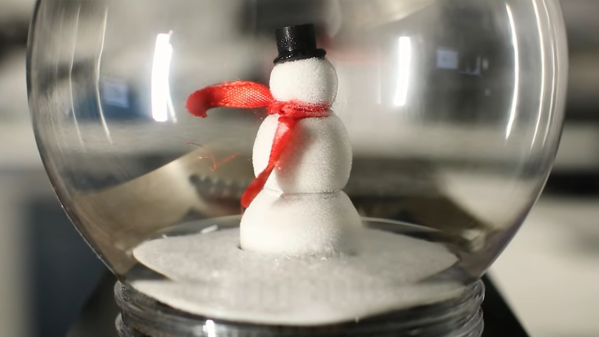
Like a lot of the Christmas decorations [Sean Hodgins] has come up with over the years, this self-frosting snowman is both clever in design and cute in execution. The working end is a piece of aluminum turned down into the classic snowman configuration; the lathe-less could probably do the same thing by sticking some ball bearings together with CA glue. Adorned with 3D-printed accessories, the sculpture sits on a pedestal of Peltier coolers, stacked on top of a big CPU cooler. Flanking the as-yet underdressed snowman is a pair of big power resistors, which serve as heating elements to fill the globe with vapor. [Sean]’s liquid of choice is isopropyl alcohol, and it seems to work very well as the figurine is quickly enrobed with frost.

But wait, there’s more — as [Sean] points out, the apparatus is 90% of the way to being a cloud chamber. Maybe we’ll see a less festive version after the holidays. Until then, enjoy his ornament that prints other ornaments, his blinkenlight PCB tree-hangers, or his tiny TV that plays holiday commercials.

Continue reading “Peltier Snow Globe Features Snowman Who Dresses Himself In Real Frost”

How To Get Into Cars: Ice Racing Mods

Typically, when it comes to inclement weather, ice is the worst of the worst of driving conditions. Regular tyres have little to no grip in such situations, and accidents are common. However, some choose to laugh at such challenges, and take to racing out on frozen lakes and rivers. The sport of ice racing can be a demanding one, though, so you’ll need to prep your car appropriately. Here’s how.

Ice, Ice, Baby

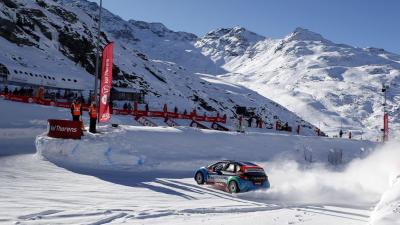
The highest tier of ice racing is the Andros Trophy, conducted in France each year. Competitors in the top class compete in mid-engined V6-powered cars with AWD and four-wheel steering.

Ice racing is largely limited to colder climates where lakes, rivers, or even actual racetracks freeze over in the winter. While some limited ice racing does occur indoors on skating rinks, it’s largely limited to motorcycles and ATVs because such facilities are just too small for cars.

The weather-dependent and esoteric nature of ice racing means that it exists at the fringes of organised motorsport, with most events being community-run at the grassroots level. Often, new competitors will start in a “run-what-you-brung” class, with unmodified street cars competing in limited or no-contact events, such as time trials or drag races. Higher tiers then generally necessitate more serious preparation and safety equipment, such as rollcages and fire extinguishers, and competitive door-to-door racing on larger tracks. However, some professional competitions do exist, running bespoke tube-framed cars built for purpose. The most notable of these is the Andros Trophy, held in the French Alps and run by the namesake jam company. Continue reading “How To Get Into Cars: Ice Racing Mods”

Growing The World’s Largest Snowflake

Plenty of areas around the world don’t get any snowfall, so if you live in one of these places you’ll need to travel to experience the true joy of winter. If you’re not willing to travel, though, you could make some similar ice crystals yourself instead. While this build from [Brian] aka [AlphaPhoenix] doesn’t generate a flurry of small ice crystals, it does generate a single enormous one in a very specific way.

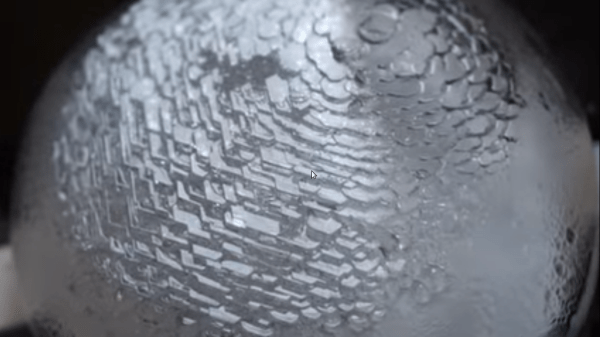
The ice that [Brian] is growing is created in a pressure chamber that has been set up specifically for this hexagonal crystal. Unlike common ice that is made up of randomly arranged and varying crystals frozen together, this enormous block of ice is actually one single crystal. When the air is pumped out of the pressure chamber, the only thing left in the vessel is the seed crystal and water vapor. A custom peltier cooler inside with an attached heat sink serves a double purpose, both to keep the ice crystal cold (and growing) and to heat up a small pool of water at the bottom of the vessel to increase the amount of water vapor in the chamber, which will eventually be deposited onto the crystal in the specific hexagonal shape.

The build is interesting to watch, and since the ice crystal growth had to be filmed inside of a freezer there’s perhaps a second hack here which involved getting the camera gear set up in that unusual environment. Either way, the giant snowball of an ice crystal eventually came out of the freezer after many tries, and isn’t the first time we’ve seen interesting applications for custom peltier coolers, either.

Continue reading “Growing The World’s Largest Snowflake”

Serene Snowdecahedrons

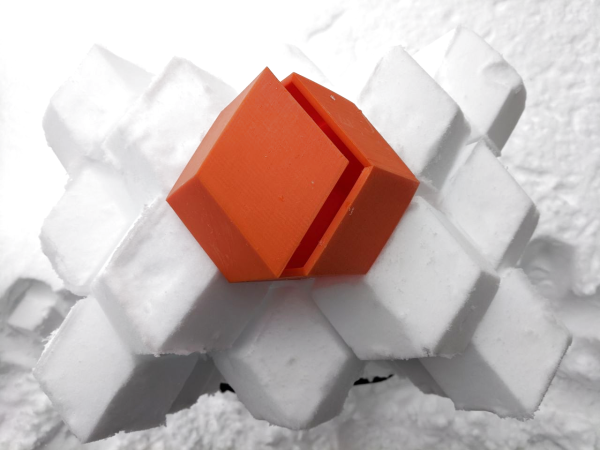
It’s no secret that many parts of the United States saw quite a bit of snow that past few weeks. Even snowed in, hackers and engineers continue to do what they do and invent crazy wonderful things. Spurred on by a grand vision of complex polyhedron snowballs, [Jacob] created a clever 3D printed mold that can create Rhombic Dodecahedrons. It has some rather unusual properties as it can be stacked perfectly (no gaps in between the snowdechedrons) and all opposing sides are parallel so it can be held easily in a mitten or glove. Additionally, since the faces are parallel, it unmolds easily and without marring the beautiful snow you just crafted.

Premade STL’s of three different sizes are provided under creative commons with some helpful instructions on how best to print them. Perhaps next time your area gets some good snow, you can be prepared to show off with your high-performance ski-sled as your fly by throwing molded snowballs. That is until you get roped into a friendly debate about whether your snowdechedrons are in fact snow “balls”.

Thanks [Jacob] for sending this one in!

High Tech Photos Capture Snowflakes Like Never Before

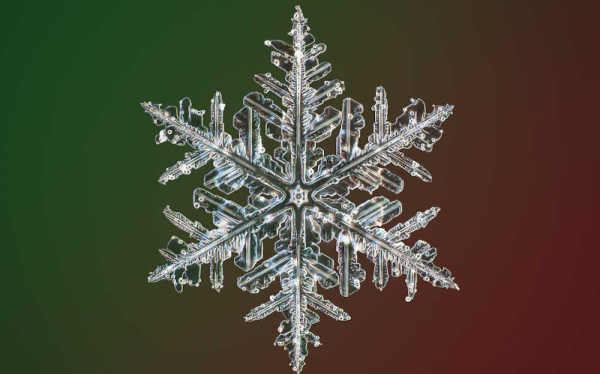
Microscopy used to be a rarity in the hobby electronics world. But anyone doing lab work has always needed a microscope and with today’s tiny parts, it is almost a necessity. However, [Nathan Myhrvold] didn’t use an ordinary microscope to capture some beautiful snowflake pictures. According to [My Modern Met], the pictures are the highest resolution snowflake pictures ever taken.

Of course, the site is more interested in the visual aspect of it, but they did provide some clues about the tech behind the pictures. According to the site:

Myhrvold used a special camera of his own design. He combined the magnifying power of a microscopic lens.. with a specially designed optical path. This path allowed the lens to channel its image to a medium-format digital sensor… In addition, the camera featured a cooling stage upon which the tiny specimens could rest. With LED short-pulse lights and a shutter speed of less than 500 microseconds, Myhrvold was able to capture multiple images of each snowflake at different focal lengths. These images were then stacked to create the final image.

Continue reading “High Tech Photos Capture Snowflakes Like Never Before”

A High Performance Ski-Sled For The Big Kids

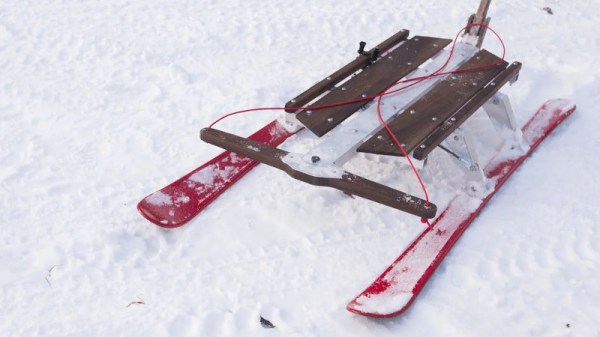
Sledding is a pastime often left to younger humans, though there is no good reason why this must be the case. [JoshXarles] is an adult with a strong enthusiasm for carving up the snow, and set out to build a high-performance sled this winter. 

It’s a ski-based design, and [Josh]’s goal from the outset was to build a rig with serious handling credentials. His favored run features several 180 degree switchbacks, so it’s important to be able to corner well without losing speed. This was achieved by using sidecut skis with a carefully designed steering system, allowing the sled to carve corners in the same way as a downhill skier. The frame of the sled is built out of aluminium box tubing, bolted together to form a strong structure. There’s also attractive wooden decking which completes the look.

The sled performed admirably in initial testing, with good steering feel and plenty of speed downhill. We’d love to try ourselves, weather permitting, of course. There are also electric options for those not blessed with geologically-suitable features to sled down. Video after the break.

Continue reading “A High Performance Ski-Sled For The Big Kids”