Thrift Store Hard Drive Enclosure

[Ken] visited our site looking for case modding stuff a little while back, but more importantly he came back to show off his latest project. Using a jewelry box found at our favorite place, the thrift store, he converted it into a 2.5 inch USB drive enclosure.

Almost instantly he found that this particular jewelry box is a perfect fit for a 2.5 inch SATA laptop drive. Taking that as a sign he whipped up some acrylic mounts and cut some holes for power and USB . The electronics are provided by another enclosure with a dead drive, again acrylic is used to insulate the drive from the decorative metal box and some rubber washers were used to help cancel out vibrations and noise.

The end result is a classy looking 150gig usb drive that looks nice on the desk, and a little reminder that if your not hitting up your local thrift / second hand stores, you could be missing out on some real gems.

MindWave Is Developer (read: Hacker) Friendly Mind Control

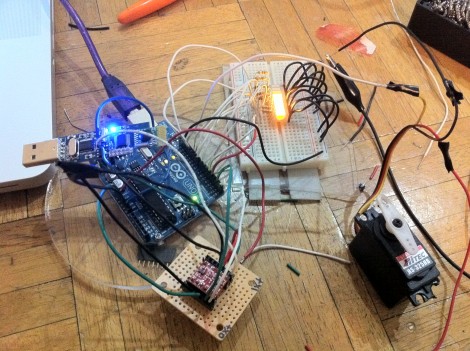
Here’s a setup to control a servo motor with your mind. [Danny Bertner] made this project happen by interfacing a MindWave headset with an Arduino. You might wonder what’s the big deal about that since we’ve covered quite a few mind control hacks that work this way? So far, the majority of those hacks used the Mindflex toy (to be fair there were several using the Force Trainer as well), which depends on a chip made by the company that is responsible for the MindWave. Both the Mindflex and the Force Trainer were reverse engineered to access the stream of data coming in from the EEG sensors. But NeuroSky is embracing the urge to mess with their products by offering developer tools.

[Danny] took advantage of these resources, using the comany’s own guide to interfacing with an Arduino (PDF). The quick clip after the break shows his finished project, grabbing data from the USB dongle that comes with the headset, converting it to the necessary levels for the Arduino, then processing the signals for display on and LED bar graph.

We can’t help but chuckle about the warranty-voiding disclaimer at the top of the PDF guide.

Continue reading “MindWave Is Developer (read: Hacker) Friendly Mind Control”

Magellan GPS Hack For Hassle-free Charging

magellan_hack

Hackaday reader [Paul] recently shared a simple hack he put together via our Flickr photostream.

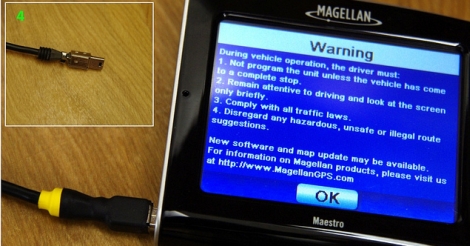
It seems that his Magellan GPS unit is pretty finicky when it comes to power supplies. When connected to the Magellan adapter, the GPS unit charged as you would expect. When connected to a PC, it sensed the connection and allowed its file system to be mounted, just as it was intended to do.

However, a problem arose when he tried hooking the Magellan up to a different power supply. The unit still thought it was connected to a PC, and refused to perform any GPS-related functions since its file system was tied up. Not wanting to lug around multiple chargers, he decided to see what the heck was going on with his GPS unit.

He pulled the plug apart and found that the 4th and 5th pins of the USB cable were shorted together. While most devices ignore the 4th pin, the Magellan checks to see if that pin is grounded. If so, it assumes it is connected to its power supply. If not, it assumes that it should act as if it is connected to a PC.

With this information in hand, [Paul] did the same thing as any of us would and hacked together a USB cable with shorted pins. The cable can be attached to any standard USB port or charger, saving him from having to lug around an extra adapter.

Long-range Bluetooth Wardriving Rig

bluetooth_wardriving

[Kyle] was digging through a box of junk he had lying around when he came across an old USB Bluetooth dongle. He stopped using it ages ago because he was unsatisfied with the limited range of Bluetooth communications.

He was going to toss it back into the box when an idea struck him – he had always been a fan of WiFi wardriving, why not try doing the same thing with Bluetooth? Obviously the range issue comes into play yet again, so he started searching around for ways to boost his Bluetooth receiver’s range.

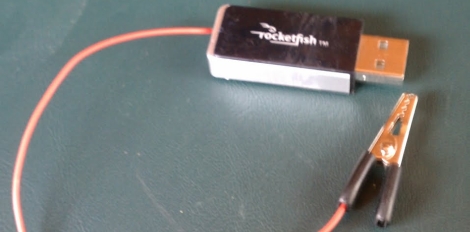
He dismantled the dongle and found that the internal antenna was a simple metal strip. He didn’t think there would be any harm in trying to extend the antenna, so he soldered an alligator clip to the wire and connected the CB antenna in his truck. His laptop sprung to life instantly, picking up his phone located about 100 feet away in his house. He took the show on the road and was able to pick up 27 different phones set in discoverable mode while sitting in the parking lot of a fast food chain.

While it does work, we’re pretty sure that the CB antenna isn’t the most ideal extension of the Bluetooth radio. We would love to see what kind of range he would get with a properly tuned antenna.

Keep reading to see a quick demonstration of his improvised long-range Bluetooth antenna.

Continue reading “Long-range Bluetooth Wardriving Rig”

Quick & Dirty USB Phone Charger

usb_phone_charger

Hackaday forum member [Dan Fruzzetti] wrote in to share a simple, yet useful hack he built just the other day. He and his wife both have Evo 4G smartphones and they were pretty disappointed in the lack of portable charging solutions available.

Instead of buying something and modifying it to his needs, [Dan] decided to build a quick and dirty charger instead. His ghetto-mintyboost was built into a cheap project box he found at Radio Shack, which is stocked with a set of four D-cell batteries. The batteries were wired in series and connected to a pair of salvaged USB ports mounted on a small piece of protoboard.

Knowing that most portable devices get 5.7v from their chargers already, he was not worried about hooking his phones straight into the 6v battery pack he built. He says that the phones actually charge pretty quickly, and that he estimates he should be able to get about 50 charges out of the box before he needs to swap the batteries.

This is not a complex hack by any means. It is quick & dirty, solves an annoying problem, and it’s dead simple to build. That’s exactly why we like it.

Controlling Weapons With Kinect

kinect_rocket_launcher

It was only a matter of time before someone would figure out how to weaponize their Kinect. Hacker [Jonas Wagner] was fiddling with his Kinect one day and thought that it would be cool to launch missiles simply by gesturing. Not having any real missiles on hand, he settled for controlling a USB-powered foam missile launcher instead.

He mounted a webcam to the top of his rocket launcher to record video of his victims, and with a bit of Python along with the libfreenect ilbrary he was well on his way to world cubicle dominance.  The Kinect waits for him to pull his hand out of its holster in dramatic fashion, monitoring his movements for tracking purposes. Once the launcher has been armed, the Kinect watches for [Jonas] to pull his hands out of frame before firing the rocket.

We doubt you’ll see this thing controlling weapons for DARPA any time soon, but it’s cool nonetheless. The launcher seems to move a touch slowly, but we’re guessing that with an uprated servo, things could be a bit snappier.

Continue reading for a quick video of the Kinect-powered rocket launcher in action.

[via KinectHacks]

Continue reading “Controlling Weapons With Kinect”

Fan And Vent Holes Prevent Sweaty Gaming Hands

[Happy Dragon] grew tired of wiping moist palms on his pants during intense gaming sessions. To combat the issue he tried adding a fan to an Xbox 360 controller that he had sitting around. He pulled a small PC fan from a Nyko Airflow and glued it over a hole he cut into the battery compartment of the controller. This forces air into the body of the unit, which exits through holes he’s drilled in the wings. He added an external battery pack to power the controller since the original batteries were removed before the fan was glues in place. The fan itself isn’t powered from this external pack, but requires a USB connection that he attaches using the disconnect from a wired Xbox controller.

After some testing, [Happy Dragon] seems… happy… with the results. He tells us that his hands are not sweaty, and that he finds he’s not gripping the controller quite as tightly as he used to so as not to block the vent holes. We can see a couple of issues with this design, like the holes filling up with crud, or the fan blowing dust and dirt into the controller (we’re thinking about the analog sticks). But perhaps a future design could create dedicated ducts inside that keep the electronics isolated from the cooling. Or maybe the exhaust from portable console builds could be used in a similar way?

You’ll notice that there’s no direct link for this hack. [Happy Dragon] didn’t write a post about this, he just sent us a half-dozen images and his description of the project. Check out the rest of the pictures after the break.

Continue reading “Fan And Vent Holes Prevent Sweaty Gaming Hands”