Coded Entry Using Your Wristwatch

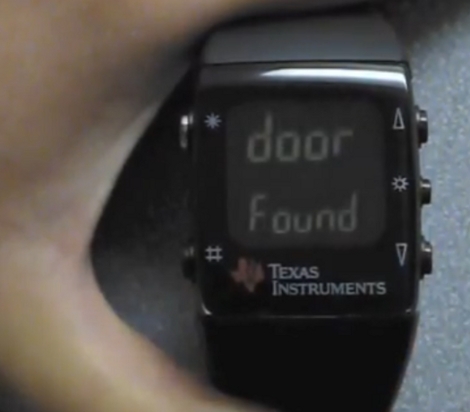
[Ziyan] and [Zach] built a door entry system that uses a code entered from your wristwatch. They’re using the TI eZ-430 Chronos that we saw in November. There is a project box mounted over the deadbolt lever. Inside, the wireless fob waits for the watch to connect. When a watch has connected and the correct code is received (using 128 bit encryption) the fob actuates a servo to turn the lock. On the user side of things the code is entered by tapping the watch. The built-in accelerometer picks up these taps and relays them to the door unit.

It’s a heck of a project! Check out their demonstration video after the break. We’d like to see a mechanical option for escaping the apartment in case the door unit fails but otherwise we think this is perfectly executed. We’re looking forward to seeing more projects that tap into this TI hardware.

Continue reading “Coded Entry Using Your Wristwatch”

InPulse Watch Gets BlackBerry Data Via Bluetooth

inPulse-blackberry-watch

[Eric] just told us about the watch he developed that displays info from a BlackBerry via Bluetooth. The watch displays updates, message alerts, incoming call information, and… tells time. Setup and control is handled with the BlackBerry keypad. The device is charged with a micro-USB connection and will last for about four days without a recharge. We’d chalk up the rather long battery life to the use of an OLED display, which will use less energy when a portion of the display is left black.

So why is it here? Well, he’s got a couple of blog posts that detail two of the final prototypes that you might find interesting. What else? Oh yeah, his original prototype used an Arduino with a Nokia 3310 LCD display. For those of you who continually call the Arduino a worthless toy, looks like it’s good enough to use when taking a product to market.

LED Pocket Watch

ledwatch

Today, it is not difficult to find all kinds of watches with LED displays. After [Paul]’s grandfather, a master horologist and pocket watch collector, passed away, he decided to retrofit a broken watch left to him with a custom LED face. Starting from scratch, he designed a PCB complete with 133 (hand soldered) LEDs, room for a temperature controlled oscillator for real time clock capabilites, a LiPo battery, and a cell phone vibrator to provide a simulated “second hand tick” feeling. The whole watch is powered by a PIC 16F946.

This is currently version 1, and he has already begun work on version 2. He plans on adding a more compact, lower power TCXO, automatic NTP syncing, and a USB port for charging and reprogramming. He has a number of detailed videos, and we have a demo video after the break.

[digg=http://digg.com/gadgets/LED_Pocket_Watch]

Continue reading “LED Pocket Watch”

Pong On Your Wrist

pong_wristwatch

[John] wanted to take a pong clock and put it in a wristwatch form factor. Take an afternoon and pour over his detailed build logs. This multi-year project is done with meticulous cleanliness that makes us jealous. He’s milled the case and buttons himself, achieving a professional look that equals or surpasses the quality of some commercially available “gaming” watches. The project centers around an OLED display driven by a TI MSP430F2013 processor. Don’t miss the video after the break covering prototyping, PCB work, case milling, and the watch in action. Currently, this is the third generation of development but with a project this exciting, are you ever really finished? Continue reading “Pong On Your Wrist”

Programmable Scientific Calculator Watch

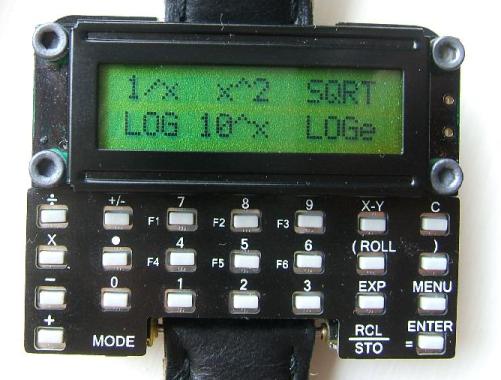
When the band support on [David]’s Casio CFX-400 Scientific Calculator Watch finally broke after 10 years of use, he found it almost impossible to find another watch with the same functionality. Like any good engineer, [David] decided to design a watch to meet his needs. The result of his endeavors was the µWatch, a programmable watch based on a PIC24 with both RPN and Algebraic calculation modes. The watch runs open source software and is expandable thanks to a serial port, an ICSP programming port, and a spot for an infrared LED on the board. On his site, [David] shows how he made the first µWatch and offers kits for anyone who wants to build their own. We’ve been told that the next batch of kits will be made available in 1-2 weeks and are expected to sell out fast.

[Thanks Tomesz]