Greenhouse Guard

pid

[Seth King] sent in his latest hack where he used an Arduino to regulate various aspects of a greenhouse. He has sensors for soil and air temperature as well as light and moisture. He built a custom circuit that uses relays to power fans, lights, and heaters. Using timers and the sensor data, the devices can be triggered to create the perfect environment for sprouts. He hopes to make the whole thing wireless by integrating XBees, but for now he ran a USB cord to his computer.

Related: Automatic grow light

Liquid Tree

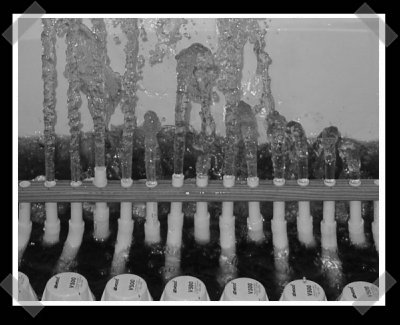
Liquid Tree is decorative, functional, and green. It’s a liquid feedback display created by [Jia Yi Lin] that is designed to tell you exactly how much water you’re wasting in the shower. Behind the pretty tubes is some interesting hardware. [Lin] used an Arduino board, and based her code off the Unipolar Stepper example. She’s posted her own code and wiring for the project. When hot water is turned on, the motors decrease the amount of liquid in the tubes. This causes the pattern to slowly disappear, indicating water consumed.

[via NOTCOT]

Waterproof IPod Touch Video Boombox


Popular Mechanics contributor [Anthony Veducci] wanted a virtually indestructible video player that he could use anywhere. Not finding a commercial solution, he decided to build his own. He already had a large waterproof case and another for the iPod Touch. The 8″ display came from an iPod accessory. Unfortunately it was developed before Apple implemented their stupid accessory locking, so he had to use an Apple approved video cable through several adapters to get it to work. The speakers were also salvaged parts. The case was assembled using a jigsaw and a whole lot of epoxy. The speaker openings are covered with latex from a pair of gloves and everything is sealed with silicone. We’re usually trying to escape technology when we head outside, but we’ll be looking back at this the next time we need to ruggedize something.

[via Gizmodo]

Infinite Water


It’s Independence Day, so if you have pets and planned a trip, chances are you wrangled a pet sitter to keep your pet from starving or dehydrating to death. Next time, consider letting this infinite water dispenser help you instead.

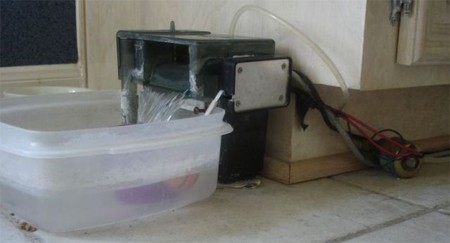
The dispenser is made of a Tupperware tub, a fish tank water filter, a float switch, and a water solenoid valve. It works essentially the same way as any toilet: the solenoid valve lets water into the filter where it is dispensed to the Tupperware container. The float switch is activated when the water in the container reaches a certain level. When the water level drops due to evaporation or thirsty pets, the float switch goes down and triggers the solenoid to let in more water. The whole works are powered by a GFI outlet for safety since this project involved water, electricity and pets.

Water Runner Robot


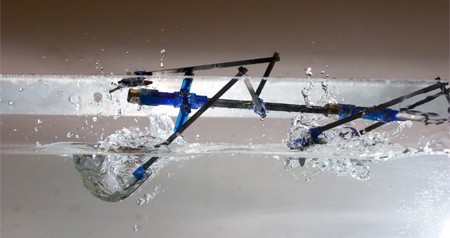
Researchers at Carnegie Mellon University’s NanoRobotics Lab have developed a robot that is capable of running on the surface of a pool of water. Like their wall climbing Waalbot, the Water Runner was inspired by the abilities of a lizard, in this case, the basilisk. The team studied the motions of the basilisk and found morphological features and aspects of the lizard’s stride that make running on water possible. Both the lizard and the robot run on water by slapping the surface to create an air cavity like the one above, then push against the water for the necessary lift and thrust. Several prototypes have been built, and there are variants with 2 or 4 legs and with on and off-board power sources. You can see a slow motion video of the robot’s movement below.

The purpose of their research is to create robots that can traverse any surface on earth and waste less energy to viscous drag than a swimming robot would. Though another of the team’s goals is to further legged robot research, the Water Runner is not without potential practical applications. It could be used to collect water samples, monitor waterways with a camera, or even deliver small packages. Download the full abstract in PDF format for more information.

Continue reading “Water Runner Robot”