posted Oct 23rd 2010 2:00pm by
Jakob Griffith
filed under:
misc hacks

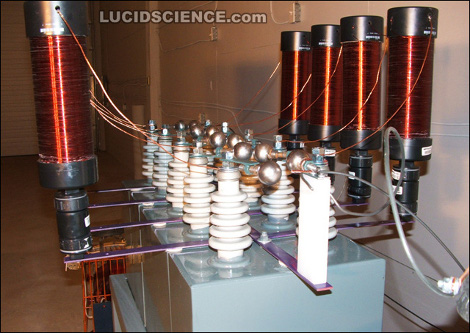
What weighs more than 500 pounds, produces 500 kilovolts, and we don’t recommend you try at home in any way shape or form? If you guessed a rock disaggregation device, you’re correct! We also accepted lightning generators as correct answers. Using high voltage electricity, a rock can be split apart down to its grains without destroying the precious minerals inside; unlike traditional grinding and mechanical techniques that often ruin the sample. All it takes is a massive hydro pole transformer, five 1uf 100 kilovolt capacitors, eight hand wound inductors, and two massive cojones to stand within 20 feet of the thing while it’s going off. Video after the divide.
Read the rest of this entry »
posted Oct 21st 2010 6:39am by
Jakob Griffith
filed under:
digital audio hacks

It’s that time again, time to take on the machine with the Hackerspace, Crash Space (and part two)! The team of Californians set out and successfully turned the front of their building into a musical instrument, similar to [David Byrne's] Playing the Building. When a pedestrian walks by they set off distance sensors, which in turn actuate mallets that strike particular objects to produce a tone. We were pleasantly surprised at how interactive the installation was, even if it didn’t sound that great. But will it be enough to beat out the previous two teams? And how will it do up against Artisans Asylum’s not what you’re thinking Breakfast Machine next time?
[thanks Deven]
posted Oct 20th 2010 9:00am by
Jakob Griffith
filed under:
arduino hacks

There are a lot of solutions to programing an Arduino: the default avr-g++, Studio, etc. But [Sandeep] let us know about using one of the more powerful IDEs out there, Eclipse, to do the same. We’ve already outlined why Eclipse is a great IDE but now the fact that you can use it in your MCU based projects adds to its usefulness and already large feature list. However, don’t be turned off by [Sandeep's] tutorial. While it is aimed at people who are completely new to setting up an IDE and working with an AVR, the tips certainly can benefit even the most experienced hacker.
posted Oct 20th 2010 6:40am by
Jakob Griffith
filed under:
wireless hacks

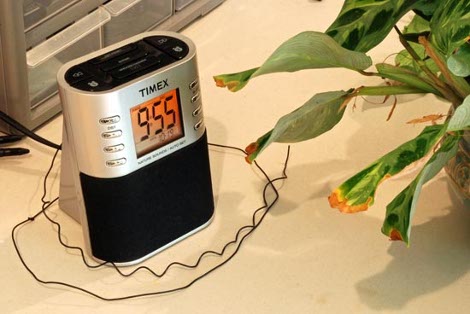
The back story behind [Mike] experimenting with plants as AM radio transmission antennas antennae is rather interesting and worth the short read. But for those who just want the facts, [Mike] took an ATMega324, modified the PWM output into a sinusoidal AM signal (using a simple form of RLC circuitry), and connected the circuit to a plant no plants were harmed in the making of this project. The results? Well we’re not ones who would spoil the surprise, you’ll have to see for yourself in the video after the jump.
Read the rest of this entry »
posted Oct 18th 2010 2:16pm by
Jakob Griffith
filed under:
arduino hacks

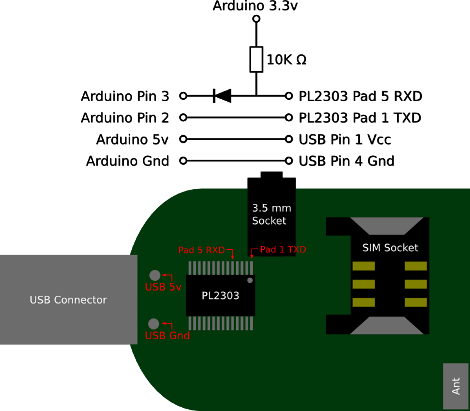
Non acronym version of the title: send and receive text messages via cell phone communication towers using an Arduino or other microcontroller. “We’ve been doing that for years!” you cry, well yes, technically. But [Fincham] lays it outs simply; commercial offerings are expensive and finding a cell phone that uses RS232 now a days is getting difficult, so a new way of doing the same old is necessary. The good news is USB GSM modems are readily available, cheap, and only require a few interface pins to get them talking with an Arduino. In fact, the image above is all you need.
posted Oct 17th 2010 6:45am by
Jakob Griffith
filed under:
digital audio hacks

Sadly, this pocket mp3 wav player doesn’t come close to the capabilities of even an iPod generation 1 yet, but you have to give [Owen] props for making it in less than 24 hours. The system consists of a Propeller MCU (cleverly wired to be swappable with “shields” similar to Arduino systems), SD card for song storage, and an LM386 for audio. While the setup is a little dull, and only plays through songs non stop with no controls whatsoever, it certainly is a good start in the right direction for a cheap and simple portable music player. Of course some planned changes are in the works, include an accelerometer (gesture based controls?), etched PCB, docking station, and a case. We’re surprised there is no form of screen planned, considering Owen appears to have a rather good handle on touch interfaces; perhaps he’s waiting for revision 3.
posted Oct 14th 2010 2:00pm by
Jakob Griffith
filed under:
transportation hacks

Part one and Part two of Hackerspace Pumping Station: One taking on the Scion challenge are up and ready for your viewing pleasure. The team at Pumping Station: One built a Tron themed bicycle that when setup properly, would churn ice cream that turned your urine neon in about 6 minutes by using dry ice and ethyl alcohol. Besides sounding not so tasty, and having a multitude of problems along the way, the project turned out the be a success. The question becomes, does it stand up to the last Hackerspace, NYC Resistor, who made a drink mixing slot machine? And how will both fair against the up and coming Musical Building by Crash Space?
[Thanks Deven]
posted Oct 12th 2010 6:06am by
Jakob Griffith
filed under:
toy hacks,
transportation hacks

[Fred Keller] and [Judy Foster], both retired, are proving that age is just a number. What you see above is a nostalgia inducing full size driveable Radio Flyer red wagon. The base of which is a 1976 Mazda pickup truck, while the wagon portion is a mishmash of wood, fiberglass and bondo, detergent bottles, and more. Even the steering wheel has been retrofitted from an actual wheel from a wagon. We were surprised to find out the entire conversion only took the two 11 months to complete (finishing this past august), and even more confounded to learn the vehicle is completely street legal.
[Thanks Rob]