posted Jul 9th 2008 9:00pm by
Juan Aguilar
filed under:
news

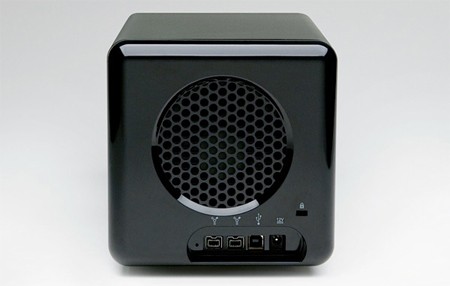
Data Robotics has released an updated Drobo with two Firewire ports and an updated processor, allowing for faster data transfer and daisy chaining multiple Drobos. The new models of this storage and backup device also features a quieter and larger case fan. The case itself has been modified slightly but to great effect, looking sleeker than ever. Sadly, they still start at $500 without any hard drives.
One nice side effect to the announcement of the new Drobos is the price drop for the old ones. Starting at $350, these still make great storage solutions, and hanging on to $150 isn’t bad either. Still, if the idea of buy anything for this purpose curls your toes, build your own network attached storage.
posted Jul 9th 2008 8:40pm by
Juan Aguilar
filed under:
home entertainment hacks,
xbox hacks

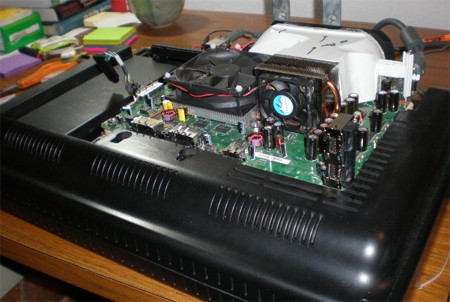
What happens when you take a little [Ben Heck] ingenuity, a little Lian Li utility, an Xbox 360 and an LCD HDTV and mix it all together? You get the Microvision 360, a combination LCD HDTV and Xbox 360.
The mod is not particularly complex. The Microvision 360’s creator [PvP_LostKnight] only removed the working parts from the Xbox 360’s case and mounted them to the back of the TV. A few of the inputs of the TV had to be moved and rewired, and a repurposed and painted tupperware container was added to cover the Xbox 360 parts. Unfortunately, [PvP_LostKnight] did not post a writeup, and even added “The wiring for this is horrible, I would not recommend anyone trying this.”
Setting aside his recommendation for a moment, a few of the advantages to his design are improved airflow to the Xbox 360 and better space usage. What we’d like to see added more than anything is power integration, with a single button to turn on both and a single power source powering the TV and the Xbox. See the proof of concept video after the break, or more photos and comments at the read link.
Read the rest of this entry »
posted Jul 9th 2008 5:40pm by
Juan Aguilar
filed under:
digital cameras hacks,
misc hacks

We’ve seen numerous products geared toward tracking the location and activities of your pets, two in the last month, but we feel sure you can make more functional devices than those you can purchase. Let’s look at a few and consider our options.
Read the rest of this entry »
posted Jul 8th 2008 8:55pm by
Juan Aguilar
filed under:
news

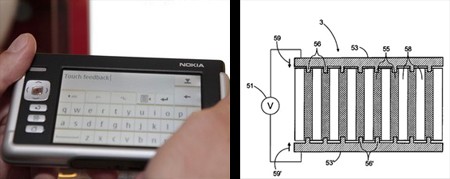
We’ve been waiting for more information on the Nokia Haptikos, the haptic feedback touchscreen announced last October and largely forgotten until now. We knew that it would be a device that could raise sections
of its touchscreen to simulate the feel of buttons or keys, we just weren’t sure how Nokia would pull that off.
Now we have a better idea, as Nokia’s recent patent filing for the Haptikos gives away some juicy details.
The secret behind the device’s feedback is a “plurality of closely spaced voltage controllable protuberances,” or in other words, several small fluid filled compartments just under the screen’s surface. Under them are several piezoelectric members that can be controlled independently; when they extend upward, they apply pressure to the fluid compartments, raising the surface of the screen in that area.
Nokia has yet to work out all the kinks, but you can see the parts that do work by downloading the Haptikos patent application (PDF file).
[via Engadget]
posted Jul 8th 2008 8:45pm by
Juan Aguilar
filed under:
misc hacks

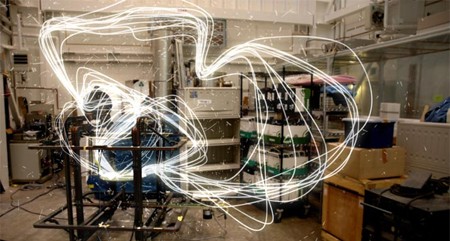
We at Hackaday often dream of having our own personal planets where we wouldn’t have to deal with other people, but our spaceships aren’t quite ready. While we figure that out, you can do the next best thing: render small planets using Photoshop or GIMP with a few other graphics apps and this guide to making small planets like the one pictured above.
Read the rest of this entry »
posted Jul 8th 2008 7:00pm by
Juan Aguilar
filed under:
news

Google has just released their own avatar based social arena a la Second Life, which is called Lively. It will require a client download and install like the popular MUD, but after that it can be accessed via IE and Firefox.
Lively allows user to create their own online spaces that can include natural or human-built settings and customize their avatars (which are relatively cartoonish in comparison to SL avatars). Google’s engineering manager for Lively [Niniane Wang] explains that they wanted to create a more socially rich environment than was possible with emotes and other chatroom features.
Lively’s core functions are not particularly novel, but it does innovate with various web integration features. Videos and images from the internet are viewable from within Lively, and users can embed their own personal Lively areas into their blogs or websites (hello VRML).
Lively is not nearly as expansive as Second Life yet, with no form of currency included and only stock items, clothes, avatars, and geometry to choose from. What’s more, it is only available for Windows XP and Vista, with no other OS support announced. We can see this getting better in the future, but those of you who’s lives are so great that you need a second one (or a third) will probably want to jump on this now.
Read the rest of this entry »
posted Jul 8th 2008 5:30pm by
Juan Aguilar
filed under:
news
posted Jul 8th 2008 2:40pm by
Juan Aguilar
filed under:
misc hacks

A group from Philadelphia PA calling themselves Team pzkpfw decided to recreate a Panzerkampfwagen III, but not entirely according to the original specs. Instead of treads and an engine, they used a system of pedals, gears and chains powered by up to six riders. The team of roughly nine men spent eleven days welding beams and plates, drilling and shaping sprockets, and painting the tank a fearsome pink camouflage. They were planning on crashing the 2nd annual Kensington Kinetic Sculpture Derby with it, which they crashed last year in a pirate ship, but they ended up being too tired from their tooling around to actually do it. There’s always next year. Get a look at their promotional video after the break, or if you’ll be in the Philly area soon, “visit the tank on Frankford Ave, just north of Norris St in Philadelphia.”
Read the rest of this entry »
posted Jul 8th 2008 2:30pm by
Juan Aguilar
filed under:
led hacks,
misc hacks

We’ve seen some fairly impressive mixer projects this year, and the Aurora mixer is no exception. It is a dual channel USB-powered mixer with two linear faders, one crossfader, eight backlit buttons and 24 potentiometers, all built around a PIC 18LF4525 microcontroller. That’s all pretty typical for a mixer, but this one is very visually attractive, featuring a clean and stylish form factor and controllable lighting both under the board and in the LEDs backlighting the buttons and knobs.
Whether you want to buy one now or build one yourself, the Aurora team has made both possible. You can contact them for pricing if you are ready to buy. If you prefer to build, this is an open source project with full assembly instructions, schematics, drivers, patches and all other source code and information you should need available here. See more photos of the Aurora mixer here, or see it in action after the break.
Read the rest of this entry »
posted Jul 7th 2008 11:50pm by
Juan Aguilar
filed under:
news
Do you have a burning desire to fight grizzly bears? If you do, We can’t guarantee that the first bear you face will win, but we really can’t imagine another outcome unless you use [Troy Hurtubise]’s Mk IV suit, which is currently up for auction. We have discussed the suit before along with several other high-tech power suits, but this is the only one with bear-resistance in mind. The suit features several safety features, including layers of chainmail and titanium.The suit was also featured in the film “Project Grizzly.” [Hurtubise] is hoping to sell the suit for $40,000 or more to offset his personal costs, and judging by the current price, he may well make it.
[via Engadget]