TinyCore Board Teaches Core Microcontroller Concepts

Looking for an educational microcontroller board to get you or a loved one into electronics? Consider the tinyCore – a small and nifty octagon-shaped ESP32 board by [MR. INDUSTRIES], simplified for learning yet featureful enough to offer plenty of growth, and fully open.

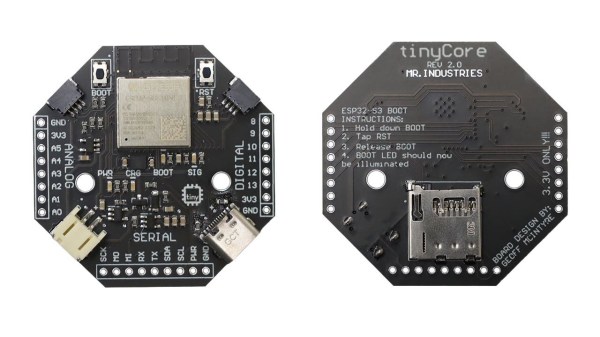
The tinyCore board’s octagonal shape makes it more flexible for building wearables than the vaguely rectangular boards we’re used to, and it’s got a good few onboard gadgets. Apart from already expected WiFi, BLE, and GPIOs, you get battery management, a 6DoF IMU (LSM6DSOX) in the center of the board, a micro SD card slot for all your data needs, and two QWIIC connectors. As such, you could easily turn it into, say, a smartwatch, a motion-sensitive tracker, or a controller for a small robot – there’s even a few sample projects for you to try.

You can buy one, or assemble a few yourself thanks to the open-source-ness – and, to us, the biggest factor is the [MR.INDUSTRIES] community, with documentation, examples, and people learning with this board and sharing what they make. Want a device with a big display that similarly wields a library of examples and a community? Perhaps check out the Cheap Yellow Display hacks!

Continue reading “TinyCore Board Teaches Core Microcontroller Concepts”
Retrotechtacular: Computers In Schools? 1979 Says Yes

The BBC wanted to show everyone how a computer might be used in schools. A program aired in 1979 asks, “Will Computers Revolutionise Education?” There’s vintage hardware and an appearance of PILOT, made for computer instructions.

Using PILOT looks suspiciously like working with a modern chatbot without as much AI noise. The French teacher in the video likes that schoolboys were practicing their French verb conjugation on the computer instead of playing football.

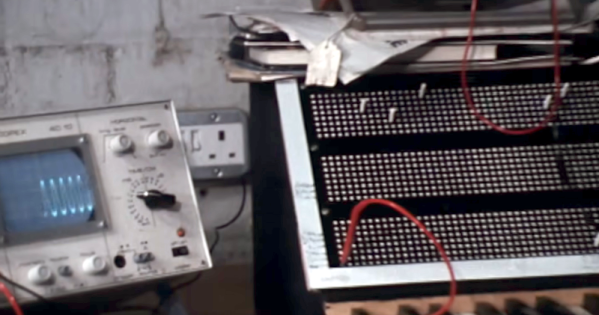
If you want a better look at hardware, around the five-minute mark, you see schoolkids making printed circuit boards, and some truly vintage oscilloscope close-ups. There are plenty of tiny monitors and large, noisy printing terminals.

You have to wonder where the eight-year-olds who learned about computers in the video are today, and what kind of computer they have. They learned binary and the Towers of Hanoi. Their teacher said the kids now knew more about computers than their parents did.

As a future prediction, [James Bellini] did pretty well. Like many forecasters, he almost didn’t go far enough, as we look back almost 50 years. Sure, Prestel didn’t work out as well as they thought, dying in 1994. But he shouldn’t feel bad. Predicting the future is tough. Unless, of course,  you are [Arthur C. Clarke].

Continue reading “Retrotechtacular: Computers In Schools? 1979 Says Yes”

“AI, Make Me A Degree Certificate”

One of the fun things about writing for Hackaday is that it takes you to the places where our community hang out. I was in a hackerspace in a university town the other evening, busily chasing my end of month deadline as no doubt were my colleagues at the time too. In there were a couple of others, a member who’s an electronic engineering student at one of the local universities, and one of their friends from the same course. They were working on the hardware side of a group project, a web-connected device which with a team of several other students, and they were creating from sensor to server to screen.

I have a lot of respect for my friend’s engineering abilities, I won’t name them but they’ve done a bunch of really accomplished projects, and some of them have even been featured here by my colleagues. They are already a very competent engineer indeed, and when in time they receive the bit of paper to prove it, they will go far. The other student was immediately apparent as being cut from the same cloth, as people say in hackerspaces, “one of us”.

They were making great progress with the hardware and low-level software while they were there, but I was saddened at their lament over their colleagues. In particular it seemed they had a real problem with vibe coding: they estimated that only a small percentage of their classmates could code by hand as they did, and the result was a lot of impenetrable code that looked good, but often simply didn’t work.

I came away wondering not how AI could be used to generate such poor quality work, but how on earth this could be viewed as acceptable in a university.
Continue reading ““AI, Make Me A Degree Certificate””

Teaching Math With 3D Printers

We’ve often thought that 3D printers make excellent school projects. No matter what a student’s interests are: art, software, electronics, robotics, chemistry, or physics, there’s something for everyone. A recent blog post from [Prusa Research] shows how Johannes Kepler University is using 3D printing to teach math. You can see a video with Professor [Zsolt Lavicza] explaining their vision below.

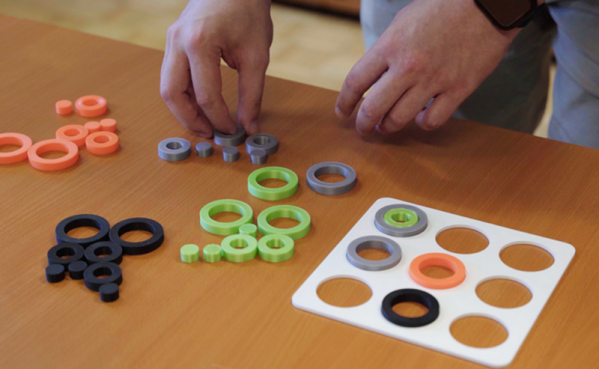
Instead of relying on abstract 3D shapes projected on a 2D screen, GeoGebra, educational math software, creates shapes that you can produce on a 3D printer. Students can physically handle and observe these shapes in the real world instead of on a flat screen.

One example of how the 3D printer finds use in a math class is producing “Genius Square,” a multilevel tic-tac-toe game. You can find the model for that and other designs used in the classes, on Printables. Some prints are like puzzles where students assemble shapes from pieces.

Putting 3D printers in school isn’t a new idea, of course. However, machines have become much simpler to use in recent years, so maybe the time is now. If you can’t find money for printers in school, you can always teach robotics using some low-tech methods.

Continue reading “Teaching Math With 3D Printers”

EmuDevz Is Literally A Software Game

The idea of gamifying all the things might have died down now that the current hype is shoving AI into all the things — but you’ve probably never seen it quite like EmuDevz, a game in which you develop an 8-bit emulator by [Rodrigo Alfonso].

There’s a lot of learning you’ll have to do along the way, about programming and how retro systems work, including diving into 6502 assembly code. Why 6502? Well, the emulator you’re working on (it’s partially-written at the start of the game; you need only debug and finish the job) is for a fantasy system called the NEEES “an antique game console released in 1983”. It’s the NEEES and not NES for two reasons. One, Nintendo has lawyers and they really, really know how to use them. Two, by creating a fantasy console that is not-quite-a-Famicom, the goalposts for EmuDevz can be moved a bit closer in.

Continue reading “EmuDevz Is Literally A Software Game”

Hackaday Links Column Banner

Hackaday Links: June 22, 2025

Hold onto your hats, everyone — there’s stunning news afoot. It’s hard to believe, but it looks like over-reliance on chatbots to do your homework can turn your brain into pudding. At least that seems to be the conclusion of a preprint paper out of the MIT Media Lab, which looked at 54 adults between the ages of 18 and 39, who were tasked with writing a series of essays. They divided participants into three groups — one that used ChatGPT to help write the essays, one that was limited to using only Google search, and one that had to do everything the old-fashioned way. They recorded the brain activity of writers using EEG, in order to get an idea of brain engagement with the task. The brain-only group had the greatest engagement, which stayed consistently high throughout the series, while the ChatGPT group had the least. More alarmingly, the engagement for the chatbot group went down even further with each essay written. The ChatGPT group produced essays that were very similar between writers and were judged “soulless” by two English teachers. Go figure.

Continue reading “Hackaday Links: June 22, 2025”

Determine Fundamental Constants With LEDs And A Multimeter

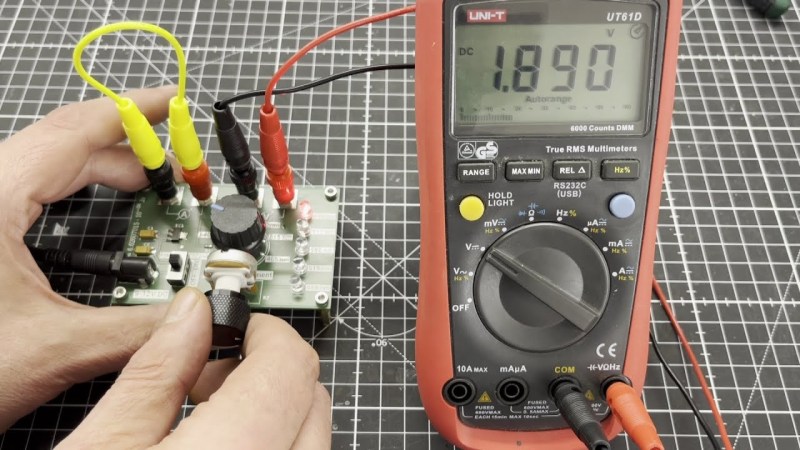
There are (probably) less than two dozen fundemental constants that define the physics of our universe. Determining the value of them might seem like the sort of thing for large, well funded University labs, but many can be determined to reasonable accuracy on the benchtop, as [Marb’s Lab] proves with this experiment to find the value of Planck’s Constant.

[Marv’s Lab] setup is on a nice PCB that uses a rotary switch to select between 5 LEDs of different wavelengths, with banana plugs for the multi-meter so he can perform a linear regression on the relation between energy and frequency to find the constant. He’s also thoughtfully put connectors in place for current measurement, so the volt-current relationship of the LEDs can be characterized in a second experiment. Overall, this is a piece of kit that would not be out of place in any high school or undergraduate physics lab. Continue reading “Determine Fundamental Constants With LEDs And A Multimeter”