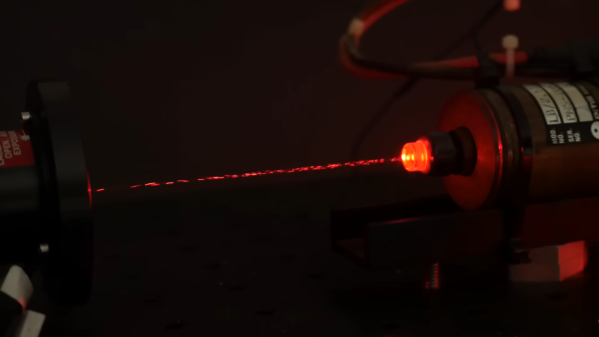
[Directive0] added a 200mW laser to his Enterprise Phase Pistol toy. This joins the ranks of hand-heldlaser hacks that we’ve seen around here lately. His build makes use of the stun and kill settings of the toy to switch between different modes. The built-in 9 volt battery holder is tapped into for power. When set to stun, the stun LED indicator is illuminated and a trigger pull sends current limited electricity to the laser diode. When the kill (or blind) setting is selected, the appropriate LED is illuminated and the trigger sends the full current from the battery to the laser diode. Power regulation is managed by the driver circuit for the laser.
This build preserves the unmodded look of the toy gun. [Directive0's] inclusion of protective glass should fend off the warnings we usually see in the comments of these types of hacks.
Phasers come with two settings: stun and kill. [Luke] took this seriously when he put two Blu-ray lasers into a toy raygun. He picked up the toy from Amazon for about twenty bucks and set to work.
The laser diodes are both pulled out of a 6x BD-R burner, which we think is a pretty expensive source to scavenge from. [Luke] removed the toy circuitry, reusing the trigger, top switch, and battery pack. The two diodes are mounted on a swiveling carriage which is turned 180 degrees to switch between the two diodes. A boost driver converts the 3v from the batteries up to 7v for the diodes.
[iskor12] put together a blu-ray laser that is waterproof and packs quite a punch. At 182 mW there is enough power here to pop dark colored balloons (see the video after the break). To make this happen, he found an LED flashlight that has rubber o-rings for waterproofing. Although small, there is enough space in the case to house the battery, driver, and laser diode. A thick ring of aluminum is placed around the laser diode to act as heat sink.
We’ll admit, we don’t know that much about lasers. This is probably the wrong question to ask, but now that he has this what do you do with it? Leave us a comment about your plans for this diabolical creation.
Microsoft is showing off five concepts for added mouse functionality. All of them seek to replace traditional move-and-click with touch sensitivity through either capacitive sensing, video recognition, sensor articulation, or laser scanning. We’re excited about the prospects of some of these features but at the same time wonder what this does to the price of this much-abused peripheral. After the break we’ll touch on each of the devices, along with time references for the video embedded above. Read the rest of this entry »
Last month we had the pleasure of bringing you [FireMyLaser's] green laser spirograph. Just green is great for a while, but why not add red and blue for a full spectrum of color! [c4r0] steps in at this point to bring us his red green blue laser. He dug around inside Blu-ray players and DVD drives until he had a collection of lasers, refractors, and other filters that fit his needs. With some careful toothpick alignment and glue, his setup was complete.
But then he went further by modified his galvo scanner to accept the RGB laser; requiring a custom circuit board and new software, both available on his site. The original is in Polish, but Google does a decent translation. Check after the jump for a video.
Popped balloons or bullets fired into apples, anyone can photograph with a quick sound based camera rig. Lasers have been used forever in motion detection. And even door bell chimes have been used before for remote camera shutter releases. No, [SaskView] wanted to go further and created his Laser Triggered High-Speed Photography setup, to photograph (of all things) milk splashes. We liked the simplicity of the project however; requiring no programmed microchips or overly complicated circuitry – rather he took a quick trip to the local dollar shop, used the amazing CHDK firmware, and he produced perfect results every time.
[Update: CHDK, not CHKD firmware. My mind must be elsewhere. Thanks jbot and agent smith]
[atduskgreg] posted this cool looking rig. That’s a batting glove, chopped up and equipped with a flex sensor and a pressure sensor. The end goal was to create a new method of drawing. You can see he’s interfaced with the servos decently. It seems fairly responsive and intuitive. Looking at his results though, make us wonder if all that effort was worth it. We would probably apply this rig to some kind of animatronics.
[Jon] wanted to have some fun with the Graffiti Research Lab’s LASER Tag. Unfortunately his computer wasn’t quite up for the challenge of detecting the laser pointer with a webcam. Not to be discouraged by this hardware limitation, he purchased a used Wacom tablet and threw together some code to make it work with the GRL display software. Now designs can be scrawled on the pad and the projector displays them with the familiar dripping paint effect. Read the rest of this entry »
With the availability of webcams and projectors, multitouch and interactive demos have become increasingly popular because they’re so easy. Students at the University of Tokyo took a new approach that uses lasers instead. They created Sticky Light, which uses mirrors, a laser, and a single photodetector. Unlike camera-tracking setups, this system requires no visual processing. The laser moves around and bumps into dark objects, sticking to them. It can follow drawings on the table or objects in space, such as shirt designs. They also created a few basic games and a demo that makes sounds based on the movement of the spots. Video of the project after the break.