Knock detecting lock

posted Nov 4th 2009 8:00am by Caleb Kraft
filed under: arduino hacks, security hacks

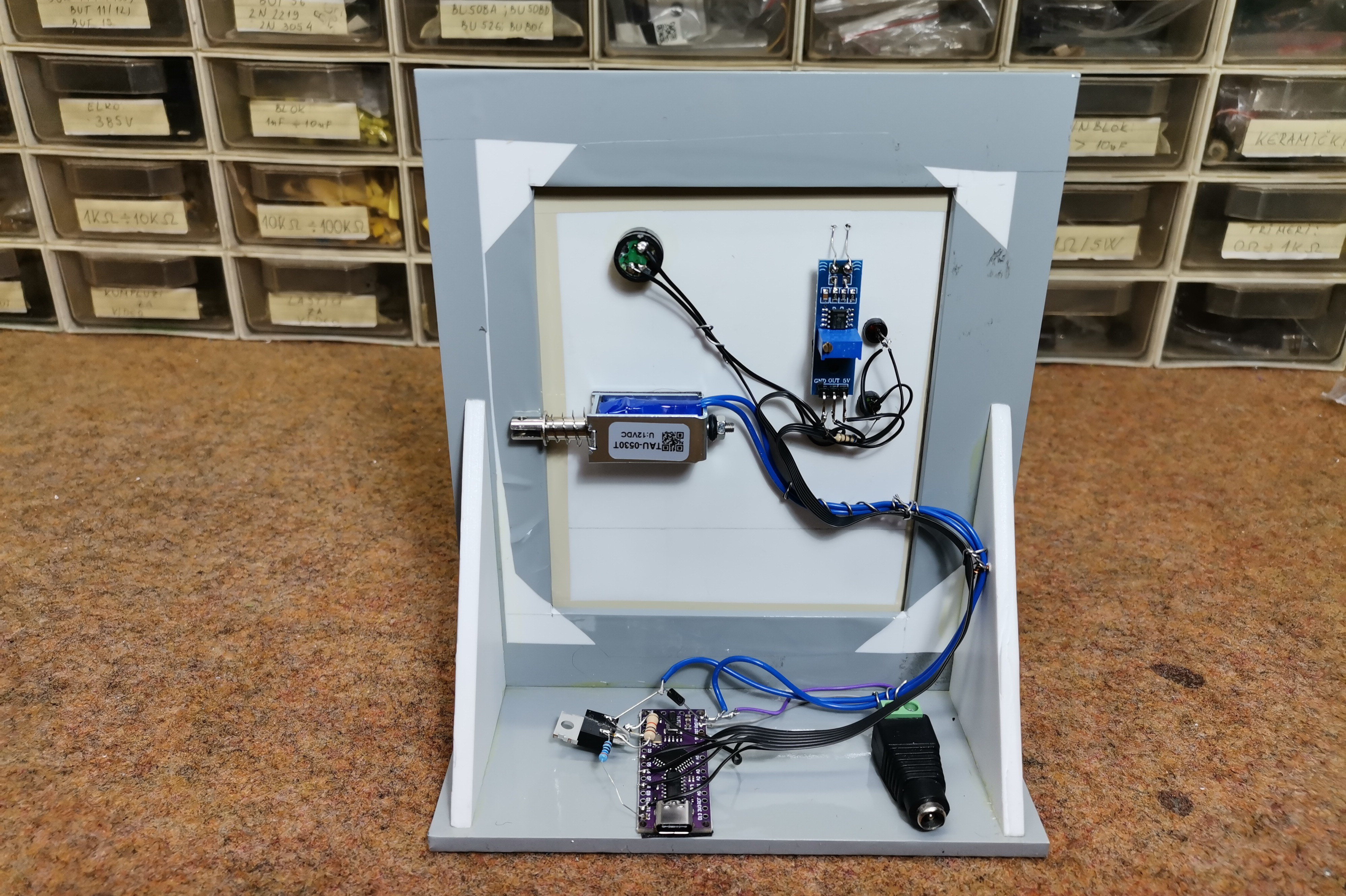
[Steve] shows us his version of the knock detecting lock system. The idea is pretty simple, knock in a certain pattern and the door unlocks. We’ve seen it before several times. This solution is somewhat cleaner than the others, not only in physical design, but also in how you reprogram it. Simply push the reprogram button and enter your new knock. We’re a bit surprised that the suction cups actually hold it on the door. Maybe it’s just us, but we can never seem to get those things to hold very well. There are lots of great pictures as well as the source code available on his site.

[via HacknMod]

Adding a keypad to a key card lock

posted Oct 9th 2009 8:00am by Phil Burgess
filed under: classic hacks, security hacks

keypad

[Colin Merkel] had a little problem: he was continually forgetting his electronic key card, locking himself out of his own dorm room. Like any normal Hack a Day reader, rather than getting in the habit of always carrying his card, the natural impulse of course is to build this elaborate rig of electronics and duct tape. Right?

The result is an additional keypad that can be used to gain access…not by altering the existing electronic lock, but with a secondary mechanism that operates the inside door handle. An 8-bit PIC microcontroller scans the outside keypad (connected by a thin ribbon cable), and when a correct access code is entered, engages a 12 volt DC motor to turn the handle. It’s a great little writeup that includes a parts list, source code, and explains the process of keypad scanning.

It’s similar to the RFID-based dorm hack we previously posted. By physically operating the handle, most any approach could be used: facial recognition, other biometrics, DDR pad, or whatever inspired lunacy you can dream up.


Photographic key duplication

posted Sep 22nd 2009 2:00pm by Mike Szczys
filed under: lockpicking hacks, security hacks

key_photo

[Ben] and his associates over at the University of California at San Diego came up with a way to duplicate keys using a picture of them. They developed an algorithm that uses measurements from known key blanks to extrapolate the bitting code. Because the software is measuring multiple points it can correct the perspective of the photo when the key is not photographed on a flat surface, but from an angle.

They went so far as to test with cell phone cameras and using a telephoto lens from 195 feet away. In most cases, correct keys were produced within four guesses. Don’t miss their wonderful writeup (PDF) detailing how key bitting works, traditional covert duplication methods, and all the details of their process. The lack of available code prevents us all from playing secret agent (or felon) with this idea but [Ben] did mention that if there is sufficient interest he might release it.

Lock bumping showed us how weak our security is, but this is a bit scary.

[Thanks Mike]

Automated dorm room door

posted Jul 6th 2009 6:25am by Caleb Kraft
filed under: home hacks, iphone hacks

[Chris] wrote in to tell us about this project he did while living in the dorms. He built a system to automate his dorm room door. It handles unlocking and opening/closing the door via iPhone, secret knock, and even the key.  The lock/knob portion is handled by a servo while the opening/closing action is hydraulic. After living with it for a year, he says that it never gets old, but there were a few bugs. Apparently it would randomly open in the middle of the night sometimes. If you’re interested in doing something like this, but not damaging the door, maybe you should check out the RFID dorm door lock project.

Marc Weber Tobias vs Medeco

posted May 22nd 2009 4:39pm by Eliot Phillips
filed under: lockpicking hacks, news, security hacks

tobias

This month’s Wired magazine has an extensive profile of [Marc Weber Tobias]. He’s a professional lock picker that delights in coming up with new techniques for taking on high security locks. In recent years, he’s run afoul of the US’s premier high security lock manufacturer, Medeco, by publishing Open in Thirty Seconds with [Tobias Bluzmanis]. Medeco still denies that this is even possible. Wired decided to to test the team by purchasing six new cylinders and timing them. Each one was open in under nine minutes. You can see a video of this on Wired’s site.

Last fall we covered a decoding attack against Medeco locks by [Jon King].

[via blackbag]


SparkFun releases RGB button controller

posted Feb 5th 2009 2:04pm by Eliot Phillips
filed under: digital audio hacks, led hacks, news, peripherals hacks

rgb_button

SparkFun has been selling button pad parts for some time and we used them in our RGB door lock project. A excellent part, but you needed to implement your own interface to use the boards. SparkFun has just released two additional versions to make it easier on builders. The first is their Button Pad Controller USB. It has a 4×4 grid of buttons lit by RGB LEDs and a USB interface. This board can be expanded using the Button Pad Controller SPI. The SPI bus means it should be easy to add the button pad to embedded projects. This newest release puts you much closer to building your own RGB monome clone or other custom controller than ever before. The unit pictured above is their own project and they have no plans on selling anything like it.

RFID dorm room door

posted Jan 2nd 2009 9:47am by Caleb Kraft
filed under: classic hacks, home hacks

rfid_door

[Max] sent us his dorm room RFID controlled lock. While RFID door locks are nothing new, his implementation is very slick. The entire unit is attached with suction cups to a mirror on the inside of the door. It looks like it could be removed and put elsewhere in a matter of seconds. That’s pretty slick. Much cleaner than the touch sensitive dorm lock we saw last year.

Acrylic tumbler lock

posted Dec 9th 2008 7:28pm by Eliot Phillips
filed under: security hacks, tool hacks

acrylictumbler

Sometimes describing how a lock actually works can be the hardest part of teaching someone about lockpicking. [Mike Gee] has designed an acrylic lock that may just be the ticket for these situations. All of the pieces are cut from clear acrylic. As you insert the key, you can see it raise the four pins up to the shear line. He says that it will definitely take some tweaking as you assemble it to get it to function smoothly. Embedded below is a video of the lock in use. You can find plans on Thingiverse.

Read the rest of this entry »


Nintendo keyless entry

posted Dec 8th 2008 7:55am by Caleb Kraft
filed under: arduino hacks, home hacks, nintendo hacks, security hacks

The Nintendo keyless entry system will vigilantly guard your door from intruders. Enter the right code and you get access, enter the wrong code and it will deny you and take your picture. [action_owl] did a fantastic job on this lock, using mainly recycled parts like an old CDRom and an Arduino. It works both with or without the computer. If you choose not to use the computer, you don’t get pictures of the people who entered the code wrong.

We like this project, but we feel it needs to be pointed out that this lock is pretty useless. Everyone already knows the code to get in is UP, UP, DOWN, DOWN, LEFT, RIGHT, LEFT, RIGHT, B, A.

Upgrade an electric lock keypad

posted Nov 30th 2008 9:35am by Caleb Kraft
filed under: classic hacks, home hacks

lock_buttons

[OldGrover] bought a Weiser electronic lock. Only 6 months after installing it, the keypad stopped working. Instead of just accepting this, [OldGrover] built a better button pad for his lock.  He decided to go with big push buttons instead of a similar to stock membrane system. After tracing out where the original buttons connected, he attached his new buttons and enclosure. Pretty simple really but it fixed the problem and kept the lock out of the landfill. Now, he has a unique looking keypad on his front door.

Hack a Day serves up fresh hacks each day, every day from around the web and a special How-To hack each week.

Send us your hacks