Over-the-air FM radio gains Internet control

posted Sep 26th 2011 7:01am by
filed under: radio hacks

[Old bit collector] is giving up control of his radio dial to the Internet. He combined a couple of Parallax products which now allow him to tune, adjust volume, and toggle the power for an FM radio receiver.

The setup is pretty simple. An FM receiver module is mounted in the breadboard seen above which helps to break out its control pins. Those are connected to a Parallax Spinnarette web server board. It’s auxiliary I/O pins are controlled via a web interface that he set up and plans to operate with the browser on his Android phone. But as you can see after the break, any web browser works as long as you know the correct address.

This is pretty good if you’re on a quest to make everything controllable from your smart phone. But we would love to use the concept to make our own streaming radio. You’d be able to tune in to all of your local stations from anywhere in the world.

Read the rest of this entry »

Monitoring water levels with a Parallax Ping sensor

posted Aug 30th 2011 4:06am by
filed under: arduino hacks

arduino_parallax_ping_water_level_sensor

When you need a mechanism to detect the water level within a container or tank, you have several different options. Most people opt for a simple float or probe that sits in the water, while others use optics to sense when the water is reaching an undesired level.

This device built by [Danilo Abbasciano] uses a Parallax Ping sensor instead. If the sensor is placed at the top of a well, cistern, or other water container, it can accurately calculate the height and volume of the fluid inside. This is done by using the Ping’s readings in conjunction with a few values already known to the user, namely the dimensions of the container.

In his implementation, the readings are relayed to a simple LCD panel for easy viewing, and a small piezo speaker is used to sound an alarm when the water level reaches a predefined threshold. This sort of measuring device can be quite useful in situations where a contact-based sensor would be subject to chemicals and corrosion, or where contamination is a concern.


We don’t need to brainstorm projects; xkcd does that for us

posted Aug 23rd 2011 12:28pm by
filed under: hardware

[Randall Munroe], the guy behind our favorite web comic xkcd, gave us yet another great project idea that falls on the heels of securing our valuables and silencing loud car stereos. The xkcd forum has been talking about how to implement this, and we’d like to hear what Hack A Day readers think about this idea.

The project isn’t much different from 3D photography. [Carl Pisaturo] has done a lot of art and experimentation based on this idea that basically amounted to largish binoculars. A poster on the xkcd forum has already built this using mirrors, but we’re wondering how much the parallax can be increased with this method. Two cameras and a smart phone would also allow automatic pan and tilt that corresponds to head movement.

We’re not quite sure if this idea can be applied to astronomy. The angular resolution of the human eye is around one arc minute, every star except for the Sun has an annual parallax less than one arc second. If anyone wants to try this out with a longer baseline (From Earth to Pluto for example), we would suggest simulating this in Stellarium. Seeing the moon as a sphere would be possible with a few hundred miles between cameras, though.

Tell us how you would build this in the comments, and be sure to send in your write-up if you manage to build it. We’ll put it up right away.

Thanks to [Theon144] for sending this in.

EDIT: Because the comments are actually bearing fruit, check out the thread on the Hack A Day forums for this post: link.

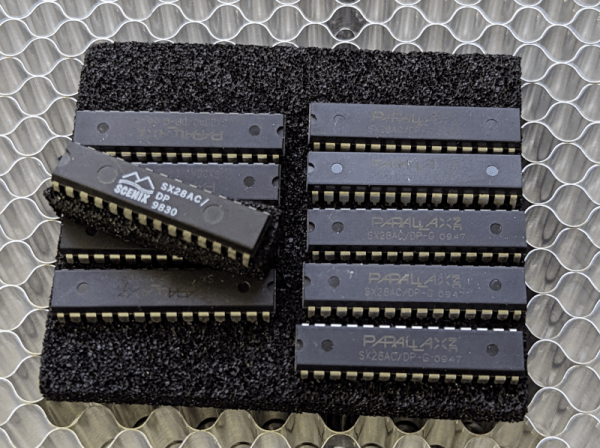
Meet Radio Shack’s new Parallax lineup

posted Aug 19th 2011 4:02am by
filed under: news

It looks like Radio Shack is pretty serious about their new found commitment to their focus on the DIY, inventor, creator and geek demographics. [Ken Gracey], Parallax forum guru, put up a post on the Parallax stuff that will be sold at Radio Shack. Everything is priced, “below spousal approval level,” but no word on what those prices are.

Here’s the (probably not conclusive) list we gleaned from the pics: 2-axis joystick, gyroscope, GPS, compass and altimeter modules, an infrared sensor, 2×16 backlit LCD, BASIC stamp 2 board, and an XBee 2-pack that we assume would be priced above girlfriend approval levels.

We’re curious about how many (and in what quantity) of these items will be stocked at the East Nowheresville strip mall, and again there’s no mention of improving the selection of individual components.

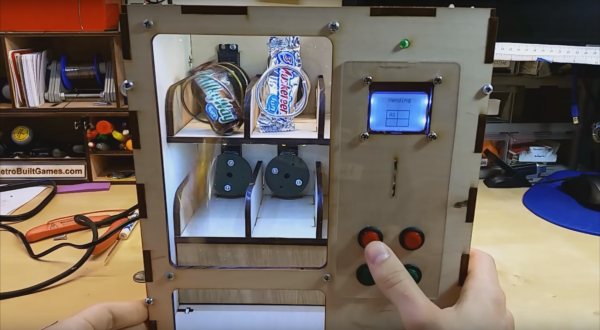
At Hack A Day, we were thinking how amazing a Radio Shack ‘component vending machine’ would be. A modified pick and place machine that will dole out caps, resistors, other components, and has the potential to be competitive with online stores. Anyone feel like sending that suggestion in?

Etch-a-Sketch automatically draws a tribute to Hack a Day

posted Aug 5th 2011 4:13am by
filed under: cnc hacks, toy hacks

automated_etch_a_sketch_hack_a_day_logo

We have seen quite a few automated Etch-a-Sketch machines in our time, but when [Jason] wrote in to share his take on the subject, it came with a nice bribe attached. We are vain. It’s not something we are proud of, but when it comes to seeing the Hack a Day logo drawn out by a robot, consider us sold.

[Jason] has several CNC router builds under his belt, and thought it would be fun to automate his Etch-a-Sketch, a toy he loved as a child. He cut some gears and a face plate for the toy with his new CNC machine, then got busy programming his Propeller microcontroller to do his bidding.

A piece CNC software handles the conversion of a bitmap image to an outline, which is then converted to a CNC cutting path. The cutting path is translated into x/y coordinates by a bit of C++ code, before being fed into the microcontroller, which is running a small SPIN application he calls RoboSketch. The Propeller takes care of the rest, quickly drawing the image or pattern to the Etch-a-Sketch.

Continue reading if you would like to see a video of [Jason’s] tribute to Hack a Day, and don’t miss some of our previous automated Etch-a-Sketch coverage if this is something on your to-do list.

Read the rest of this entry »


Robotic gardener takes its cue from bomb disposal bots

posted Aug 1st 2011 10:01am by
filed under: robots hacks, wireless hacks

[Dave] posted some pictures and videos of his ‘Nuntius’ robot on the Propeller forums. From the pictures it’s an impressive build, but to really appreciate [Dave]‘s skill, check out the Youtube demo.

The controller is a Propeller protoboard with bits of angle aluminum fastened together. Pots are positioned at the joints of the remote’s arm so the robot’s arm can mirror the shape of the remote. We usually see Armatron bots controlled via computer, or in the rare case of human control, a mouse. [Dave]‘s build just might be one of the first remote manipulator builds we’ve seen on Hack A Day.

Read the rest of this entry »

Propeller-based robot with basic object avoidance

posted Jul 6th 2011 11:57am by
filed under: robots hacks

propeller_development_robot

The Parallax Propeller is a pretty powerful MCU as [Dino] recently discovered in his latest Hack a Week installment. He wanted to build a simple robotics platform that he could use for testing out various sensors, and he figured he might as well learn about a different type of micro controller in the process.

He pieced together his robot using a pair of old Roomba motors he had sitting around, mounting them on a standard RadioShack project box. A Propeller MSR1 control board runs the show, and a Propeller PING sensor is used to get an idea of what the robot’s surroundings look like. He is an admitted newbie when it comes to using Propeller micro controllers, but [Dino] was able to give his robot some rudimentary object avoidance abilities fairly easily. A few small bugs aside, he had the robot up and running in short order, a testament to how easy it is to work with the Propeller platform.

Stick around to see a brief video covering the robot’s construction we have embedded below.

Read the rest of this entry »

Digital Audio on the Parallax Propeller

posted May 6th 2011 4:05am by
filed under: digital audio hacks, Microcontrollers

[Beth] had the idea for transmitting digital audio over S/PDIF on a Propeller a few years ago, but only just got around to a writeup. For that, we thank her.

The writeup has a marvelous walkthrough of the S/PDIF protocol and the problems associated with with generating the signal. S/PDIF is a relatively resource-intensive protocol – the signal is clocked at 64x the audio sample rate. That signal is doubled for biphase mark code, keeping everything in sync. [Beth] says the microcontroller would neet at least 24 MIPS of processing power just to generate the S/PDIF signal – processing audio would be another task altogether. Because of the processing power needed, and the weird clock rates needed, [Beth] decided to go with the Propeller. The implementation uses only one core of the Propeller, leaving another seven cores available for sound synthesis or even a visualization over VGA.

[Beth] admits this could be done with just about any microcontroller (although it would need to be clocked at a multiple of 4.096 MHz for a 32kHz audio stream), but we really appreciate the work that went into bit-banging this signal.

Video of [Nick] at Gadget Gangster playing around with digital audio on a Propeller after the break.

Read the rest of this entry »


Hack a Day serves up fresh hacks each day, every day from around the web as well as hacking related news.

Send us your hacks


Hacks

Resources