RFID reader gets user inputs and smart card write capability

posted Feb 9th 2012 8:58am by
filed under: security hacks

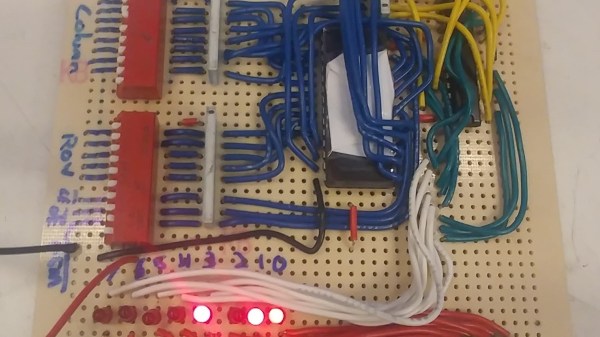
[Navic] added a slew of abilities to his RFID reader. It’s now a full-featured RFID reader and smart card writer with extras. When we looked at it last time the unit was just an RFID and smart card reader in a project enclosure. You could see the RFID code of a tag displayed on the LCD screen, but there wasn’t a lot more to it than that.

The upgrade uses the same project enclosure but he’s added four buttons below the display. These allow him to access the different features that he’s implemented. The first one, which is shown in the video after the break, allows him to store up to six tags in the EEPROM of the Basic Stamp which drives the unit. He can dump these tag codes to a smart card (pictured above), but also has the option of interfacing with a PC to read from and write to that card.

We don’t think you can directly write RFID tags with the device, but we could be wrong.

Read the rest of this entry »

Keep your kids in line with a time clock

posted Dec 19th 2010 10:13am by
filed under: arduino hacks, clock hacks, home hacks

When the cat’s away the mice will play, but a least you’ll know when they came home if you use this time clock. It’s called the Kid-e-log and [John Boxall] developed it to help a friend who wanted to keep track of their teenage children’s after school activities while they were still at work. He figured having them punch a time clock would at least let you know if they came straight home as they were supposed to. An RFID tag was issued to each (no, they didn’t implant the tags) and used to record the time. To keep fraud to a minimum the hardware has a battery back-up for its real-time clock, and the tag read events are stored to EEPROM for retention between power cycles. This doesn’t prevent common tricks like taking the reader with you, or sending your tag with a sibling, but it’s a start. See it in action after the break.

Read the rest of this entry »


Cheap(er) biometric gun safe

posted Oct 5th 2010 1:00pm by
filed under: security hacks

[Greg] sent in his biometric pistol safe lock. He keeps his guide light on details so not every Joe can crack the system (there is a thread to sift through if you really wanted to), but the idea runs fairly simple anyway. [Greg] took an old garage door opening fingerprint scanner and wired it into a half broken keypad based pistol safe. While he did have some issues finding a signal that only fired when the correct fingerprint is scanned, a little magic with a CMOS HEX inverter fixed that problem quick.

This does bring one question to our minds, are fingerprint scanners as easy to crack as fingerprint readers?

RFID readers, writers, and spoofers

posted Sep 25th 2010 12:00pm by
filed under: security hacks

[Carl] has done a lot of work developing a collection of RFID hardware. The two cards you see above are spoofers that can be programmed in the field using the keypad on the left, or the rather intimidating banks of DIP switches on the right. We also enjoyed his look at the Atmel T5557 and ATA5567 on-card chips used for the tags themselves. He shared the schematics for his designs but unfortunately he’s not distributing the firmware. None-the-less, if you’re interested in learning more about RFID this is a wonderful resource as it covers readers, writers, spoofer, and tags.

Teensy credit card reader

posted Jul 24th 2010 6:00am by
filed under: classic hacks, peripherals hacks

Here’s a hack that makes business sense. [PT] recalls last year’s HOPE conference when their booth was using a virtual credit card terminal for purchases that required manual entry of card information. This year they’ll have the same virtual terminal but this magnetic stripe reader will fill it out automatically.

A magstripe reader (reading only, no funny business here) from Mouser grabs data from the card. A Teensy microcontroller board, which identifies itself as a USB keyboard, automatically fills out the virtual terminal from the parsed data. The real question, are his customers comfortable sliding their plastic through a hacked reader?


Build your own RFID reader

posted Apr 19th 2010 11:00am by
filed under: security hacks

We asked for it and our readers delivered. [Klulukasz] left a comment pointing to this diy RFID reader that was a final project in 2006 for a class at Cornell University. It is well documented and includes not only a schematic and code, but an explanation of the design considerations used during the build. The project uses an ATmega32 and the parts list priced out at about $50 at the time. There were plenty of responses to the RFID spoofer post pointing out that there are readers available for $40, but we want the fun of building our own.

A bit more vague with the details but no less interesting is this other simple RFID reader design. Thanks to [Chuck] for his comment which pointed to that link.

Is that some type of new Kindle?

posted Feb 22nd 2010 11:25am by
filed under: misc hacks

[Mr C Camacho] picked up an inexpensive digital picture frame hoping to hack into it. He hasn’t had the time to crack open the hardware so that it will do his bidding but he did find a creative way to make it an ebook reader. Using a python script he processes books, creating images of the pages.

The python script, available after the break, takes free books from Project Gutenburg and spits out JPG images. Page turning and bookmarking are not what they ought to be but the process does work. The thought of someone staring at a picture frame on the subway is a bit amusing but we’re sure that sooner or later someone will ask if it’s a new version of the Kindle.

Read the rest of this entry »

RFID meets Open Sound Control

posted Dec 30th 2009 2:30pm by
filed under: digital audio hacks, wireless hacks

Have you been working on a MIDI controller that uses RFID to identify and control different instruments? No? Neither have we but now we’re going to have to look into it. That’s because [Martin.K] has done a lot of the work for us. His nfOSC package links an RFID reader to the Open Sound Control library.

In the video after the break we see [Martin] placing RFID tags onto a Touchatag reader. With each addition, his software triggers a tag add event that OSC picks up and translates to a midi event; in this case it adds a new instrument to the mix. Can this be used to relieve musicians from staring at computer screens during performances? What if there was a small shelf in front of you? As you happily play your electric Didgeridoo, small items with RFID tags on them can be added or removed from that shelf to change the samples that are triggered when toiling away on that sonic weapon. This should be fun!

Read the rest of this entry »


Hack a Day serves up fresh hacks each day, every day from around the web as well as hacking related news.

Send us your hacks


Hacks

Resources