ThingamaKIT: Make Your Own Thingamagoop


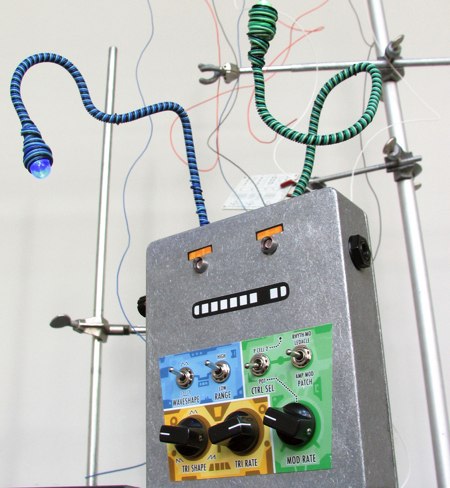
Bleep Labs’ Thingamagoop is a small synthesizer packed with wacky controls for generating unique sounds; you can now build an expanded version yourself with the ThingamaKit. Made “because there are not nearly enough beeping, zapping, bixxerfouping, anthropomorphic synthesizer monsters in the world,” it generates sounds of different pitches depending on the type and intensity of light hitting a photocell on the front panel. It’s most unique feature, is its LEDacle, which is something like a tentacle with an LED on the end. This can be pointed towards the photocell to modulate the sound. Output is through a 1/4″ audio jack.

Bleep Labs sells fully assembled Thingamagoops for $100, but the new DIY kit is available for half price. The kit version of the Thingamagoop has more controls, two photosensors, and two LEDacles. You can buy it with or without the case, and it doesn’t require any complex wiring. Look after the break for video of some Thingamagoops in action.
Continue reading “ThingamaKIT: Make Your Own Thingamagoop”

Ardupilot: Arduino Based UAV Autopilot


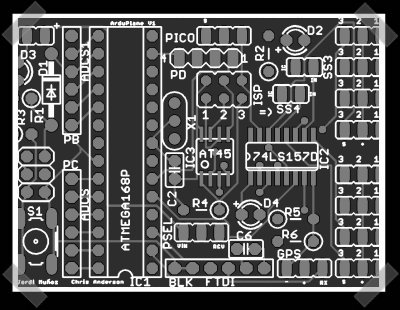
A short while back, [Chris Anderson] released an Arduino based autopilot. It rings in fairly cheap and being open source, you can tweak away. To add more functionality, he’s releasing a dual core version. Thanks to the second processor, it no longer requires an external hardware co-pilot. It uses an on-board GPS and features an ATtiny based fail safe. It’s still under development, but he’s made the design files available.

Netflix Player Source Code Released


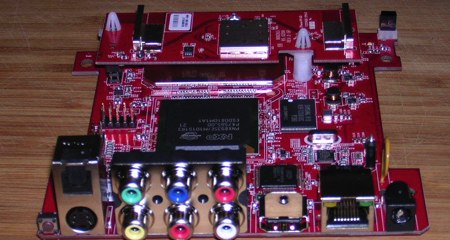
The Netflix Player continues to gain in popularity. Roku has finally released the GPL code for their Netflix Player. Just today Forbes published that Roku would roll out a software update allowing it to stream from other online services. The diminutive device has no internal storage and just enough RAM to buffer the stream. Many have wondered how a Linux box is handling the DRM; this is purely a feature of the NXP PNX8935 processor being used. While waiting for the code, hackers have already popped the box open to see what’s inside. We found [hokiokie7]’s photos of the internals on Roku’s forum. The only really interesting thing we’ve seen so far is that the WiFi is on a daughter card that plugs into the USB. That should make it much easier to support other devices, if users ever manage to get into the system.

UPDATE: [mbailey] points out in the comments that he was able to telnet to the device.

Beer Bot Will Pour You A Cold One


We love beer and we love robots, so guessing how we feel about this robotic bartender should be a no-brainer. Known as Mr. Asahi, the robot opens bottles and pours beer while taking your orders with aplomb and a jovial British accent. It also has a customized lazy susan with slots for bottles and notches for the robot’s hand to grasp.

Amazingly, this is not Asahi’s first beer pouring robot. That one requires you to do most of the leg work, though, so this one is a marked improvement. Best of all, it won’t ignore you when a person more attractive than you comes into the bar, and it won’t snub you for leaving a lousy tip. We now fear alcohol fueled robot rampages… they get more human every day. Video after the break.

Continue reading “Beer Bot Will Pour You A Cold One”

Eee PC 900 Touchscreen

[youtube=http://www.youtube.com/watch?v=3wVhW6a9i7Y&hl=en&fs=1&rel=0&color1=0x3a3a3a&color2=0x999999]
Jkkmobile has just posted their touchscreen hack for an Eee PC 900, and it looks great. Installation of this kit is pretty easy, just fit the panel to the screen, connect the controller to the USB lines, close it up, calibrate it, and you’re done. The controller board is placed on top of the WiFi card. Jkkmobile has informed us of touchscreens for older Eee PCs before, but this is one of the first we’ve seen for a 900+ model. The post lists a few sources for touchscreen kits, but no word on which one they used.

VU Meter Made With An LM3915


So here’s the situation: you have an audio device, maybe a boombox, perhaps one you built yourself, but it has no VU meter. No problem; building a VU meter is easy with these instructions from [Joe].

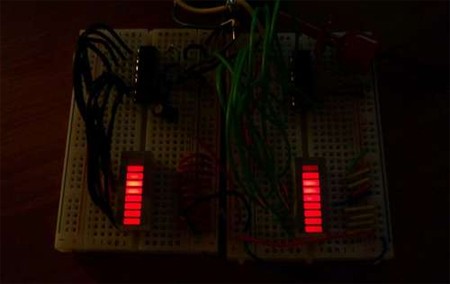
You’ll need either an LM3915 or LM3916 chip, a couple of bread boards, two audio jacks, ten LEDs, and a few other components. Wire them all together per the schematic, then plug an audio source into the input jack. You can plug your speakers or output device into the output jack, and you’re done. Keep in mind that LM3916s switch negative, so positive to positive wiring from LEDs to the bread board will be necessary. The wiring on [Joe]’s version is a bit convoluted, but it can be cleaned up on yours if you take the time. Video embedded below.

Continue reading “VU Meter Made With An LM3915”

Easiest Rock Band To MIDI Setup Yet

[youtube=http://www.youtube.com/watch?v=S6bQaHuFvLw&hl=en&rel=0&color1=0x3a3a3a&color2=0x999999]
We have news for those of you dismissing the new Wii Version of Rock Band. Sure, the lack of DLC is a huge factor, but if you’re looking to use the instruments with MIDI software, [Jordan Balagot] has found what may be the easiest way. Since the Wii instruments are connected via USB, they are easy to connect to a computer. [Balagot] used a program called junXion that is a data routing app for OS X. JunXion can take any USB human interface device and remap the buttons, making it easy to set up the drums as a MIDI input device in an intuitive way. Install junXion, plug in the drums, map the pads, and rock out.

[via Create Digital Music]