
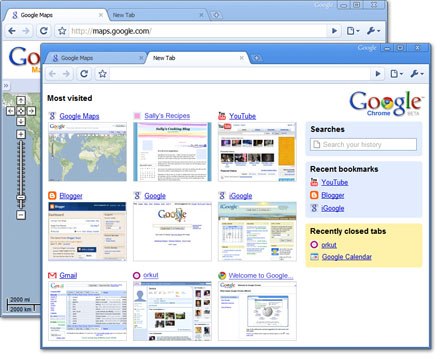
The webcast for Google’s new Chrome browser starts at 11PDT. The browser is supposed to feature better memory management. Right now they’re opening with Led Zeppelin and Queen, so I guess it’s supposed to be rockin’ as well. Download it for Windows here. Chromium source available here.
Year: 2008
Interactive Globe Display
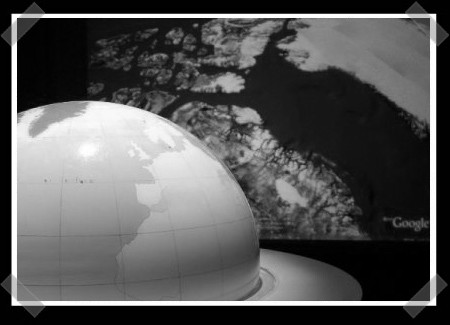
[ERASME] built this interactive globe interface for an exhibit on Inuit people and their land. The goal was to have a tactile input device to Google Earth data. The unit is composed of a half globe for location selection, a touch pad for layer selection, and a Wiimote for view changes.They had to develop their own driving application for Google Earth as none exists for Linux. The software, called KeyEvents takes inputs from all the devices and mimics keyboard and mouse control in Google Earth.
There is much more information on how they got the pieces to work together, as well as some videos in french showing the device working. One thing that stands out though is that they decided to use direct association on their Wiimote, thus stopping rogue Wiimotes from gaining control. Who would carry a Wiimote around just to hijack public displays? We would.
[thanks Leucos]
RGB Desktop Clock
[youtube=http://www.youtube.com/watch?v=-hxZRCponks&hl=en&fs=1&rel=0][Mark Roy] designed this fine RGB LED desktop clock. It uses a PIC16F877A microcontroller and a DS1307N Real Time Clock. There is a ring of 12 RGB LEDs around the perimeter. Hours are indicated in red, minutes green, and seconds blue. If the hands overlap, the colors are mixed. Three buttons are used to set the time and it can run on as little as 0.7volts. You can find out more about the project on Stellar Core. He has plans to kit it in the future.
Apollo Guidance Computer Clone
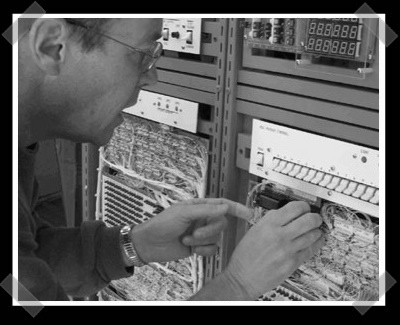
[Cliff Miller] pointed out this incredible project from 2004. [John Pultorak]’s journey began in late 2000 when he decided to build a 60’s or 70’s era minicomputer. While gathering technical documentation, he found some interesting information on the Apollo Guidance Computer and felt that was the way to go. The AGC was the first integrated circuit computer ever built. Designed by MIT in 1964 it was constructed from ~5000 ICs, almost all 3-input NOR gates. [John]’s version uses late 1960’s 74LS TTL logic which gains him a 10 to 1 reduction in the number of ICs. A good thing when you have to do ~15K wirewrap connections. He also used flipflops and register chips instead of building everything from NOR gates. [John] essentially built the AGC three times: First, he coded a simulator in C++. Then, he imported the logic design into CircuitMaker to verify that it would actually work. Finally, he built the 3 by 5foot machine. He’s provided an amazing amount of documentation for anyone that wants to explore this device and the overview alone is well worth a look.
Modular Portable System
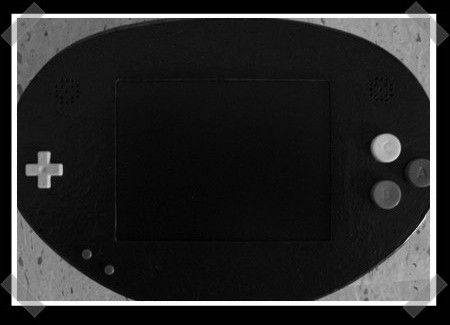
Reader [John Grayson], known for his multiconsole portable, has constructed a brand new portable. Not liking the controls or the tethered nature of retro TV games he decided to build a modular portable system. He built a custom system that uses cartridges created from TV game systems. The device has a 5.4″ screen and two Canon batteries for 4.5 hours of play.
HTC Dream Android Phone
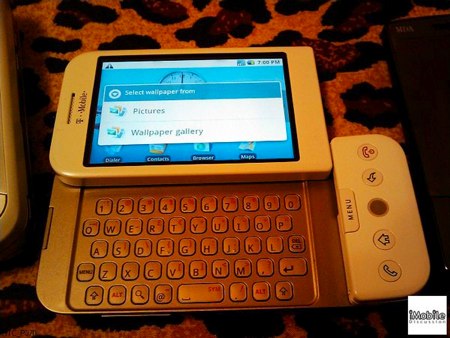
Engadget has a full gallery of the new HTC Dream, the first production phone running Android. It will be available on T-Mobile some time this Fall (missing features notwithstanding).
MySpace Cofounder Tom Anderson Former Hacker
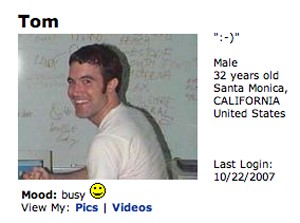
MySpace users are very familiar with the visage of their first “friend” and MySpace cofounder [Tom Anderson], but did you ever wonder what he used to do before he became everyone’s friend? TechCrunch’s investigative reporting revealed that [Tom] was a hacker in the eighties who hacked into the Chase Manhattan Bank computer system, which attracted the attention of the FBI. Under the handle “Lord Flathead”, he became the leader of a black hat hacker group by the time he was fourteen. His activities (along with those of other hackers) led to one of the largest FBI raids in California history. Because he was a minor at the time, he was not arrested, but put on probation in exchange for an agreement to stop committing computer crimes. This definitely makes having [Tom Anderson] on your friends list just a bit more interesting, doesn’t it?
[via Digg]









